

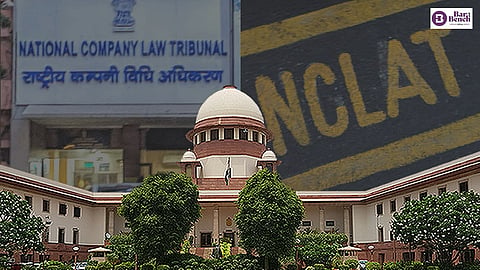
The Supreme Court on Wednesday took suo motu cognisance of the mounting delays by the National Company Law Tribunals (NCLT) i approval of corporate resolution plans of companies under insolvency.
A Bench comprising of Justice JB Pardiwala and Justice KV Viswanathan warned that the situation threatens to defeat the very purpose of the insolvency framework under the Insolvency and Bankruptcy Code (IBC).
“We take suo motu cognisance of the aforesaid in larger public interest. The issues need to be addressed on war footing. Otherwise, the purpose of enacting IBC would stand frustrated,” the Court opined.
Taking serious note of the situation, the Court directed the matter be placed before the Chief Justice of India (CJI) Surya Kant for further directions.
The Court relied on a report submitted by the Registrar of the NCLT's Principal Bench, which revealed that as many as 383 applications for approval of resolution plans are currently pending. The delays reportedly range from 48 days to as long as 738 days, with some cases lingering for up to four years.
Noting that such delays undermine the time-bound framework envisioned under the Insolvency and Bankruptcy Code, 2016 (IBC), which mandates swift resolution of distressed assets, the Court observed,
“The picture is extremely grim and dismal.”
The Court recorded that the reasons cited for the backlog include lack of adequate infrastructure, leading to half-day sittings due to frequent changes in Bench composition, as well as a large volume of objections filed by stakeholders against resolution plans.
It also noted that interim orders are being passed in very few cases to manage the process.
The Court’s decision to take suo motu cognisance builds on concerns it had already flagged earlier this month while hearing a dispute arising out of insolvency proceedings against AVJ Developers.
On April 16, the Apex Court had expressed strong disapproval over delays by the National Company Law Tribunal (NCLT) in clearing resolution plans under the Insolvency and Bankruptcy Code (IBC).
Calling the situation “very unfortunate,” the Court had noted that in several cases, approval applications had remained pending for nearly two years or more after being cleared by the Committee of Creditors (CoC), the body of lenders that votes on a revival plan.
The Court had then directed the NCLT’s Principal Bench in New Delhi to furnish comprehensive nationwide data, including the number of pending resolution plan approval applications, the duration of such pendency, and the reasons for delay.
It had also impleaded the Insolvency and Bankruptcy Board of India (IBBI) to assist with country-wide statistics.
During the hearing today, the counsel appearing for a Resolution Professional (RP) of AVJ, highlighted a severe shortage of members in the NCLT.
While the sanctioned strength stands at 63 members, only 28 judicial members and 26 technical members are currently posted across various benches, significantly impairing the tribunal’s ability to function efficiently.
"There is acute shortage of 10 members, which is severely affecting the efficiency of the functioning of NCLT benches in disposal of cases within the time bound manner," held the Court.
Additionally, the Court expressed concern over the nature of appointments within the tribunal’s administrative structure.
“Registrar post is being filled up on contractual basis, it has been brought to our notice. This is something unheard of,” remarked Justice Pardiwala.
He further noted that most members and staff are appointed on a contractual basis, with their services being purely temporary. Issues relating to non-payment of salaries and allowances were also flagged.
Senior Advocates Gopal Jain and Navin Pahwa had been appointed as amici curiae to aid the Bench, with directions to compile and submit data.
[Read Live Coverage]