
Subscribe
Subscribe
- Latest Legal News
- News
- Dealstreet
- Viewpoint
- Columns
- Interviews
- Law School
- Legal Jobs
- हिंदी
- ಕನ್ನಡ

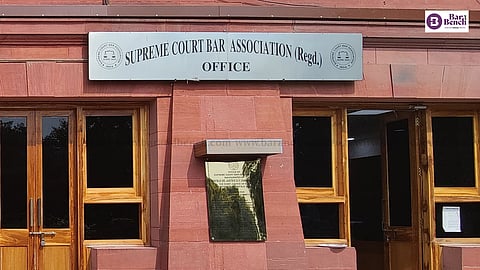
The Supreme Court on Friday issued notice on a petition filed by the Supreme Court Bar Association (SCBA) seeking a range of structural reforms to ensure that women advocates across the country are able to practice law with dignity and on equal terms with their male counterparts. [Supreme Court Bar Association v. Union of India & Ors]
The Bench of Chief Justice Surya Kant and Justices Joymalya Bagchi and V Mohana directed that the matter be tagged with a pending case.
The petition, filed through Advocate-on-Record Pragya Baghel and settled by Senior Advocates Vikas Singh, Monika Gusain and Anindita Pujari, is built on two extensive surveys conducted by the Ladies Welfare Sub-Committee of SCBA's Executive Committee, followed by a national survey that drew over 2,600 responses from women advocates across the country.
The national survey was released by CJI Surya Kant at the SCBA's first National Conference in Bengaluru in March this year.
The findings cited in the petition paint a stark picture of the hurdles women face in the profession. As many as 81.3% of respondents said that their professional journey had been harder than that of their male peers, while 53.9% felt that designation as Senior Advocate came easier to men.
The petition also points out that no woman has ever held the office of Attorney General or Solicitor General of India and that only 6 women have ever served as Additional Solicitor General since Independence.
The survey further found that 72.3% of women advocates said that their gender adversely affected their professional networking, citing barriers such as travelling alone at night, staying at outstation hotels, or returning from court late in the evening. Sexual harassment was disclosed by 16.1% of respondents, while another 12.7% preferred not to say.
On the question of maternity and caregiving, the petition notes that 55.2% of respondents faced difficulty in getting matters deferred during childbirth. Nearly 90% supported the introduction of formal "returnship" programmes for women re-entering practice after career breaks.
The SCBA has grounded its plea in Articles 14, 15, 19(1)(g) and 21 of the Constitution, arguing that the right to practise law cannot be considered meaningful without basic infrastructure and institutional support for women in the profession.
The petition also draws on India's obligations under Articles 7 and 8 of the Convention on Elimination of All Forms of Discrimination against Women (CEDAW), particularly on equal representation in public institutions. It also invokes Article 11(1)(d), which guarantees equal remuneration for work of equal value.
Among the reliefs sought, the SCBA has asked the Court to direct a gender-inclusive policy for empanelling women advocates as government law officers, a formal maternity and caregiving accommodation framework permitting deferments and virtual appearances, functional crèche facilities within court premises, a dedicated national mental health helpline for advocates, structured mentorship programmes, fair chamber allotment for women and first-generation advocates, and a minimum stipend framework for junior lawyers.
[Read Live Coverage]