Supreme Court modifies earlier ruling on composition of High Court benches with ad hoc judges

The Chief Justice of a High Court can constitute division benches consisting of two ad hoc judges or a combination of a sitting judge and an ad hoc judge, and decide who would preside over such benches.
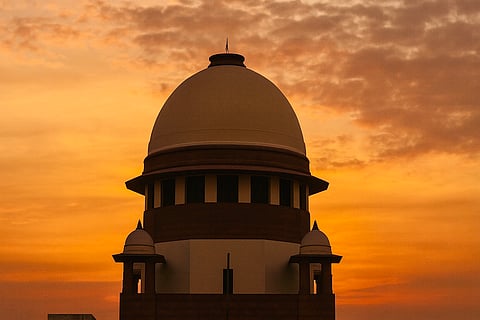
Supreme Court of India
Supreme Court of IndiaAI generated
Published on
2 min read

The Supreme Court on Thursday modified its judgment in the Lok Prahari case, granting High Court Chief Justices greater flexibility to decide the composition of division benches involving ad hoc judges appointed under Article 224A of the Constitution.

A Bench of Chief Justice of India (CJI) Surya Kant and Justice Joymalya Bagchi held that the Chief Justice of a High Court would be empowered to constitute division benches consisting of two ad hoc judges or a combination of a sitting judge and an ad hoc judge, and decide who would preside over such benches.

The issue arose when the Court took note of concerns expressed by retired judges willing to serve as ad hoc judges. The CJI said that the Court was considering whether a more workable solution could be evolved.

“We are thinking aloud, if the Chief Justice is able to persuade the sitting judge to sit along with the former judge as a bench partner,” he observed.

CJI Surya Kant and Justice Joymalya Bagchi

Attorney General for India R Venkataramani supported the proposal, while suggesting that it be handled administratively.

“If it can be internally and not a judicial order, then it can be worked out,” he said.

Dictating the operative portion of the order, the CJI said,

“If there are two ad hoc judges, the Chief Justice will decide to form their division bench. We also leave it to the Chief Justice to form a bench of sitting judge and ad hoc judges wherever necessary and decide who will preside over the bench and in the manner agreeable to both the judges.”

The Court further clarified,

“With this, the main judgment is also suitably modified.”

In January 2025, a three-judge Bench of then Chief Justice of India Sanjiv Khanna, and Justices BR Gavai and Surya Kant had relaxed the conditions governing the appointment of ad hoc judges in High Courts to address mounting pendency, particularly in criminal cases.

Earlier, in the 2021 Lok Prahari v. Union of India case, the Supreme Court had activated the “dormant” Article 224A of the Constitution and laid down guidelines for the appointment of ad hoc judges to deal with the unprecedented backlog of cases in High Courts.

The Court had underscored that Article 224A could be invoked only after the process for filling regular vacancies had been initiated.

The 2021 judgment had further held that the discretion of the Chief Justice of a High Court under Article 224A could be exercised in situations where vacancies exceeded 20 per cent of the sanctioned strength, if cases in a particular category were pending for over five years, if more than 10 per cent of the backlog was over five years old, or where the rate of disposal was lower than the rate of institution of cases.

Bar and Bench - Indian Legal news
www.barandbench.com