Supreme Court refuses to entertain Aland Dargah's plea to restrain repeated Hindu rituals in its premises

The plea said there have been strategic efforts year after year by Hindu parties to change the dargah's religious character by securing interim court orders for Shivaratri pujas.
Supreme Court of India
Published on
3 min read

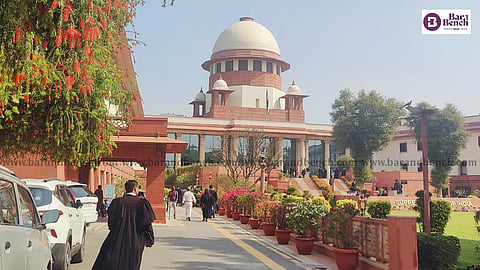
The Supreme Court on Thursday refused to entertain a petition filed by the management of the Aland Ladle Mashaik Dargah, which sought directions to restrain the conduct of Hindu Maha Shivaratri puja and other Hindu rituals at the dargah's premises.
The dargah's management had moved the petition under Article 32 of the Constitution of India, which allows parties whose fundamental rights have been violated to directly approach the Supreme Court for relief.

It raised concerns that there have been strategic efforts year after year by Hindu parties to change the dargah's religious character by securing interim court orders for Shivaratri pujas.

Its plea sought the top court's intervention so that the site's religious character is not altered through such activities.

A Bench of Justices Dipankar Datta and SC Sharma, however, today opined that an Article 32 petition was not appropriate in the matter. The plea was eventually withdrawn.

Justice Dipankar Datta and Justice Satish Chandra Sharma

Notably, when the matter was mentioned before Chief Justice of India (CJI) Surya Kant and Justice Joymalya Bagchi yesterday, this Bench had also questioned why an Article 32 petition was filed instead of first approaching the High Court.

"Why is everything coming in Article 32? ... The impression created is that pleas are coming because the law is convenient, and message going is that High Court is defunct," CJI Kant had said.

The shrine at the heart of the dispute is associated with a 14th-century Sufi saint, Hazrat Shaikh Alauddin Ansari (also known as Ladle Mashaik) and 15th-century Hindu saint Raghava Chaitanya, both of whose remains lie at the site. A structure referred to as the Raghava Chaitanya Shivling is also located in the premises, according to The Hindu.

Both Muslims and Hindus offered worship at the site. However, communal tensions flared in 2022 over worship rights.

In February 2025, the Karnataka High Court permitted 15 members from the Hindu community to conduct Shivaratri puja at the Raghava Chaitanya Shivling. The same was conducted under heavy security arrangements.

A year earlier as well, it is reported that Hindu pujas were conducted to mark Shivaratri without any untoward incidents occurring, based on a Court order allowing 15 Hindus to enter the dargah premises and conduct the rituals.

The plea filed by the dargah's management before the top court raised concerns that there was a coordinated pattern to change the character of a religious place by securing interim orders from courts.

"It is respectfully submitted that the pattern is unmistakable and deeply troubling. What cannot be proved through evidence and adjudication is sought to be manufactured through interim orders sought from the High Court. What is barred by the Places of Worship (Special Provisions) Act, 1991 is sought to be achieved through police-facilitated entry during festivals," the plea alleged.

As per the petition, in 1968, the Town Municipal Council of Aland, after spot inspection, had rejected an application seeking permission to construct a Samadhi/ Temple within the dargah compound. It recorded that the site was the Mazaar (shrine or tomb) of Hazrath Mardan-e-Gaib surrounded by Muslim graves, with no documentary basis for any non-Wakf construction.

Despite this settled position, repeated attempts have been made to reopen the religious character of the shrine through civil litigation, all of which failed, the plea added.

As per the plea, when litigation failed, communal mobilisation was attempted and on February 1, 2022, the Shree Siddalingaswamy Karuneswar Temple at Andola announced an "Aland Chalo" padayatra to "cleanse a Shivalinga" at the Mazaar on Mahashivaratri.

When the Karnataka Wakf Tribunal restrained the same, it was sought to be nullified through festival-specific applications and suits seeking permission to perform Pooja on Mahashivaratri, the plea claimed.

"Each proceeding is timed strategically, each invokes a different forum, and each is designed to create a foothold that the next proceeding can build upon," the plea added.

The dargah further alleged that the latest in such attempts is the writ petition filed by Sidramayya Hiremath in 2026 before the High Court of Karnataka seeking a direction to the State and police authorities to permit him and other devotees to perform pooja within the Dargah premises on February 15 (Mahashivaratri), along with police protection.

A similar petition was also filed in 2025 by the same person, in which the High Court had allowed 15 persons to enter and conduct puja on Mahashivaratri.

"These petitions are being filed year after year around Shivaratri only to create a foothold of religious entry, convert temporary access into an asserted practice, and thereafter reopen the character of the site through repeated litigation," the plea, now withdrawn, claimed.

Bar and Bench - Indian Legal news
www.barandbench.com