
Subscribe
Subscribe
- Latest Legal News
- News
- Law Firms
- Columns
- Interviews
- Law School
- Legal Jobs
- हिंदी
- ಕನ್ನಡ
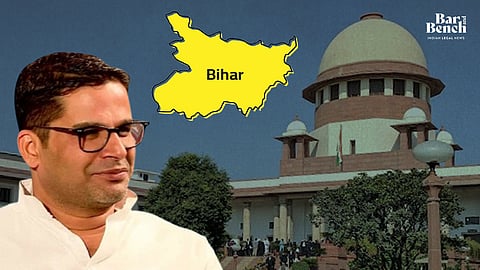
The Supreme Court on Friday refused to entertain the petition by Jan Suraaj Party founded by political strategist Prashant Kishor alleging misuse of a state welfare scheme to influence voters ahead of the 2025 Bihar Assembly elections [Jan Suraaj Party vs The Election Commission of India].
A Bench of Chief Justice of India (CJI) Surya Kant and Justice Joymalya Bagchi pulled up the party for trying to use judicial forum to secure relief after having lost the polls.
Kishor's party had contested 242 of the 243 Assembly seats in the 2025 polls but failed to secure a single seat.
"How many votes did you get ? Once people reject you, you use the judicial forum to get relief! Somebody should have challenged the scheme itself then. That is not the prayer before us. You just want the election to be declared null and void," the Court said.
Pertinently, the Court said that the High Court is the appropriate forum to decide the matter.
"Since it deals with only one State, please go to that High Court. In some cases, there is a serious issue of freebies which we will seriously examine,"
Senior Advocate CU Singh, appearing for Jan Suraaj Party, said that the scheme under which the payment was made to voters, was announced just before the polls and the payments were made when the model code of conduct was in force.
"But when a State has a grave fiscal deficit and it is a dole in the sense that 10,000 will be payed immediately and over 35 lakhs people enrolled in this scheme just after model code of conduct was announced," Singh argued.
"Direct transfer scheme is different. This is about women self help groups," the CJI replied.
The Court said that while it will examine the issue of freebies, it will also have to see the bonafides of the petitioner.
"We will consider the freebies issue. But we have to see the bona fide also.. we cannot look at that at the behest of a party which has just lost. When you come to power, you will do the exact thing," said Justice Surya Kant.
The petitioner eventually withdrew the plea.

At the heart of the party's challenge before the Supreme Court was the scheme launched by the Nitish-led Bihar government just before the elections - the Mukhyamantri Mahila Rojgar Yojana. Under the scheme, the State decided to transfer ₹10,000 directly to one woman in every family to help her start self-employment, with a further promise of ₹2 lakh after assessment.
According to the plea, eligibility for the scheme was linked to membership of JEEVIKA, a network of women’s self-help groups. The State announced that women not already part of JEEVIKA could enrol to receive the benefit.
The Jan Suraaj party alleged that while around one crore women were already associated with JEEVIKA before the Model Code of Conduct (MCC) came into force, newspaper reports later showed that 1.56 crore women eventually received payments.
This indicated that new beneficiaries were added and paid after the election schedule was announced and while the MCC was in operation, the petition said.
The petition argued that releasing cash benefits during this period amounted to “corrupt practices” meant to unduly influence voters in favour of the ruling government.
The plea claimed that this deprived other political parties of a level playing field and struck at the core requirement of free and fair elections.
The plea also flagged the role of the Election Commission of India. It alleged that women, who were beneficiaries of the scheme, were deployed at polling booths on voting days in both phases of polling, even though many of them had already received the cash benefit.
According to Jan Suraaj, this deployment had no rational basis and further compromised the neutrality expected during elections.
Another key challenge in the petition related to how the scheme was funded. The party claimed that the programme was approved by a cabinet decision without legislative sanction and that money was withdrawn from the State’s Contingency Fund, allegedly in violation of Article 267 of the Constitution. It has been alleged that the scheme was not part of the regular budgetary process.
To bolster its case, the petition relied on earlier directions issued by the Election Commission of India on the Model Code of Conduct. These guidelines prohibit governments from announcing or expanding welfare schemes, releasing fresh funds, or processing beneficiary-oriented programmes once elections are announced, if such steps are likely to influence voters.
The plea contended that despite these clear instructions, the Bihar government proceeded with cash transfers during the election period and that the Election Commission failed to intervene effectively.
According to the petition, the impact of a direct cash transfer scheme of this nature, rolled out on the eve of elections and continued during the MCC, could not have been ignored.
Thus, the election process was vitiated, violating the Representation of the People Act, 1951, and constitutional guarantees under Articles 14, 21 and 324, it was contended.
The party told the Court that it is relying on newspaper reports as official documents and data are not available on government websites.
The petition also invoked the Supreme Court’s past emphasis on free and fair elections as a basic feature of the Constitution, arguing that welfare measures cannot be used as tools to secure electoral advantage.
The petition was filed through advocate Aditya Singh.
[Read Live Coverage]