Supreme Court rejects plea to regularise over 350 WB Madrasa teachers, staff

The pleas challenged the findings of a committee constituted in 2023, which held that appointments made before a 2020 judgment upholding the validity of the WB Madrasah Service Commission Act, 2008, were invalid.
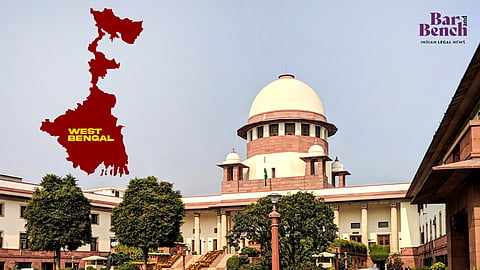
Supreme Court with West Bengal state
Published on
2 min read
Listen to this article

The Supreme Court on Monday dismissed a batch of petitions filed by teachers and non-teaching employees of recognised Madrasas in West Bengal, who had challenged the denial of regularised appointment and payment under the State government’s grant-in-aid scheme by a committee constituted by the top court in 2023.

A Bench of Justices Dipankar Datta and AG Masih delivered the judgment.

The Court today noted that pursuant to earlier orders, it had examined the details of 13 affected petitioners, out of over 350 petitioners, to examine if any of them made out a case for the grant of relief. The did not, the Court held.

"We proceeded on the basis that if any one of these 13 petitioners persuaded us to hold in his or her favour, we would examine the remaining cases as well. Unfortunately, none of the 13 petitioners could impress us," the Court said.

It, therefore, dismissed all petitions before the Court.

"Therefore, we have not only rejected the claims of all 13 petitioners whose cases were scrutinised, but have also rejected the claims of all the remaining petitioners. All the writ petitions are devoid of merit and are accordingly dismissed," the Court concluded.

Justice Dipankar Datta and Justice Augustine George Masih

The matter involved over 40 writ petitions filed by around 361 persons claiming to have been appointed as teachers or non-teaching staff in different Madrasas in West Bengal. The petitions were filed under Article 32 of the Constitution.

The dispute is tied to the West Bengal Madrasah Service Commission Act, 2008, which created a statutory commission to recommend appointments of teachers in recognised Madrasas.

In 2014, a single-judge bench of the Calcutta High Court struck down the Act. The decision was affirmed by a Division Bench in 2015.

However, the Supreme Court stayed the Division Bench judgment in March 2016. On January 6, 2020, in Sk. Md. Rafique v. Managing Committee, Contai Rahamania High Madrasah, the Supreme Court upheld the constitutional validity of the 2008 Act.

However, the question then turned to the validity of appointments made before the Supreme Court's ruling.

In February 2023, the top court ordered the constitution of a committee to determine the validity of appointments made after the Calcutta High Court's 2015 ruling, but before the Supreme Court's 2020 judgment upholding the 2008 Act.

The committee submitted its report finding that such appointments were invalid.

Affected employees challenged the committee's findings before the top court.

In August 2024, the Court protected the petitioners' services through an interim order. In May 2025, it directed the State to pay salaries to those petitioners who were actually discharging teaching duties, subject to further orders.

The principal questions before the Court included whether the committee correctly rejected the petitioners' claims and whether any of them are entitled to recognition of their appointments, continuation in service and payment of salaries and allowances under the State government's grant-in-aid scheme.

Bar and Bench - Indian Legal news
www.barandbench.com