Supreme Court seeks response from AAP’s Vishesh Ravi on plea by BJP's Yogender Chandolia alleging false education declaration

The Delhi High Court had held that Chandolia's election petition over Ravi’s alleged false educational qualification declaration had become infructuous after the 2025 Assembly polls.
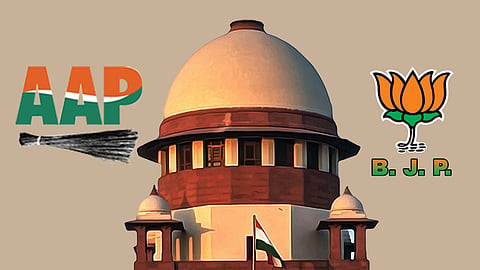
AAP BJP and Supreme Court
Published on
2 min read
Listen to this article

The Supreme Court on Monday sought responses on Bharatiya Janata Party (BJP) MP Yogender Chandolia’s plea challenging the election of Aam Aadmi Party (AAP) MLA Vishesh Ravi from Delhi’s Karol Bagh over an alleged false educational qualification declaration.
A Bench of Justice BV Nagarathna and Justice R Mahadevan was hearing Chandolia’s challenge to a Delhi High Court judgment that had dismissed his challenge to Ravi’s 2020 election victory.

In April 2026, the High Court had held that the case could not continue after fresh elections were held in 2025.

Justice BV Nagarathna and Justice R Mahadevan

Chandolia, who contested the 2020 Karol Bagh election as the BJP candidate, challenged Ravi’s election on the ground that he had furnished allegedly false information regarding his educational qualification in his affidavit and Form 26.

Ravi had won the 2020 election with 67,433 votes, while Chandolia finished second with 35,686 votes. The dispute has continued even after the 2025 Delhi Assembly elections, when Ravi was re-elected from Karol Bagh.

In its April 24, 2026 judgment, a Division Bench of the Delhi High Court held that Chandolia’s plea could not amount to a corrupt practice under Section 123(4) of the Representation of the People Act. The High Court had held that the provision covers false statements made about another candidate to hurt their electoral prospects, whereas Chandolia’s allegation concerned Ravi’s own educational qualifications.

The High Court had also held that a declaration in a nomination affidavit does not by itself amount to “publication” under the provision. Since Ravi’s 2020 term had ended and he had been re-elected in 2025, the court held that Chandolia’s election petition had become infructuous.

Arguing before the Supreme Court today, counsel appearing for Chandolia pointing out that Ravi had allegedly described himself as a B.Com graduate in his 2013 nomination papers, while stating in 2015 that he was pursuing graduation. He submitted that the case raised a question of law on whether lying about one’s educational qualifications in an election affidavit can be treated as an election offence.

The Apex Court, similar to the High Court, observed that subsequent elections had taken place.

"Fresh elections have taken place. Respondent No. 1(Ravi) has succeeded," noted the Court.

The counsel also referred to a pending Supreme Court appeal arising from the election dispute involving former Delhi minister Jitender Singh Tomar. Tomar too had faced allegations of making false declarations about his educational qualifications in his election affidavit.

It was submitted that Ravi had declared himself to be only Class 10 pass in the 2020 nomination papers, despite the earlier declarations regarding his education. He argued that Ravi had declared himself to be Class 10 pass, while in 2015 he had stated that he was pursuing graduation from IGNOU.

Taking note of this submission, Justice Nagarathna pointed out that,

"IGNOU degrees were not recognised for some time."

The Court ultimately asked Ravi and other respondents candidates who contested the 2020 Karol Bagh election to submit their responses.

[Read Live Coverage]

Bar and Bench - Indian Legal news
www.barandbench.com