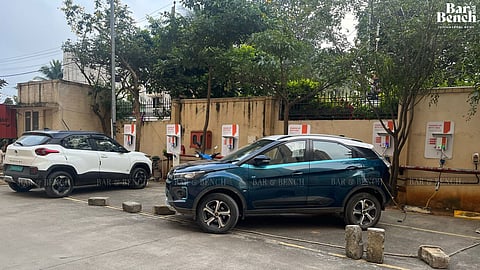
Supreme Court seeks response from Centre, UP on PIL seeking EV charger permissions in housing societies

The PIL alleged that residents were facing resistance at the society level when seeking to install chargers in their allotted parking bays.
EV charger
EV charger
Published on
2 min read

The Supreme Court on Tuesday agreed to examine a plea alleging that housing societies are frustrating the rollout of electric vehicle charging infrastructure by withholding No Objection Certificates from residents who want to install EV chargers inside the society at their own expense [Rachit Katyal vs Union of India].

A Bench of Chief Justice of India Surya Kant and Justice Joymalya Bagchi issued notice to the Union government, the State of Uttar Pradesh, Nirala Estate Phase-3 in Greater Noida (West), and its facility manager, Cushman & Wakefield Property Management Services India Pvt Ltd on the plea filed by one Rachit Katyal.

CJI Surya Kant and Justice Joymalya Bagchi

Katyal, a resident Greater Noida resident, contended that despite the Ministry of Power’s consolidated “Guidelines for Installation and Operation of Electric Vehicle Charging Infrastructure-2024”, residents were facing resistance at the society level when seeking to install chargers in their allotted parking bays.

Katyal, who owns a flat in Nirala Estate Phase-3, said that after purchasing an electric vehicle, he sought permission on May 26, 2025 to install a certified private charging unit at his own cost through authorised technicians. The society and its management agency did not take a decision despite reminders and reference to the Central guidelines, he contended.

Such refusal undermines the national push towards clean mobility and fall foul of constitutional guarantees of equality and life under Articles 14 and 21.

He submitted that arbitrary delays and denials by resident welfare associations and housing societies act as a significant barrier to EV adoption in urban residential complexes.

On the situation in his society, it was pointed out that the project houses nearly 4,000 flats and dozens of electric vehicles, but has only two low-capacity charging points available for common use.

The 2024 guidelines recognise the right of residents in group housing projects to set up private charging points in their designated parking spaces, subject to safety requirements and through existing or sub-metered electricity connections.

Drawing a comparison with Maharashtra, where circulars reportedly mandate time-bound issuance of permissions, the petitioner contended that the absence of similar enforceable directions in Uttar Pradesh has resulted in inconsistent implementation of the Central framework.

Thus, he sought directions to ensure uniform enforcement of the 2024 guidelines and to restrain housing societies from arbitrarily denying NOCs for installation of EV chargers.

Alternatively, there should be direction to the housing society and its management to grant permission for installation of an individual EV charging station in his allotted parking space till the Government of Uttar Pradesh brings in appropriate legislation on the issue, it was contended.

Advocates Sriram Parakkat and Shubhash Choudhary appeared for Katyal.

Bar and Bench - Indian Legal news
www.barandbench.com