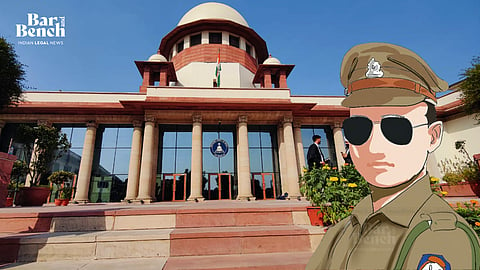
The Supreme Court on Thursday questioned the practice of State governments appointing ‘acting’ police chiefs instead of sending recommendations to the Union Public Service Commission (UPSC) for appointing a regular Director General of Police (DGP)..A Bench of Chief Justice of India (CJI) Surya Kant, and Justice Joymalya Bagchi observed that the practice deprives meritorious and senior police officers of consideration for the post of DGP.The Court noted that State governments, in violation of the Prakash Singh guidelines, fail to send names on time for the selection of a DGP and instead opt for appointing an acting DGP.To curb the practice, the Court empowered the UPSC to write to State governments seeking timely proposals for the selection of DGPs. The Court added that the UPSC could approach it in case any State fails to comply."We authorise the UPSC to write to the States to send timely proposals for recommendations of respective DGPs whenever such occasions arise. When such proposals are not sent, we direct the UPSC to move an application in the Prakash singh case. It goes without saying that necessary consequences including accountability of the concerned States will be taken up," the Court ordered..According to the top court’s guidelines, a DGP or a head of the police force in a State is appointed by the State government from a panel of three officers shortlisted by UPSC. .The Court today issued the directions for timely appointment of DGPs while dealing with an appeal challenging Telangana High Court's order directing UPSC to process the names recommended by State government.UPSC had objected to the direction on the ground that the State government had caused inordinate delay in selection of the DGP. The last DGP, Anurag Sharma, retired in 2017 and thereafter, the State did not make any recommendations to the UPSC, the central body said.The State eventually sent a recommendation in April 2025 but the UPSC did not act upon it saying there was already substantial delay since 2017. UPSC considered it to be a serious lapse and wanted the State government to first seek a clarification or order from Supreme Court in the Prakash Singh case. It also submitted that Telangana government was not the only State resorting to such delay tactics..The Court agreed with the UPSC's concern and remarked that such delay had affected the career growth of many senior police officers, who have now retired and were overlooked by the State. However, the Court also opined that the UPSC's objection will not help the situation. Instead, it will help the defaulting States, it added.Accordingly, the Court directed the UPSC to proceed with the process for selection of DGP for Telangana."We hold without hesitation that the State should make recommendations for the DGP at the earliest. It goes without saying that the zones of consideration will be on eligibility of officers who fall under such zone and will be on the basis of inter se merit. Commission is granted 4 weeks more time to do the needful," the Court ordered.Senior Advocate Naresh Kaushik along with Advocate on Record Vardhman Kaushik and Advocate Dhruv Joshi appeared for UPSC.