

The Supreme Court on Thursday declined to interfere with a Bombay High Court order which held that Rule 10 of the Information Technology Rules, 2009 is not a source of power for a Magistrate to direct the blocking of online content [Dhyan Foundation v. Google LLC & Anr.]
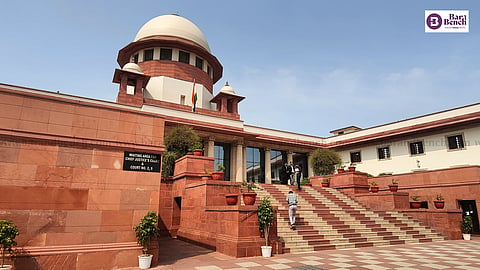
A Bench of Chief Justice of India (CJI) Surya Kant and Justices Joymalya Bagchi and Vipul Pancholi said that the Magistrate does not have such inherent powers under law.
"Inherent power is not there in the Magistrate. There is absolutely no jurisdiction. He just cannot pass blocking order. Why are you flagging a dead horse," the Bench remarked.
The Bench further said that the enactment of Bharatiya Nagarik Suraksha Sanhita (BNSS), which replaced the Code of Criminal Procedure (CrPC), presented an opportunity to place the Magistrate at par with civil judge but that was not done.
"BNSS had the wonderful opportunity to put the Magistrate on par with the civil judge but it was not done. So what can we do?" the Court orally remarked.
The Court was hearing an appeal filed by Dhyan Foundation, a charitable non-governmental organisation (NGO) working for animal welfare, against the tech giant Google.
The NGO moved the top court against the Bombay High Court's order of December 2025.
Aggrieved by five allegedly defamatory videos on YouTube, Dhyan Foundation had initially approached the Metropolitan Magistrate’s Court in Mumbai and obtained an order directing Google to stop circulation of the said content.
When Google failed to comply, the NGO initiated contempt proceedings, which the Magistrate entertained.
Google challenged this before the sessions court along with an application for condonation of delay.
After the Sessions Court condoned the 116-day delay and stayed the contempt proceedings, Dhyan Foundation challenged both orders before the Bombay High Court.
Google argued that Section 69A of the Information Technology Act empowers only the Central government or specially authorized officers to direct the blocking of online content for specific reasons, including for protecting the sovereignty, integrity of India and security of the State.
The High Court noted that there was a prima facie case that the Magistrate might have exceeded his jurisdiction.
The High Court also observed that blocking material from the public domain effectively restricts both an individual’s right to free speech and the public’s right to receive information and said such curbs are permissible only under a clear law with robust safeguards.
The High Court upheld the sessions court's stay on contempt proceedings against Google, finding prima facie merit in the jurisdictional challenge.
As for the challenge to the sessions court’s decision to condone the delay, the NGO argued that bureaucratic hurdles in a large corporation do not constitute sufficient cause.
However, the High Court rejected this argument. It emphasised that courts should prefer deciding matters on their merits rather than on technicalities.
The High Court also observed that Google's explanation did not lack bona fides and declined to interfere with the lower court's discretion to condone the delay.
This led to the appeal before the Supreme Court.
The Court today declined to interfere with the High Court and asked Dhyan Foundation to approach the civil court and seek injunction.
"Please go to the civil court and get an injunction," the Bench said.
"When links are disabled here, it is available overseas," Senior Advocate Sidharth Luthra said on behalf of Dhyan Foundation.
Senior advocates Aabad Ponda, appearing for Google, said that despite Magistrate lacking the jurisdiction, the search engine removed all the links except one.
"Even though the Magistrate passed the order without jurisdiction, we removed all within 36 hours. Only one foreign link is remaining," Ponda said.
After hearing the parties, the Supreme Court declined to intervene.