Water and power disconnection for solid waste rule violations, orders Supreme Court

The Court said solid waste management cannot remain the responsibility of sanitary workers alone and requires participation from every waste generator.
Garbage, cows
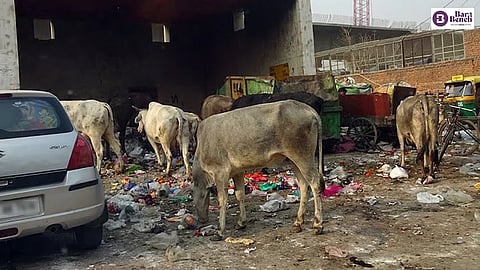
Garbage, cowsImage for representative purposes only
Published on
4 min read
Listen to this article

The Supreme Court on August 18 directed local bodies to inform bulk waste generators in writing that failure to segregate, store and properly hand over solid waste will result in the temporary disconnection of their water and electricity supply [Bhopal Municipal Corporation v. Dr Subhash C Pandey and Others].

A Bench of Justices SVN Bhatti and NV Anjaria said the disconnection would be ordered by the special cell of the jurisdictional district collector. It added that the supply would be restored once the bulk waste generator submits a compliance certificate.

Every local body shall, through its Chairman/Commissioner/Secretary, as directed by the jurisdictional District Collector, communicate in writing to every BWG within its limits the obligations viz, (i) segregation, storage and handover of solid waste generated; and (ii) the consequence of non-compliance resulting in the temporary disconnection of water and electricity supply by order of the District Collector’s Special Cell, restorable upon submission of a compliance certificate by the BWG,” the Court said.

Pertinently, the Court also directed the departments of school and higher education to immediately incorporate theoretical and practical lessons on solid waste management in school curriculum.

The Court further said students should be trained to educate their family members, while teachers should be trained as trainers. Trained students would function as “household-level supervisors”, the Court added.

The Department of School and Higher Education shall, with immediate effect, integrate both theoretical and practical knowledge on solid waste management for students to train their family members, and also train teachers as trainers,” the order stated.

Justice SVN Bhatti and Justice NV Anjaria

The Court issued the directions while hearing two appeals filed by the Bhopal Municipal Corporation against separate National Green Tribunal (NGT) orders concerning its compliance with the Solid Waste Management Rules, 2016.

In its the order, the Court also mandated periodic audits by district education departments and the submission of reports to the jurisdictional district collectors.

It further asked the authorities to consider using the existing online portal to upload geotagged photographs of accumulated waste and monthly compliance reports. The Court said the reports would move through the administrative chain from district collectors to State Secretaries and Union ministries.

The directions were issued after the Court considered an interim report filed by the Supreme Court Monitoring Committee (SCMC) on the implementation of the Solid Waste Management Rules, 2026.

The Court acknowledged that statutory committees and enforcement agencies had been put in place. However, it said the continuing problem of accumulated garbage could not be addressed merely by establishing committees.

The Court consequently laid down an enforcement mechanism under which the SCMC, acting through State Chief Secretaries, is to direct district collectors to identify all bulk waste generators within their respective jurisdictions in coordination with local bodies. It ordered that the exercise be completed within six weeks.

The Court said district collectors must inform bulk waste generators about the consequences of non-compliance with the Rules.

Such consequences would include temporary disconnection of power or water supply until the waste generated by them conforms to the Rules, it added.

The Bench explained that the communication was intended to give bulk waste generators an opportunity to establish the required facilities and report their compliance online to local bodies. The local bodies would inspect the facilities and forward their reports to the district collectors, the Court said.

The Court also said the SCMC should direct district collectors to increase the participation of elected ward representatives of gram panchayats, municipalities and municipal corporations in implementing the Rules.

It directed local bodies to notify the amount of waste generated, accounted for and unaccounted for, along with the steps taken to secure full basic participation by stakeholders.

The prevailing assumption that solid waste is a problem for sanitary workers alone, while the rest of the population remains passive generators, is neither legally correct nor practically sustainable.
Supreme Court

The Bench also rejected the assumption that solid waste management was the responsibility of sanitary workers alone.

The prevailing assumption that solid waste is a problem for sanitary workers alone, while the rest of the population remains passive generators, is neither legally correct nor practically sustainable, and is constitutionally unethical,” the Court observed.

The Court noted that Rule 4 of the 2026 Rules places an obligation on every waste generator to segregate, safely store and hand over waste.

It went on to add that this statutory duty was reinforced by the fundamental duty to protect the environment under Article 51A(g) and was inseparable from the right to a clean and healthy environment under Article 21.

Thus, it directed the SCMC to focus on the pollution of rivers caused by municipal solid waste and place relevant data before it. It also added that the SCMC would monitor sectoral compliance by the Railways, Defence and other ministries.

The matter will be heard next on November 17.

[Read Order]

Attachment
PDF
Bhopal Municipal Corporation v. Dr Subhash C Pandey and Others
Preview
Bar and Bench - Indian Legal news
www.barandbench.com