Not every emotional outburst is threat to economic security: Supreme Court pulls up NIA over probe into Beldanga violence
The Supreme Court on Wednesday questioned the basis on which the National Investigation Agency (NIA) cited provisions under the Unlawful Activities (Prevention) Act, 1967 (UAPA) to justify its probe into the recent violence at West Bengal's Beldanga.
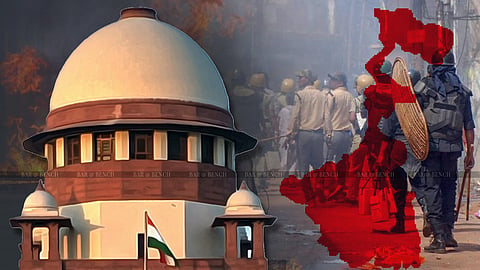
The NIA claimed that the violence had affected the economic security of India and was thus a terrorist act under Section 15, UAPA.
A Bench of Chief Justice of India (CJI) Surya Kant and Justice Joymalya Bagchi noted that the State of West Bengal had not yet handed over the case files for the NIA to arrive at such a conclusion.
"Without looking into documents, you have said Section 15 UAPA is justified. The case diary was not placed before you...this is a pre-decisional conclusion arrived at...Every emotional outburst cannot be packaged as a threat to economic security!" Justice Bagchi told the NIA's counsel.
The Court also noted that similar violence took place in April 2025 as well. However, despite the High Court observing that the NIA is at liberty to probe the matter, the agency was slow to act.
"In April 2025, we saw this kind of violence and State government also agreed (to NIA probe). High Court division bench asked NIA to see if probe can be conducted. But then NIA slept over it!" said Justice Bagchi.
The Court was hearing the West Bengal government's challenge to an NIA probe into violence that took place in January at Murshidabad's Beldanga.
According to news reports, the violence broke after the body of 30-year-old Alauddin Sheikh, a resident of Sujapur Kumarpur in Murshidabad, was brought to his native village in West Bengal from Jharkhand. Sheikh was allegedly murdered in the neighbouring state.
Following the violence, the police registered four First Information Reports (FIRs) and arrested at least 30 people. The protestors had blocked the national highway and also attacked a news reporter.
On January 20, the Calcutta High Court directed the State government to utilise central armed police forces in the area to prevent a recurrence of violence. The directions were passed on a plea by Bharatiya Janata Party (BJP) leader Suvendu Adhikari. The High Court also observed that it will be open for the Central government to consider an NIA investigation into the incident.
The NIA, therefore, initiated a probe into the matter.
This was challenged by the West Bengal government before the Supreme Court in two petitions - one challenging the High Court's directive that the NIA may probe the matter, the other challenging an order passed by the Union Home Ministry on January 28, directing an NIA probe.
The Court today opined that it was best if the Calcutta High Court itself resolved the issue, after examining what the NIA has to say about the case in a report to be submitted in a sealed cover.
"Go back to the High Court and make a plea for reconsideration," said Justice Bagchi.
"Whether UAPA should be invoked or not...We will ask NIA to submit a report on this in sealed cover (to High Court)," CJI Kant weighed in.
Addressing counsel for the State, Justice Bagchi said,
"You can say there was no use of explosives and that there was no intention to affect economic security. You can tell High Court that NIA invoked its power incorrectly."
Representing the NIA, Additional Solicitor General (ASG) SV Raju maintained that there was strong basis for a probe. He also protested the State's delay in handing over case files.
"This is a porous border near Bangladesh. There was violence and deadly weapons were used...We are doing independent investigation...they are not handing over probe papers to us. Please direct them to do so," he argued.
The Court eventually ordered that the matter be heard by the Calcutta High Court Chief Justice. The NIA was ordered to submit a report on its investigation status before the High Court in a sealed cover, indicating whether there was a prima facie case for a further probe.
"Since there are passing observations in High Court order (January 20 order) without any documentary evidence, we request High Court to consider the NIA report independently and issue consequent decisions...It is clarified that we have not expressed any observation on merits of the case. It is further directed that the plea by West Bengal shall be heard by a Division Bench headed by Chief Justice of the High Court, before whom the earlier plea is pending," the Court added.
As the hearing drew to a close, Senior Advocate Kalyan Banerjee, representing the West Bengal government, also accused the NIA of being selective in its actions.
"Only in West Bengal, the NIA Is active!" he said.
ASG Raju was swift to rebut,
"Sorry to say, it is well known what is happening there."

