Public prosecutor can't independently seek police remand without request by police: J&K High Court

Without such a request, the public prosecutor has no independent authority to seek police remand, the Court said.
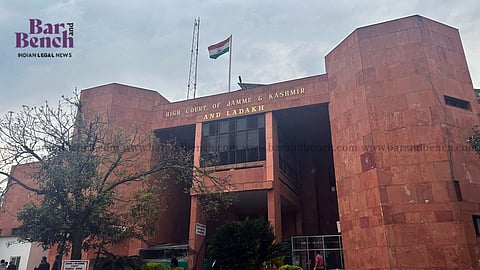
J&K High Court, Jammu Bench
Published on
3 min read

The High Court of Jammu and Kashmir and Ladakh recently observed that a public prosecutor has no independent authority to seek police custody of an accused (police remand) unless such a request originates from the investigating agency itself [State of J&K vs Dhanwanter Singh].
Justice Sanjay Parihar made the observation while dismissing a criminal revision plea filed by the State challenging a trial court's refusal to allow the prosecutor's plea for the remand of certain accused in a 2005 murder case to the police.

The record shows that the investigating agency neither had sought supplementary investigation nor requested police custody of the respondents. The Public Prosecutor, without such a request, had no independent authority to seek police remand under Section 167 CrPC,” the High Court observed.

Justice Sanjay Parihar

The case concerned an FIR registered for offences under Sections 302 (murder), 307 (attempt to murder), 147, 148, 149 (offences related to rioting and unlawful assembly) and 323 (hurt) of the Ranbir Penal Code, along with Section 3/25 of the Arms Act. After completion of investigation, a charge-sheet was filed before the trial court against multiple accused.

While several accused faced trial, three of them absconded and were proceeded against under Section 512 (which allows recording evidence in the absence of accused) of the Criminal Procedure Code (CrPC).

The co-accused who stood trial were acquitted on August 19, 2013, and the State filed an acquittal appeal before the High Court.

Subsequently, the absconding accused surrendered in January 2014 and were formally charged. The prosecution then moved an application seeking police remand to interrogate the accused who had earlier absconded, to enable further investigation and the filing of a supplementary charge-sheet.

The Sessions Court, however, rejected the request for police custody on March 6, 2014. Soon thereafter, relying on the same evidence that had already resulted in the acquittal of the co-accused, the trial court acquitted the three who had absconded and then surrendered on March 19, 2014.

Aggrieved by the refusal to order police remand for the three accused, the State filed a criminal revision plea before the High Court in March 2014. This plea remained pending for several years.

The High Court dismissed the said plea on January 30. It held that the challenge to the order refusing police remand no longer survived once the accused had been acquitted, as the order refusing police remand stood merged with the final judgment of acquittal.

The Court also noted the prolonged pendency of the revision plea for over a decade without effective service upon the respondents (the three accused who had surrendered in 2014) or any demonstrated urgency on the part of the State to pursue the matter.

"Despite issuance of process, the respondents were never effectively served and for over ten years, no urgency was shown by the appellant (State) for early disposal," it noted.

The Court also found that the police had never sought permission to file a supplementary investigation nor requested police custody of the respondents.

In such circumstances, the Public Prosecutor could not independently invoke the power under Section 167 of the Criminal Procedure Code to seek police remand, the Court held.

The filing of the original charge-sheet against all accused further indicated that custodial interrogation had not been considered necessary during investigation, the Court observed while dismissing the revision plea.

'Once the charge-sheet was filed against all accused, it implied that no further custodial interrogation was considered necessary, rendering the impugned order being perfectly in consonance with law. Accordingly, nothing survives in this revision petition. The same is, accordingly, dismissed," the order said.

The State was represented by Deputy Advocate General Pawan Dev Singh.

[Read Order]

Attachment
PDF
State_of_JK_vs_Dhanwanter_Singh
Preview
Bar and Bench - Indian Legal news
www.barandbench.com