Recalling the lawyers who shaped India - Raju Ramachandran's 14 Lawyers: Portraits from the Bar

The event featured a panel discussion with former Supreme Court Justice Madan Lokur, Senior Advocate Nitya Ramakrishnan, former diplomat Pavan Varma and author Mahmood Farooqui.
Senior Advocate Raju Ramachandran
Published on
5 min read
Listen to this article

The launch of Senior Advocate Raju Ramachandran's new book, 14 Lawyers: Portraits from the Bar, on Friday saw legal luminaries and authors recall their experiences and memories of lawyers who permanently shaped India's legal landscape.
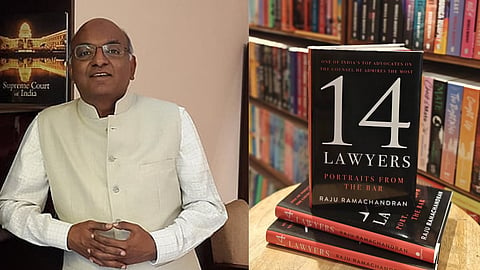
The book brings together 14 profiles of lawyers who practised before the Supreme Court of India across several decades, figures who, according to Ramachandran, shaped the institution but whose lives remain largely undocumented outside law reports and courtroom memory.

While Ramachandran himself did not speak at the launch event, the event featured a panel discussion with former Supreme Court Justice Madan Lokur, Senior Advocate Nitya Ramakrishnan, author and former diplomat Pavan Varma and author Mahmood Farooqui. The discussion was moderated by Senior Advocate Prashanto Chandra Sen.

The evening opened with a welcome address by Advocate Shibani Ghosh, who pointed out the deliberate colour scheme of the book's cover - black and red alongside the customary black and white. She explained that the black is a nod to Ramachandran's sympathies with the Dravidian movement and the Black Lives Matter movement. The red reflects his left-leaning politics, she said.

Raju Ramachandran Book Launch

The panel discussion opened with Sen referring to Justice Rohinton Nariman's foreword to the book, which divides its subjects into seamen lawyers - those who argued forcefully and loudly - and gentlemen lawyers, who did not.

Despite this divide, Sen said, a golden thread unites all 14.

"They are people who had the courage of their convictions and they said what they had to without worrying about the consequences. Also, it is a reflection of the author's personality to select them and call them his heroes, whom he wants to introduce to the present generation."

He said that the present generation has much to learn from their work, especially in an era of "glitzy commercialisation" and constant digital distraction.

"What it helps us do is to redirect and re-anchor ourselves on the work itself and say, if our work is good, it will be a vehicle of eminence and progress in this profession and that's the best way to do it. Today, we see juniors looking at their cell phones. It's natural to be distracted by it, but it is important to understand the court and the only way to do it is to unfailingly be in court every day and observe the court," Sen added.

Each panelist focused on personalities profiled in the book.

Justice Madan Lokur
Justice Madan Lokur

Justice Lokur spoke of Justice VM Tarkunde, recounting an episode during the Emergency when Tarkunde publicly opposed the supersession of judges by Chief Justice AN Ray and subsequently refused to appear before Justice Ray's court for as long as he remained Chief Justice.

Lokur also spoke of SN Kackar, recalling his reputation as a soft-spoken but formidable advocate at the Allahabad High Court whose ambition to become Attorney General was undone by a "quirk of fate" when Justice HR Khanna's resignation as Law Minister opened that post to Kackar instead.

Lokur further recounted Lal Narayan Sinha's reputation for being wily with an anecdote in which Sinha dryly suggested Justice PN Bhagwati simply pass an order abolishing crime in the country, in response to the judge's activist tendencies on the bench.

Lokur also remembered his own friendly disagreements with TR Andhyarujina over judicial reform and public interest litigation.

"All these persons were outstanding persons whom you could look up to as lawyers. They had this court craft, this ability to convince judges," he said.

Pavan Varma
Pavan Varma

Former parliamentarian and diplomat Pavan Varma, who studied law alongside Ramachandran, said of the book,

"There was a great deal of elegance, there was eloquence, there was celebration, there was refinement, there were the quirks which are a natural accessory of good minds and the courage of conviction. And a great deal of meticulous hard work. And there were, if I may say so, a much larger amount of ethics."

Varma also spoke at length about Frank Anthony, praising his courage of conviction in parliament.

"The central hall where you get exceptionally subsidised coffee is really the only place where you have a discussion because the rest of the time, the House is adjourned. In its entire history, the House of Commons has not been adjourned for a single day. And we are now soon going to equal it because there is not a single day when the Indian Parliament is not adjourned. So in such a situation, to have an eminent lawyer, a good man, taking up issues which he felt were important for the evolution of this country as a vibrant and viable democracy, that is a tribute to a great man," he added.

Nitya Ramakrishnan
Nitya Ramakrishnan

Ramakrishnan focused on the legacies of RK Garg and MK Ramamurthi. She described Garg as a man of great personal charm who nonetheless supported the Emergency and the supersession of judges. She highlighted Garg's advocacy in cases on obscenity law and bearer bonds, drawing a parallel to the Supreme Court's more recent striking down of electoral bonds.

Ramakrishnan also spoke of "the incomparable" Shyamala Pappu, who broke into the male-dominated field of law and pushed for gender-just laws. She also spoke of Gobinda Mukhoty's civil liberties work, including his controversial defence of two policemen convicted of custodial rape.

She closed by recalling Ramamurthi's decades-long friendship with her father, forged in Alipur Jail where they were lodged during the Quit India movement.

"So this book is an account by the author of the heroes he saw in play, and therein lies its richness. He talks of their achievements, he talks of milestones, but also he speaks of other anecdotes in their lives and he speaks of their various foibles. So with grace and wit and humour, he treads that middle ground between adulation and animadversion. He does it beautifully," Ramakrishnan said.

Pavan Varma
Pavan Varma

Farooqui closed the discussion by situating the book within a longer tradition of lawyers as public servants and leaders, from Gandhi and Nehru to Jinnah. He praised the book for functioning simultaneously as a social history of the legal profession and as a series of intimate character portraits. He noted that by writing only about the deceased, Ramachandran had given himself the narrative closure that only death, and not life, can offer.

Closing the event, Ghosh announced that Ramachandran is already at work on his next book - a history of the Privy Council as the final court of appeal for British India.

[Live Coverage]

Bar and Bench - Indian Legal news
www.barandbench.com