Simplicity in public transactions is good governance: Supreme Court

Administrative procedures should avoid complexity, redundant requirements, and unnecessary burdens, which waste time, expense, and disturb peace of mind, the Court added.
Supreme Court
Supreme Court
Published on
3 min read

The Supreme Court recently underscored the need to ensure simplicity in public transactions, adding that laws, regulations and procedures should be clear and easy for the public to understand [Adarsh Sahkari Grih Nirman Swawlambi Society Ltd. v. State of Jharkhand and ors].
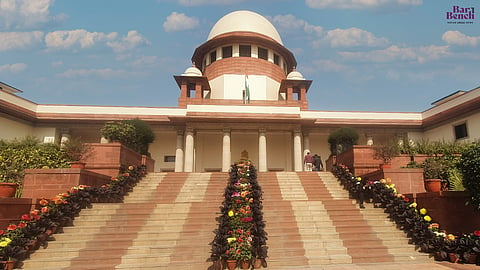
The Bench of Justices PS Narasimha and Atul S Chandurkar added that legal procedures governing public transactions should not be made unnecessarily complex with irrelevant hurdles that would simply lead to the waste of time and expenses.

"Simplicity in public transactions is good governance. Constitutional courts uphold this virtue to strengthen the rule of law and ensure access to justice. In administrative law, simplicity means laws, regulations, and procedures should be clear, straightforward, and easy to understand, allowing for effortless compliance. Administrative procedures should avoid complexity, redundant requirements, and unnecessary burdens, which waste time, expense, and disturb peace of mind," the Court's December 5 ruling said.

 Justice PS Narasimha and  Justice AS Chandurkar
Justice PS Narasimha and Justice AS Chandurkar

The Bench added that courts should strike down legal procedures that are unnecessarily complex with irrelevant or excessive requirements.

"While higher courts set aside executive decisions on the grounds of illegality if they are not founded on relevant considerations, or even when the decisions are based on irrelevant considerations, it is important to recognize the principle that executive actions that mandate certain unnecessary, excessive requirements, must equally be set aside as illegal," it said.

Executive actions that mandate certain unnecessary, excessive requirements, must be set aside as illegal.
Supreme Court

The Court made the observation while striking down a 2009 memo issued by the Jharkhand Registration Department.

The memo was tied to certain preconditions that have to be satisfied for a cooperative society to get a stamp duty exemption for document registration under Section 9A of the Indian Stamp (Bihar Amendment) Act, 1988.

Section 9A exempts stamp duty on instruments that transfer premises held by a cooperative society to its members.

The February 20, 2009, stated that District Sub-Registrars can grant this exemption to cooperative societies only if a recommendation for the same is made by the Assistant Registrar, Cooperative Society.

A society named the Adarsh Sahkari Grih Nirman Swawlambe Society Ltd. challenged this additional requirement. It argued that the memo's requirement went beyond the scope of the Stamp Act and imposed a new hurdle not contemplated by law.

After the Jharkhand High Court refused to interfere, the society moved the Supreme Court for relief.

The State defended the memo, arguing that such recommendations were being sought to prevent misuse by fake societies.

The top court, however, found this requirement to be irrelevant and unnecessary.

It noted that once a society is registered under Section 5 of the Jharkhand Self-Supporting Cooperative Societies Act, 1996 and issued a certificate of registration, Section 5(7) of the Act declares it to be conclusive proof of the society's existence and its continuation as a body corporate.

The Court said that this certification already proved the existence of the society.

It, therefore, found that the further requirement of a recommendation by the Assistant Registrar, Cooperative Society, was superfluous and unnecessary.

"This requirement, in our opinion, is disruptive of ease of transaction, without any value addition to the integrity of the transaction," it added.

The Bench concluded that the memo rested on irrelevant considerations and that it does not offer any value addition to the integrity of the transaction sought to be undertaken by the society.

It opined that adding irrelevant requirements in public transactions would unnecessarily consume limited time and human resources, and interfere with efficiency and good governance.

The Court proceeded to set aside the memo under challenge.

"We have no hesitation in holding that the impugned Memo issued by the Principal Secretary, Department of Registration is set aside on the ground of illegality, as it seeks to rely on a superfluous and redundant requirement," it said.

Advocate Rahul Arya appeared for the appellant society.

Advocate Kumar Anurag Singh appeared for the State of Jharkhand.

[Read Judgment]

Attachment
PDF
Adarsh Sahkari Grih Nirman case
Preview
Bar and Bench - Indian Legal news
www.barandbench.com