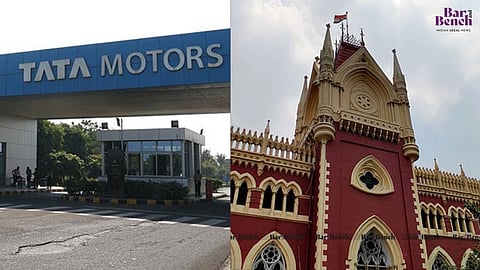
Singur Nano plant dispute: Calcutta HC refuses unconditional stay on ₹765 crore arbitral award in Tata's favour

The Court said no exceptional case was made for an unconditional stay, and ordered the WB Industrial Development Corporation to provide property or cash security within eight weeks to secure the stay.
Tata Motors
Tata Motors
Published on
3 min read
Listen to this article

The Calcutta High Court has refused to unconditionally stay a ₹765.78 crore arbitral award passed in 2023 in favour of Tata Motors Ltd in its dispute with the West Bengal Industrial Development Corporation Ltd (WIBDC) over the Singur Tata Nano plant project [West Bengal Industrial Development Corporation Ltd v. Tata Motors Ltd].

The WBIDC had challenged the arbitral award on the ground that one of the arbitrators who decided the arbitral dispute was biased.

Justice Aniruddha Roy found no prima facie merit in this allegation nor any case for an unconditional stay on the arbitral award.

The Court, therefore, ordered WBIDC to give details of properties or furnish cash security within eight weeks if it wanted to secure a stay on the arbitral award.

For this eight week period, there shall be an unconditional stay of the award for WBIDC to secure the award amount, the Court clarified.

It added that if WBIDC fails to provide this security, the stay will stand automatically vacated.

Additionally, the Court also dismissed WBIDC's application to unconditionally stay the award with costs of ₹50,000, payable by WBIDC to the West Bengal State Legal Services Authority.

Justice Aniruddha Roy

The matter is tied to the leasing of land in Singur to Tata Motors by the WBIDC, to set up a plant for the manufacture of Tata Nano cars.

However, after massive protests by farmers in Singur, with support by the then-opposition party Trinamool Congress (TMC) led by Mamata Banerjee, Tata abandoned the Singur project by 2008. The Supreme Court eventually declared the land acquisition of the Singur land by the WBIDC as illegal and ordered the return of land to the farmers.

In October 2023, a three-member arbitral panel ordered WBIDC to pay Tata Motors ₹765.78 crores to compensate for the losses they incurred.

This award was challenged by WBIDC before the High Court. It also filed an application to stay the award unconditionally until the appeal is finally decided.

WBIDC alleged that the presiding arbitrator’s alleged participation in seven Tata Motors-related car launch events showed bias, and that such bias amounted to fraud under the second proviso to Section 36(3) of the Arbitration and Conciliation Act.

The proviso mandates an unconditional stay where the making of an arbitral award is induced or affected by fraud or corruption.

The Court, however, refused to grant any such unconditional stay, on finding that there was no prima facie bias or fraud involved in the arbitral award.

To interfere at the present stage and unconditionally stay the award, the alleged act of fraud must be glaring, the Court said, which was not the case here.

“The act of fraud must be so egregious and glaring so as to undo and unsettle the award on the sole nature of egregiousness alone. In an arbitration proceeding, the scope of adjudication is such that there cannot and should not be any inferred conclusion which is not there on the face of record,” the Court said.

The Court also questioned why the WBIDC did not raise its allegations of bias and fraud before the arbitral award was passed. Information about the car launch events cited by the WBIDC were freely available in the pubic domain and were deemed to have been within the knowledge of the WBIDC.

Further, since WBIDC failed to provide conclusive proof that Tata Motors organised the seven events, the Court determined there were no exceptional circumstances to justify an unconditional stay.

“This Court is of the considered view that there is no exceptional case for which this Court can stay the award impugned unconditionally,” the Court held.

Consequently, the Court directed WBIDC's managing director or chairman to submit an undertaking, backed by a board resolution, to secure the entire award amount using unencumbered properties or a cash deposit within eight weeks.

Senior Advocate and then Advocate General Kishore Datta, instructed by Ginodia & Co, with advocates Siddharth Sethi, Manoj Kumar Tiwari, Raghvendra Pratap, Yuvraj Chatterjee, and Suddhadev Adak appeared for the WBIDC.

Senior Advocates Sudipto Sarkar and Siddhartha Mitra, instructed by Avijit Deb Partners, with advocates Deepan Kr. Sarkar, Samriddha Sen, and Soumitra Datta appeared for Tata Motors.

[Read order]

Attachment
PDF
West Bengal Industrial Development Corp. Ltd v. Tata Motors Ltd
Preview
Bar and Bench - Indian Legal news
www.barandbench.com