Stray dogs case should not end up like Aravalli case, engage domain experts: AM Singhvi to Supreme Court

Singhvi cautioned the Court against passing irreversible interim directions in the stray dogs case without expert inputs, citing the Aravalli mining verdict as a recent example.
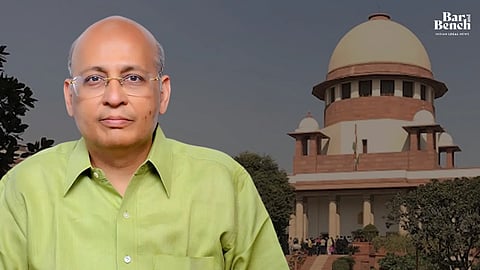
Dr. AM Singhvi and Supreme Court
Published on
4 min read

Senior Advocate Abhishek Manu Singhvi on Friday urged the Supreme Court to involve domain experts while dealing with the ongoing stray dogs case, warning that the matter should not culminate in a situation similar to the Court’s recent Aravalli ruling.

He cautioned a bench of Justices Vikram Nath, Sandeep Mehta, and NV Anjaria that well-intentioned judicial intervention, if not guided by scientific expertise, could result in irreversible outcomes, drawing a parallel with the Court’s recent Aravalli Hills ruling that had to be stayed and reconsidered after concerns were raised about the absence of domain expertise in the decision-making process.

Singhvi, who was appearing for an animal rights organisation by the name All Creatures Great and Small, argued that having an amicus curiae to help the Court is not enough, especially when the case involves complex policy questions.

He submitted that amici curiae are legal advisers and not subject-matter experts and that courts must supplement legal assistance with scientific and technical inputs.

“The obligation of the Court to enforce rights is in the absence of legislation. Your Lordships will be building a new edifice if you enter into that territory. While our amicus is great, the concept of amici are basically law advisers. They are not domain experts. Your Lordships must have domain experts along with the amicus. In the recent Aravalli judgment, the reconsideration was because that committee had 90% bureaucrats - generalists, not domain experts. Reconsideration was done because the domain experts had to come in. It will improve the quality of Your Lordships’ orders,” Singhvi submitted.

Justices Vikram Nath, Sandeep Mehta and NV Anjaria

Singhvi's arguments came during the Court's suo motu hearing on the stray dogs case that gained national attention last year after a Bench of Justices JB Pardiwala and R Mahadevan directed the Delhi government and municipal authorities to round up and shelter stray dogs from all localities.

Justice JB Pardiwala and Justice R Mahadevan

That order triggered widespread protests by animal rights groups and was later modified by the present Bench. The modified directions shifted the focus to vaccination, sterilisation and release of dogs in accordance with the Animal Birth Control Rules.

Since then, the Court has expanded the scope of the case.

In November 2025, as an interim measure, the Court directed States and the National Highways Authority of India to remove stray animals from highways across the country. It also ordered fencing of government and private educational and health institutions within eight weeks to prevent stray dog bites, and directed that dogs picked up from such institutional areas should not be released back into the same premises.

Against this backdrop, Singhvi today urged the Court to reconsider approach.

He submitted that the statutory framework governing stray dogs is already exhaustive and that judicial intervention is limited to filling gaps left by the legislature.

Singhvi argued that courts are constitutionally required to enforce rights in the absence of legislation, but cannot enter areas that the legislature has consciously occupied.

He then drew a direct comparison with the Supreme Court’s recent Aravalli Hills verdict, where the Court had stayed its own earlier judgment after concerns were raised about the absence of domain experts in the committee appointed by the Court.

He argued that a similar mistake must be avoided in the stray dogs case.

He further warned that interim orders in such cases often acquire the trappings of finality and are difficult to undo.

Singhvi referred to the Court’s November 7 interim directions on stray animals and argued that even interim measures involving expenditure, infrastructure creation and physical relocation become irreversible in practice.

“Willy-nilly, Your Lordships have passed an order. And it is more final than final can be. The trappings of finality are there if substantial issues are decided. The expense also is a finality. One cannot have initiation of expense and then reverse it. Even if Your Lordships agree with me, the order by its very nature is irreversible,” he said.

Other senior counsel also addressed the Court on today. Senior Advocate Rajshekhar Rao questioned whether earlier interim directions were proportionate. Senior Advocate Shadan Farasat pointed to State failure in implementing Animal Birth Control Rules.

Senior Advocate Madhavi Divan suggested institutional solutions such as dashboards and portable sterilisation units. Senior Advocate Pragyan Pradip Sharma proposed identifying aggressive dogs through scientific methods. Senior Advocate Zal Andhyarujina stressed that sterilisation, not removal, was the sustainable solution.

The Bench, however, remained cautious about comparative international examples and emphasised the scale and complexity of the Indian context.

The hearing will continue on January 13.

[Read Live Coverage]

Bar and Bench - Indian Legal news
www.barandbench.com