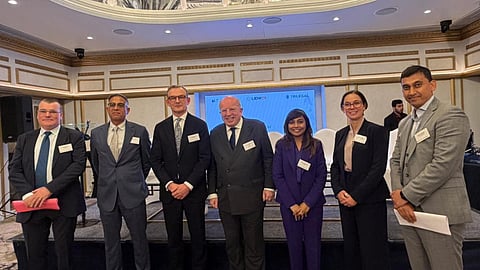
India’s next phase of economic growth will depend on stronger institutions and the rule of law, Akshay Jaitly said at a recent discussion in London on the India-UK commercial corridor..The Trilegal partner said that the success of an economy should not be measured only by the performance of its largest companies. He added that large companies can do well in most systems, either because an economy is open or because they are close to the government.According to Jaitly, the real test is whether small businesses can be set up, run and scaled.“The gauge of an economy’s openness or success cannot be, or should not be, what its largest companies are doing.”.Jaitly said that India had benefited enormously from the 1991 economic reforms, which allowed businesses and law firms to engage with the world at a scale that was not possible earlier. However, he added that the country now needed a second phase of reforms.“Growth for India in this next phase is going to be an institutional story.”.He was speaking at a session titled Geopolitics, Capital, Trust and Resilience: UK, India and the New World Order, hosted by FTI Consulting and Trilegal at the London International Disputes Week (LIDW) 2026 on June 4..The panel featured Jaitly, FTI Consulting Senior Managing Director Karthik Balisagar, Vesuvius General Counsel Henry Knowles, Stephenson Harwood partner Ros Prince and UK India Business Council Director of Government Affairs and Membership Services Stephen Crisp. It was moderated by Trilegal partner Sushmita Gandhi..Justice Robin Knowles CBE, Judge of the High Court of England and Wales, delivered the special address. He said that commercial courts around the world must learn from one another, since commerce moves faster than jurisdictional boundaries.“Commerce presents to us today. It’s obviously moving so fast. It doesn’t recognise the borders that we might draw up in order to make our own arrangements.”Justice Knowles said that no single jurisdiction, practice or expert has all the answers on how law should respond to changes in business. He highlighted that even jurisdictions with substantial legal resources - including India and England - must continue to learn from each other..Balisagar said that the world was witnessing a shift in the US-led global order. He pointed to financial weakness, inequality and China’s rise as forces shaping the current geopolitical transition. He added that capital continued to flow into India because of demographics, a growing middle class, infrastructure spending and digital public infrastructure..Crisp said that the India-UK free trade agreement reflected long-term trust between the two countries. The agreement would benefit manufacturing, food and services, though it would not permit UK lawyers to practise in India, he pointed out..Prince said that closed legal markets were not necessarily harmful, since they could protect local legal jobs while still allowing collaboration between foreign and domestic firms..Henry Knowles said that geopolitical disruptions had forced companies to rethink supply chains, regulation and contracts. He added that businesses now had to plan for interruptions caused by sanctions, tariffs, logistics, regulatory changes and cyber risks..Jaitly closed by flagging regulatory reform as a key concern. He pointed out that nearly 65 per cent of India’s formal economy was under some regulator or another, making regulatory capacity central to investor confidence.“If we don’t focus on the operation of our regulators, we don’t create the predictability and the trust that we need.”