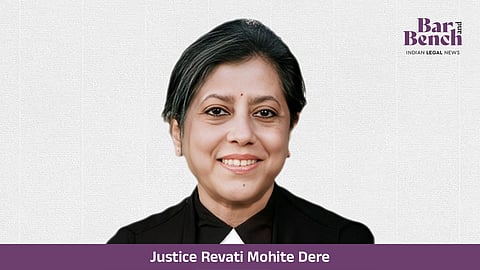

The Supreme Court on Monday upheld the decision of the Bombay High Court to proceed with criminal contempt of court against a petition for attributing political motives to Justice Revati Mohite Dere in a petition concerning the death of Disha Salian [Nilesh C Ojha vs. High Court of Bombay].
The Bench of Justice Vikram Nath and Justice Sandeep Mehta emphasised that judicial independence is a "non-derogable feature" of the Constitution and observed that intemperate allegations directed at a judge’s integrity strike at the foundation of the justice delivery system.
"The act of carrying a pending judicial controversy into the public domain in a manner that tends to sensationalise the proceedings... is wholly inconsistent with the discipline expected of an advocate...reckless aspersions strike at the very foundation of judicial independence by undermining the trust upon which the authority of the judiciary ultimately rests," the Court said.
The proceedings originated from a plea filed Satish Salian, father of Disha Salian, seeking a fresh investigation into his daughter's death.
Disha is the former manager of the deceased actor actor Sushant Singh Rajput. She was found dead in mysterious circumstances on June 8, 2020
On April 1, 2025 - one day before the matter was scheduled for admission - Salian's advocate, Nilesh C Ojha, held a press conference.
During the interaction, he alleged that Justice Dere was disqualified from hearing the matter because her sister was associated with the Nationalist Congress Party (Sharad Pawar) and was an accused in an FIR filed by Salian.
Following the presser, Justice Mohite-Dere reported the incident to the Chief Justice of the High Court, leading to a five-judge Bench initiating suo motu criminal contempt proceedings against Ojha.
Following the issuance of a show-cause notice by the High Court in April 2025, Ojha moved an interim application seeking to implead Justice Dere as a party-respondent to the contempt proceedings.
He contended that since the judge had provided the information that triggered the suo motu action, she was effectively a "complainant" who must be made a party to the case.
The High Court dismissed this application, observing that a judge who merely furnishes information to the Chief Justice does not become a necessary or proper party to the litigation.
In that same order, the High Court initiated a second criminal contempt case against the Ojha after finding the contents of the impleadment application itself to be "disparaging and scandalous."
A subsequent application by Ojha to recall these findings was dismissed on October 16, 2025, prompting him to approach the Supreme Court.
Before the top court, Ojha argued that the High Court’s refusal to implead Justice Dere stifled his right to a bona fide legal defense. He contended that since the proceedings were founded upon the judge's letter to the Chief Justice, she occupied the position of a "complainant."
The Court, however, rejected these contentions, clarifying that a judge who furnishes information regarding contemptuous conduct to the Chief Justice is merely a source of information and not a "complainant" subject to cross-examination or impleadment.
It noted that in an environment of heightened public scrutiny, the credibility of the legal process depends on the perception of judges as objective and neutral arbiters, rather than active participants in a litigation.
It remarked that public confidence constitutes the bedrock of the judiciary's legitimacy.
"The societal perception of Judges as being detached and impartial referees is the greatest strength of the judiciary and every member of the judiciary must ensure that this perception does not receive a setback consciously or unconsciously."
The apex court also declined to interfere with the High Court's initiation of the second contempt case.
The judgment underscored that advocates, as officers of the court, bear a "heightened duty" to uphold the dignity of the institution. It noted that grievances against judicial orders must be addressed through legal remedies rather than through public commentary intended to influence perceptions of judicial neutrality.
Characterizing Ojha's conduct as an "adventure" that fell short of professional propriety, the Supreme Court requested the Bombay High Court to proceed with the matter expeditiously.
It clarified that the High Court remains free to adjudicate all issues independently and on its own merits.
[Read Judgement]