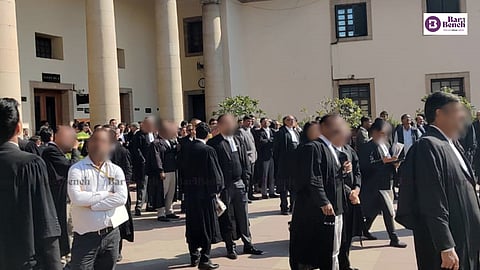
The Supreme Court on Thursday took note of repeated strike calls by the Noida's Gautam Buddha Nagar Bar Association and directed the district judiciary to compile details of such court boycotts/ strikes resorted to by the bar. .A Bench of Chief Justice of India (CJI) Surya Kant and Justice Joymalya Bagchi set out a mechanism to assess the scale of disruption and trigger disciplinary action and directed the district judiciary and the Allahabad High Court to immediately act on the issue.“We direct District and Sessions Judge of GB Nagar to send details of days when bar members abstained from work due to such resolutions to the Registrar General of the High Court. After report is received, immediate action should be taken in terms of our order. We request the committee (of the High Court) to examine the report of district judge and take immediate action,” the Court said in its order..The directions were initiated to enforce its earlier ban on lawyers’ strikes. The Court noted that the Gautam Buddha Nagar Bar Association had passed repeated resolutions calling for abstention from work. Such abstentions are already prohibited under an earlier ruling, CJI Kant said.“This court had passed a judgment in December 2024 restraining the district bar associations from abstaining from work.” .The Court recorded that the issue was not an isolated one but involved repeated violations.“The President of Gautam Buddha Nagar Bar Association has passed repeated resolutions abstaining from work,” observed the Court..The Court was also informed that a three-member committee had been constituted by the Allahabad High Court to examine the issue, but indicated that further action was necessary in light of continued disruptions..Lawyers in Gautam Buddha Nagar have in recent years repeatedly resorted to strike calls over local administrative and professional issues, leading to disruption of court functioning.Such abstentions have often resulted in adjournments across district courts in Noida and Greater Noida, with litigants unable to secure hearings or routine relief on scheduled dates. On several occasions, strikes have extended over multiple days, effectively bringing court work to a standstill.The impact has also been felt beyond courtrooms, with registry-related work and filings slowed or halted during periods of abstention.These recurring disruptions have happened despite the Supreme Court’s consistent position that lawyers cannot collectively boycott court proceedings, a principle reiterated in its December 2024 judgment..[Read Live Coverage]