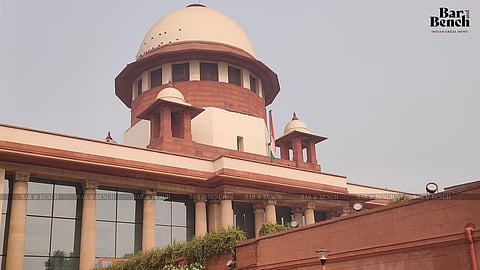
The Supreme Court recently flagged a 23-year delay in the commencement of trial in a dowry death case and directed all High Courts to prioritise cases in which criminal trials have been stayed [Vinay Gupta & Ors. vs. The State of Rajasthan]. .A bench of Justices JB Pardiwala and KV Viswanathan described as “very disturbing” and “painful” the manner in which a dowry death trial remained stalled for 23 years because a criminal revision against framing of charges was kept pending before the Rajasthan High Court with an interim stay in place.Thus, it dismissed the appeal filed by the accused challenging the High Court’s eventual rejection of their revision plea, but made it clear that the matter could not “rest at that”.The Court issued a broader institutional message to the judiciary across the country. It requested the Chief Justices of all High Courts to ensure that petitions in which interim orders are passed staying criminal trials are taken up for hearing at the earliest, particularly in serious and sensitive cases such as murder, dowry death and rape.In line with this direction, it ordered that a copy of its order be sent to the Registrar Generals and Secretary Generals of all High Courts for placement before their respective Chief Justices..The case arose from the death of a young woman at her matrimonial home in Ajmer district within a year of her marriage. She was married on November 21, 2000. On December 31, 2001, she died in what the Court described as “mysterious circumstances” at her matrimonial house.On January 10, 2002, an FIR was registered at the Nazirabad City Police Station at Ajmer for offences under Sections 498A (cruelty) and 304B (dowry death) of the Indian Penal Code. The complaint was lodged by the woman’s brother, who alleged persistent dowry harassment and claimed that she had been killed by administering poison.The police investigated the case and filed a charge-sheet against the husband and six of his relatives in August 2002. The trial court framed charges on November 15, 2002.In January 2003, the accused approached the Rajasthan High Court by filing a criminal revision challenging the order framing charges. On February 14, 2003, the High Court stayed further proceedings in the trial..What followed was a prolonged period of inaction. The criminal revision was taken up for hearing by a single-judge only in August 2023, nearly 20 years later. After being released for re-hearing and listed before a regular bench, the revision was finally dismissed on August 1, 2025.The accused then approached the Supreme Court..The Supreme Court said it saw no error in the High Court’s decision to reject the challenge to framing of charges and dismissed the special leave petition outright.However, the Bench said the case raised troubling questions about systemic delays and the manner in which interim stays can paralyse serious criminal trials for decades.The Court expressed shock at the time taken by the High Court to decide a revision petition that directly stalled a sensitive trial involving allegations of dowry death.“We would like to know first and the foremost why it took 23 years for the High Court to take up the Criminal Revision Petition filed by the petitioners for hearing, more particularly when the subject matter of challenge in the Criminal Revision Petition was an order framing charge in a very sensitive and serious trial like one of dowry death," it queried in its order. The Bench said it was perturbed that despite an interim order staying the trial, the revision was not listed and decided at the earliest.Calling the litigation an “eye-opener”, the Court warned of the wider consequences of such delays on the criminal justice system.“If criminal trials in such serious offences remain pending for years together on the strength of interim orders passed by the High Courts, it would lead to nothing but mockery of justice. Justice has to be done with all the parties. Justice cannot be done only with the accused persons. Justice has to be done even with the victim and the family members of the victim. Injustice anywhere is a threat to justice everywhere," it noted. .Justice has to be done with all the parties. Justice cannot be done only with the accused persons. Justice has to be done even with the victim and the family members of the victim. Injustice anywhere is a threat to justice everywhereSupreme Court .To examine the issue in depth, the Court passed a series of directions. It asked the Registrar General of the High Court of Rajasthan to send the entire records of the criminal revision proceedings along with all order sheets to the Supreme Court through a special messenger.The Bench also sought detailed data from the High Court on how many criminal revision petitions were filed and disposed of each year between 2001 and 2026, including a specific break-up for the year in which the present revision was filed. It further asked how many times the petitioners’ revision was notified for hearing over the 23-year period.The Court also turned its attention to the role of the prosecuting agency and sought an explanation from the State of Rajasthan on what steps, if any, it took during this long interregnum to ensure that the criminal revision was heard and decided expeditiously.It then requested the Chief Justices of all High Courts to prioritise petitions in which interim orders are passed staying criminal trials. .The matter has been listed for further consideration on January 15. .The petitioners were represented by advocates Abhishek Gupta and Sheena Taqui. The State was represented by Senior Advocate Shiv Mangal Sharma. .[Read Order]