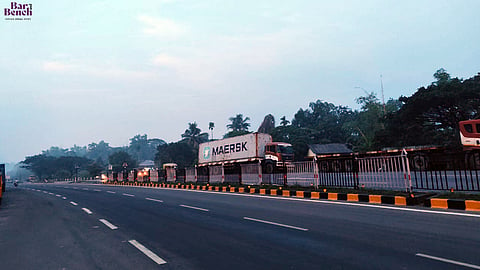
The Supreme Court on Monday questioned the National Highways Authority of India (NHAI) over its inability to act against illegal roadside dhabas and encroachments along national highways [In Re: Phalodi Accident]. .A Bench of Justices JK Maheshwari and Vijay Bishnoi said that the NHAI cannot keep shifting the responsibility to district and police authorities and sought a detailed compilation on the authority's power to take direct action. .The Court was hearing a suo motu case registered after two major highway accidents in Rajasthan and Telangana claimed 34 lives in November. On November 2, a bus carrying pilgrims collided with a stationary trailer truck near Matoda in Rajasthan’s Phalodi, killing 15 passengers. The next morning, a gravel-laden lorry rammed into a State Transport bus in Telangana’s Rangareddy district, leaving 19 dead.Both incidents, according to media reports, involved poor road maintenance and illegal roadside dhabas that prompted heavy vehicles to park dangerously along the highways.The Court had earlier directed the NHAI and the Ministry of Road Transport and Highways (MoRTH) to conduct surveys and report on unauthorised roadside structures and the condition of highways in both States..During today's hearing, Solicitor General Tushar Mehta, appearing for NHAI, said that an affidavit had been filed detailing the steps taken.The Bench, however, sought clarity on whether NHAI had the authority to take direct action against encroachments or whether it was deflecting responsibility.Justice Maheshwari said the Court wanted to understand the scope of the NHAI’s powers under law and not just its correspondence with other departments.“The NHAI is throwing mud on the contractor, police authorities or local administration. We want to understand the powers of the NHAI, what do the Act and Rules say. Can we leave everything on administrative authorities?” Justice Maheshwari asked.Mehta responded that he would study the statutory framework and revert on the issue.Justice Bishnoi noted that encroachments were widespread and directly contributed to accidents on highways.“I am a regular traveller on the Bharatmala Expressway. All over the highway, the illegal dhabas are there. Trucks are there,” Justice Bishnoi remarked.Mehta replied that after every six-lane road there existed a service road meant for vehicles to halt, but acknowledged that dhabas often occupied these spaces illegally.“The difficulty is that removal of dhabas is within our power, but there is a general delegation of power to district magistrates. Because he has police authorities under his control. We keep on telling him to remove dhabas. But we will have to find out some way,” Mehta said.The Bench observed that the issue was not just about identifying the dhabas but about establishing accountability among agencies responsible for preventing encroachments and ensuring road safety.“What we need is what are the provisions of the Act to take an action, what are the rules and regulations, compilation of all this. Another part is action taken and how far the action is in consonance with the provisions. Third is who is responsible for not taking action or implementing the provisions,” Justice Maheshwari said.Mehta then assured the Court that the NHAI would address all the concerns raised.Justice Maheshwari noted that the Court intended to frame general guidelines to improve road safety across the country.“We will issue some common guidelines to be followed pan India,” the judge said..In its order, the Court recorded that it had examined the report submitted by the NHAI and asked the authority to compile information on its own statutory powers, rules and regulations and a record of violations and correspondence. The report, it said, should also identify individuals or entities responsible for failing to prevent such incidents..The Court is expected to examine the statutory framework governing NHAI’s enforcement powers before issuing nationwide directions on road safety and encroachment removal.