Supreme Court grants relief to debarred law students amid confusion over attendance rules

The Court gave students a one-time exemption and clarified that its earlier stay on a Delhi High Court judgment relaxing mandatory attendance would not cost them an academic year.
Students, Supreme Court
Published on
3 min read
Listen to this article

The Supreme Court on July 21 granted relief to law students across the country who were debarred from academic progression over low attendance [Prakruthi Jain v. Bar Council of India].
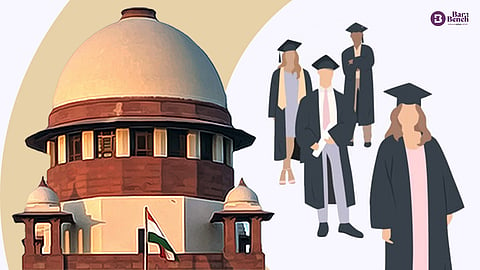
A Bench of Justices Vikram Nath, Sandeep Mehta and R Mahadevan clarified its earlier interim order staying a Delhi High Court judgment relaxing compulsory attendance, after confusion over attendance rules led to students being debarred across the country.

“The students who acted under a bona fide belief that mere shortage of attendance would not be an impediment to their appearing in the examinations for the ongoing academic session are entitled to the benefit of doubt as a one time measure only,” the Court said.

Justice Vikram Nath, Justice Sandeep Mehta, and Justice R Mahadevan

The clarification came in a batch of petitions challenging the Delhi High Court’s November 2025 judgment, which had directed that law students could not be barred from taking examinations or continuing their academic progression solely because of a shortage of attendance.

Following the judgment, the Bar Council of India (BCI) wrote to law colleges and universities across the country directing them to comply with the High Court’s ruling while it reconsidered the attendance regulations.

In May this year, the Supreme Court stayed the operation of the High Court’s directions prospectively. After the stay, several colleges began preventing students with attendance shortages from appearing in examinations, leading to fresh litigation before the Supreme Court and various High Courts.

Taking note of the situation, the Court said that students caught in this intervening period deserved protection. It observed that the Delhi High Court’s judgment had diluted attendance norms and that the BCI had virtually accepted those directions by issuing its own circular.

The Court accordingly directed,

"Hence, we hereby direct and provide that the students whose academic session was ongoing when the judgment dated 3rd November, 2025 was rendered by the Delhi High Court, shall not be detained or prevented from appearing in the final examinations for the said academic session. The order dated 26th May, 2026 being prospective in its operation, the law students who are now facing an imminent consequence of loss of academic session on account of shortage of attendance shall not be prejudiced by the order passed by this Court and that they shall be permitted to appear in the final examination for the said academic session."

It further ordered that students who had missed all or part of their examinations because of attendance shortages must be allowed to take supplementary examinations for the same session.

Also Read
Can law students be barred from exams over attendance shortage? Supreme Court to decide
Students, Supreme Court

During the hearing on Tuesday, the Bench said that it was conscious of the confusion created during the period between the Delhi High Court’s judgment and the Supreme Court’s stay.

Counsel appearing for students argued that the confusion had been caused by the BCI itself after the Delhi High Court’s judgment. They further submitted that after the High Court ruled in November 2025, the BCI wrote to universities directing them to follow the judgment and warning that failure to do so could invite action.

Senior Advocate Mukul Rohatgi, appearing for NMIMS, argued that the Delhi High Court judgment should not be treated as laying down the law across the country.

The Court responded,

“The Bar Council has to take a holistic view to see if the view taken by the Delhi High Court is correct or not,” the Bench observed.

The students’ counsel then said,

"There is an impact on mental health when so many students are just debarred. After they follow a high court judgement and Bar Council letter."

Senior Advocate Mukul Rohatgi

In the meanwhile, Rohatgi opposed granting any further relief, arguing that several High Courts had already taken a contrary view on attendance requirements.

The Bench, however, indicated that the larger issue remained open.

Counsel for the students also submitted that many universities were refusing to give effect to the Supreme Court’s prospective stay and were debarring students from examinations. Taking note of the concern, the Bench said it would clarify its earlier interim order so that students caught in the intervening period were not prejudiced.

Accordingly, the Court extended a "one-time" benefit to students affected during the intervening period by allowing them to appear in their examinations.

It listed the case for further hearing on August 25.

[Read Live Coverage]

[Read Order]

Attachment
PDF
Prakruthi Jain v. Bar Council of India
Preview
Bar and Bench - Indian Legal news
www.barandbench.com