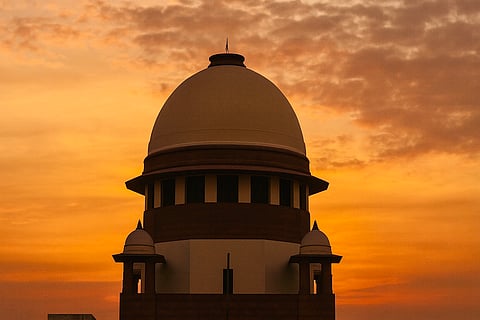

A visible divergence of opinion on the bench marked the Supreme Court's hearing on Friday on the mandatory three-year practice requirement for entry into the Civil Judge (Junior Division) cadre. [Bhumika Trust v. Union of India]
The Bench of Chief Justice of India (CJI) Surya Kant and Justices K Vinod Chandran and Augustine George Masih debated the way forward, even as Amicus Curiae Senior Advocate Siddharth Bhatnagar placed four structured suggestions before the Court.
Bhatnagar told the Court that 7 of the 12 High Courts that filed affidavits supported uniform retention of the rule. His first suggestion was retention without any modification.
His second and most detailed suggestion proposed that women and persons with disabilities (PwD) be permitted to appear for the civil judge examination without completing three years first, but be required to mandatorily complete the remaining practice period after clearing the exam, before proceeding to judicial academy training. Seniority would run from the date of appointment. He also suggested reducing the requirement for these two categories of candidates from 3 years to 2 as an alternative.
The third suggestion was a staggered phase-in: zero years required in 2026, one year in 2027, two years in 2028 and the full three from 2029.
The fourth, focused on PwD candidates specifically, recommended lower qualifying benchmarks, age relaxation and directions to High Court Accessibility Committees to operationalise Sections 19 and 23 of the RPwD Act.
Committees of the High Courts of Delhi, Gauhati, Odisha, Punjab and Haryana, Chattisgarh, Manipur and J&K and Ladakh backed uniform retention. The Delhi High Court committee warned that relaxation for one category would invite similar claims from others.
The J&K High Court committee drew a firm distinction between eligibility and suitability, opining that the three-year rule fell squarely in the former and could not be diluted for any category. The Karnataka and Meghalaya High Court committees favoured accommodations for specially-abled candidates within the existing framework. The Tripura High Court committee alone suggested that the rule be dropped entirely for such candidates.
Senior Advocate Pinky Anand submitted that students and fresh graduates had not been adequately consulted and that the practice requirement bore no relationship to adjudicatory skills, placing the average age of a judicial aspirant at twenty-nine.
Justice Chandran pushed back.
"I have been a Chief Justice. I have been a senior judge. The entire thing is about coaching centres. We have interviewed the judges," he said.
When Senior Advocate Colin Gonsalves argued that NLSIU Bangalore was losing its sharpest graduates to the rule, Justice Chandran observed:
"A lot of people who passed out took the hard road, practiced and then...."
CJI Surya Kant took a different line. He said that the Court would respect the May 2025 ruling, but was focused solely on modality. He questioned what passive courtroom presence over three years actually amounted to in terms of real practice.
"Today, if you don't pick up meritorious people, then God knows what people will you have for another 20-40 years," he said.
The CJI then indicated a possible direction:
"After one year practice, one year can also be a training year and then probation starts. That can also be the view."
The Court directed all High Courts to extend application deadlines for advertised posts to April 30, 2026. Fresh advertisements by States or High Courts are also to carry the same deadline. The matter will be taken up next week.
Notably, Justice Chandran and Justice Masih had been part of the bench that delivered the judgment under examination. The May 20, 2025 ruling in All India Judges Association and Ors v. Union of India and Ors was delivered by then CJI BR Gavai along with the two judges. It had restored the three-year Bar practice condition removed in 2002 on Shetty Commission recommendations.