
Subscribe
Subscribe
- Latest Legal News
- News
- Dealstreet
- Viewpoint
- Columns
- Interviews
- Law School
- Legal Jobs
- हिंदी
- ಕನ್ನಡ

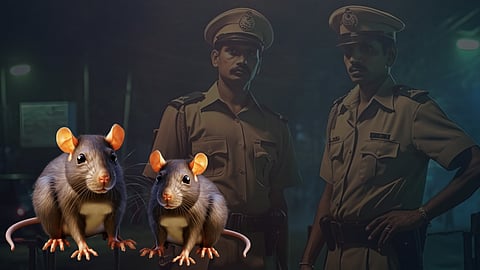
The Supreme Court recently granted bail to a corruption-accused former government official in Bihar after expressing surprise over a claim that currency notes seized in the case were destroyed by rats in the police malkhana (evidence room) [Aruna Kumari v. The Economic Offences Unit].
A Bench of Justices JB Pardiwala and KV Viswanathan suspended the four-year sentence of the accused official, a former Child Development Programme Officer (CDPO) named Aruna Kumari, and ordered her release on bail after noting that the evidence against her was indeed destroyed.
“We are taken by surprise that the currency notes got destroyed by rodents,” the bench said while granting bail.
The Court further flagged the destruction of seized currency as being a significant revenue loss for the State of Bihar.
"We wonder how many such currency notes recovered in this type of offences get destroyed as they are not kept at a safe place. It's a huge revenue loss for the State," it noted.
The case dates back to 2019, when the Economic Offences Unit (EOU) in Bihar conducted a trap operation against Kumari. She was accused of demanding and accepting a bribe of ₹10,000 in her capacity as a CDPO.
Following the raid, the EOU claimed to have recovered the currency notes from her possession. The notes were then sealed in an envelope and deposited in the local malkhana as primary evidence for the trial.
During the trial under the Prevention of Corruption Act, the prosecution faced a peculiar hurdle: the bribe money had vanished.
The prosecution argued that while the malkhana register proved the receipt of the envelope, the actual currency notes could not be produced in court. The reason provided was that rodents had infested the evidence room and destroyed the envelope along with the cash.
The trial court initially acquitted Kumari of all charges, leading the State to appeal the decision before the Patna High Court.
In February 2025, the Patna High Court set aside the acquittal and held Kumari guilty. In its judgment, the High Court acknowledged the rodent issue but ruled that it did not negate the prosecution's case.
"In Malkhana register, receipt of an envelop containing bribe money in connection with the instant case was duly recorded. Thus, there is no doubt that seized money was produced in Malkhana register but as a result of improper condition of Malkhana and lack of up to date preservation system, the envelop along with currency notes were destroyed by rodents." the high court noted.
It further reasoned:
"For destruction of the seized money, which was recovered from the possession of the accused, the prosecution case cannot be held to be not proved. In many cases, seized articles may not be produced during trial for one reason or the other."
It said just as a conviction can be sustained in a murder case without a body (corpus delicti), a corruption conviction could stand without the physical cash, provided other circumstantial evidence was sufficient.
This decision was appealed before the Supreme Court.
The Supreme Court remained far from convinced by the explanation for the missing cash.
It suspended Kumari's sentence, and ordered her release on bail.
Furthermore, it noted that the explanation offered by the prosecution for the destruction of the bribe money by rodents "does not inspire any confidence".
It indicated that it shall examine this issue in due course.
[Read Order]