
Subscribe
Subscribe
- Latest Legal News
- News
- Law Firms
- Columns
- Interviews
- Law School
- Legal Jobs
- हिंदी
- ಕನ್ನಡ
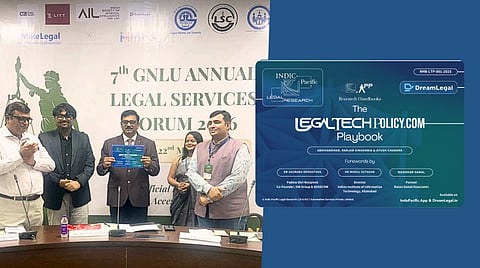
The LegalTechPolicy.com Playbook, a legal technology implementation guide, was recently launched at the Gujarat National Law University (GNLU) by the university's director Dr. S Shantakumar.
The March 22 launch ceremony was organised by GNLU’s Legal Services Committee as part of the 7th GNLU Legal Services Forum, 2026.
Key dignitaries who attended the event included Rhishikesh Dave, Dean of Sharda School of Law, Sharda University; Siddharth Marwah of Khaitan & Co; Dr. Kalpeshkumar L Gupta, Founder of ProBono India; and Hardik M Parikh, Faculty Coordinator of the GNLU Legal Services Committee.
Designed as a strategic roadmap for modern legal practice, the Playbook outlines 80 standard operating principles categorised across five key areas. These principles are specifically structured to assist in-house legal departments and emerging startups in streamlining their legal management and optimising technology integration.
The playbook was authored by Abhivardhan, President of the Indian Society of Artificial Intelligence and Law; Ranjan Singhania, CEO, DreamLegal.in; and Ayush Chandra.
Distinguished figures across the technology and legal sectors have also given forewards for the book. Padma Shri Dr. Saurabh Srivastava, Co-Founder, nasscom and IAN Group has remarked,
“What makes this playbook particularly relevant is its practical orientation. The authors understand that businesses need frameworks they can actually implement, not theoretical treatises. The People-Process-Technology approach they've reimagined resonates deeply with my own experience: technology is meaningless without the right processes, and processes fail without collaborative people driving them. Too often, we rush to adopt the latest legal tech solution without asking whether we've even clarified the underlying accountability structures or workflows.”
Prof. Dr. Mukund Sutaone, Indian Institute of Information Technology (IIIT), Allahabad, has added,
“Since the 80 SOPs are precise yet implementation‑agnostic, they can act as direct specifications for workflow engines, access‑control systems, data governance platforms, and AI‑assisted legal tools tailored to a given Receiver’s context.”
Manohar Samal, MCIArb, Partner, Ratan Samal Associates LLP Manohar said,
“The Playbook deals with legal technology issues in a manner which renders it to be an actionable document and not a mere theatrical treatise.”
The implementation guide has also garnered widespread support from the professional community, featuring 11 in-book and post-completion testimonials from a diverse group of emerging and veteran legal luminaries.
Contributors endorsing the playbook include Atul N, Arunima Jha CIPP(E), Mirul Bhavsar, Tanvin Anand, Simarjeet Singh Satia, Saswati Soumya Sahu (ANB Legal), Ila G., Aditi Vasani, Aneed Charles (Genpact), Sankhini M, Hamda Arfeen (LegalEase Solutions, LLC), and Unnati Anand (Alumnus, Cornell Law School).
This publication is unique, since it is not a long academic armchair work. It is an implementation guide developed not only for law firms and corporate legal professionals, but also for start-ups for whom legal management becomes tedious and time-consuming.
Some features of the implementation guide include:
Bilateral Stakeholder Approach: Every principle balances the responsibilities of the "Receivers" (startups, enterprises, MSMEs) with the corresponding obligations of the "Providers" (legal professionals, compliance teams).
Actionable SOPs: The playbook provides 80 practical Standard Operating Principles divided across five core facets of legal management.
Reimagined PPT Framework: The guide adapts the traditional People, Process, and Technology model specifically for legal management. The goal is to identify and eliminate operational bottlenecks before adopting new tools, ensuring technology genuinely improves business mobility.
Comprehensive Coverage: The principles span Corporate Governance Ethics, Data Law Management, Commercial Law and Vendor Management, Technology Adoption Management, and Integrated Knowledge and Document Management.
Structured Workflows: It offers clear guidance on establishing accountability architectures (differentiating vertical and horizontal accountability), handling data classification, managing third party and fourth party technology risks, and setting up secure document repositories.
Preservation of Human Judgment: A central theme is that automation and artificial intelligence tools must enhance legal workflows while strictly preserving critical human legal decision-making.

The LegalTechPolicy.com Playbook was also launched at a Pre-Summit Event of the AI Impact Summit 2026 - an IndiaAI initiative organised by the the National Forensic Sciences University (NFSU), Gandhinagar.
During the event, Abhivardhan, Co-Founder and President of the Indian Society of Artificial Intelligence and Law, officially presented the first edition of the playbook to Dr. Deepankar Sharma, Associate Dean of the School of Law, Forensic Justice and Policy Studies.
In today's high-velocity ecosystem, startups frequently scale their operations faster than their internal legal and compliance infrastructures can support. This imbalance creates severe vulnerabilities, particularly as emerging companies rely on complex webs of third-party vendors, industry platforms, and cloud infrastructure to maintain momentum.
The LegalTechPolicy.com Playbook serves as a critical operational asset for these entities, providing a rigorously structured approach to legal management without requiring the financial overhead of a massive in-house legal department.
Codified Accountability Architectures: Lean teams often struggle with unclear liability chains when engaging external vendors or navigating broader industry ecosystems. The playbook's "Provider vs. Receiver" framework establishes non-negotiable legal boundaries, ensuring startups maintain strict ownership of their intellectual property, define precise data privity, and avoid operational bottlenecks caused by vendor lock-in.
Mitigating 'Shadow IT' and Data Risks: As startups integrate disparate SaaS tools to solve immediate problems, they inadvertently expose themselves to significant data and compliance risks. The playbook delivers 80 actionable Standard Operating Principles to systematically audit, govern, and secure third-party and fourth-party technological dependencies.
Structured AI Governance: The rapid deployment of autonomous and Agentic AI (a central theme of the February 9 IndiaAI Summit) introduces unprecedented compliance challenges. The playbook equips founders with a practical evaluation matrix to safely deploy these high-leverage tools, ensuring that technological efficiency does not compromise essential human legal judgment or regulatory compliance.
Abhivardhan is the Founder, President and Managing Trustee of the Indian Society of Artificial Intelligence and Law, and the Managing Partner of Indic Pacific Legal Research. He is also the author of India’s first privately proposed AI bill, AIACT.IN, and has been featured in numerous media outlets, and prestigious Indian and international law, policy and technology forums.
Ranjan Singhania is a legal technology entrepreneur and the founder of DreamLegal, a marketplace simplifying how legal teams discover, evaluate, and adopt legal tech solutions. With a background in law and a deep focus on legal operations, he works closely with law firms, in-house teams, and legal tech companies to streamline workflows, improve efficiency, and accelerate digital transformation. Ranjan actively researches legal tech trends and speaks on building practical, problem-first technology solutions for the legal industry. He is passionate about bridging the gap between legal professionals and technology through accessible tools, education, and data-driven insights.
Ayush Chandra is a Mumbai-based legal professional with a multidisciplinary edge. He holds a Bachelor's in Legal Sciences and Law from the University of Mumbai, an LLM in Criminal Law from NMIMS, and a Diploma in Cyber Laws from the Asian School of Cyber Law and Government Law College, Mumbai. He’s currently pursuing a Master’s in Business Law at NLSIU Bengaluru. He owns a Canadian Copyright for cybersecurity technology in smart financial transactions and serves as Chairperson of Policy Innovation Committee at the Indian Society of Artificial Intelligence and Law, contributing to AI governance and legal innovation.
<Sponsored Post>