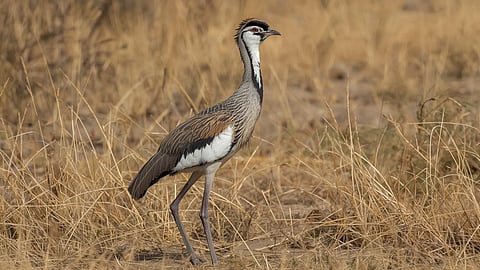

The Supreme Court on Friday issued a series of conservation measures for the protection of the Great Indian Bustard (GIB) and Lesser Florican, two critically endangered bird species facing extinction due to power infrastructure and loss of habitat [MK Ranjitsinh & Ors. vs. Union of India & Ors.].
A Bench of Justices PS Narasimha and AS Chandurkar accepted the recommendations of an expert committee and ordered that all key measures be implemented within two years.
The Court observed that the issue was not merely about conserving a species but about reconciling environmental protection with India’s renewable energy transition.
It said both objectives must be pursued together “without sacrificing one at the altar of the other.”
Among the key measures include the undergrounding of 80 km of critical 33 kV power lines in Rajasthan and 79 km of similar lines in Gujarat, rerouting of several 66 kV lines and a complete ban on new wind turbines or solar parks above 2 MW capacity.
The Bench was hearing a batch of petitions filed in 2019 seeking urgent directions for the conservation of the Great Indian Bustard, also known as Godawan in Rajasthan.
The bird, once found across much of India, now survives in small pockets of Rajasthan and Gujarat with fewer than 250 individuals left. The petitioners had sought immediate steps including installation of bird diverters, restrictions on new transmission lines and the appointment of a monitoring committee.
In April 2021, the Court had imposed a sweeping restriction on overhead transmission lines across nearly 99,000 sq km of Rajasthan and Gujarat. It had also directed that high-voltage power lines be laid underground to protect the endangered birds.
However, the Union government later sought modification of the order, arguing that such restrictions would cripple India’s renewable energy sector and were technically unfeasible.
The Bench then revisited its earlier order in March 2024, acknowledging that while protection of the species was “non-negotiable,” environmental policy decisions must also account for climate goals and energy security. It then set up an expert committee to suggest balanced solutions.
The expert committee, comprising wildlife scientists, conservationists and representatives of key ministries, submitted its reports in September and November 2024 after extensive field visits in Rajasthan and Gujarat.
It identified revised “priority areas” - 14,013 square km in Rajasthan and 740 square km in Gujarat, for conservation of the Great Indian Bustard and recommended immediate mitigation measures.
Among the key directions accepted by the Court are the undergrounding of 80 km of critical 33 kV power lines in Rajasthan and 79 km of similar lines in Gujarat, rerouting of several 66 kV lines, and a complete ban on new wind turbines or solar parks above 2 MW capacity within the revised priority areas.
The Court also directed the undergrounding of 250 km of high-risk power lines identified by the Wildlife Institute of India within two years.
The Court also accepted the recommendation to create “power corridors” outside critical habitats so that future lines can be consolidated and bird deaths from collision can be reduced.
The Bench agreed with the committee’s decision to defer installation of bird flight diverters until their effectiveness is scientifically verified, noting that poor-quality devices could prove counterproductive.
The Bench further called on corporations to recognise environmental protection as part of their statutory social responsibility. It observed that under Section 135 of the Companies Act, corporate social responsibility must include “corporate environmental responsibility.”
“Allocating funds for the protection of the environment is not a voluntary act of charity but a fulfilment of a constitutional obligation,” the Court said, referring to the duty under Article 51A(g) of the Constitution to protect and improve the natural environment.
The Court also acknowledged the traditional role of local communities, particularly the Bishnois of Rajasthan, in protecting the Godawan, describing their eco-centric philosophy as a model of harmony between humans and nature.
The Bench finally directed the Union Environment Ministry to oversee the implementation of the expert panel’s recommendations within two years and ensure coordination between State agencies and power authorities.
The petitioners were represented by Senior Advocates Shyam Divan and Prashanto Chandra Sen along with advocates Sonia Dube, Kanchan Yadav, Surbhi Anand, Anshula L. Bakhru, Arpith Jacob Varaprasad, Saumya Sharma, Tanishq Sharma, Muskan Nagpal and Sayantan Chanda.
The Centre and other respondents were represented by Additional Solicitor General Aishwarya Bhati along with Senior Advocates Ruchi Kohli, Manish Singhvi and Ranji Thomas.
[Read Judgment]