
Subscribe
Subscribe
- Latest Legal News
- News
- Law Firms
- Columns
- Interviews
- Law School
- Legal Jobs
- हिंदी
- ಕನ್ನಡ
Women have emerged as a driving force in India’s insolvency and restructuring landscape, overcoming challenges and redefining leadership in a fast-evolving profession. A webinar organized by INSOL India in collaboration with IWIRC brought together leading professionals to discuss women’s contributions, career growth, and systemic challenges in insolvency law.
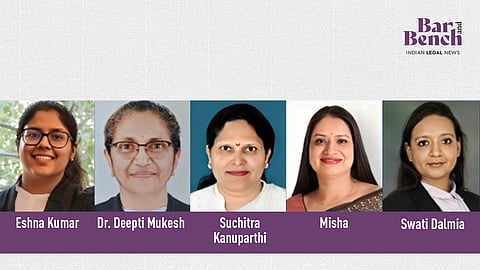
The panel featured Dr. Deepti Mukesh (Former Judicial Member, NCLT), Suchitra Kanuparthi (Former Judicial Member, NCLT), Misha (Partner, Shardul Amarchand Mangaldas & Co.), and Swati Dalmia (Partner, Fox Mandal & Associates), with Eshna Kumar (Founder, Chambers of Eshna Kumar) as the moderator.

Opening the discussion, Dr. Deepti Mukesh reflected on the evolution of India’s insolvency framework, emphasizing how legal reforms have changed perceptions of insolvency from a social stigma to an institutionalized resolution process. “The scare from the word insolvency is gone, but the scare about not paying debt remains. That is what we strived to achieve,” she remarked.
She pointed out that women were historically absent from insolvency practice, but today, they are taking up leading roles as Insolvency Resolution Professionals (IRPs) and Liquidators.
“Hardly any female used to come up in insolvency matters. In 2016, we had a tremendous change. The entire attitude of creditors and debtors changed, and today, I see women taking full-time careers as an IRP or a Liquidator,” she said.
Suchitra Kanuparthi emphasized the importance of structured training programs to increase women’s participation in insolvency law. She called for the IBBI (Insolvency and Bankruptcy Board of India) to establish a dedicated panel of experienced women insolvency professionals to ensure greater representation.
"IBBI should maintain an entire panel of women Insolvency Professionals...Women who have the experience and qualification and knowledge. There should be system where they can be trained. Women can do a better job than men. I am sure about it." she remarked, highlighting the need for formalized pathways to leadership roles in the sector.
Adding to the discussion, Misha shared her experience as a litigator specializing in insolvency law. She acknowledged that while women have entered the space in larger numbers, career attrition remains a challenge, particularly due to mid-career personal commitments.
“When women choose to marry, when they choose to have children, it becomes very very challenging especially considering how fast paced insolvency proceedings are....the reason we don’t see a lot of women in accounting or financial roles is because of the mid-career choices we have to make.", she pointed out.
She further explained that women bring a more inclusive, stakeholder-driven leadership style to insolvency practice.
“Many men like being led by a woman. You have to prove yourself for somebody to start listening to you...Traditional leadership used to be rigid, but today, we see leadership that listens to all stakeholders, understands their concerns, based on empathy and understanding of people's needs. Women do have an advantage when it comes to this.”, she observed.
Bringing a unique perspective, Swati Dalmia compared women’s resilience in insolvency law to their ability to adapt under pressure. “Women are like tea bags—until you put them in hot water, you don’t recognize their strength,” she remarked.
She emphasized that the insolvency profession has become more gender-inclusive, but women must continue to push boundaries. “There is no impediment today in 2025. We see a lot of gender equality in this space. Arbitration is no longer an old boys’ club”, she added.
She also pointed out how women have an innate sense of flexibility making them better suited for the insolvency industry.
"The way insolvency law is evolving is our natural instinct that we women have. Having the inherent characteristic of evolving over time. It's a very fast paced moving system. I think women are quite adaptable to bring out and come up with open minded solutions. Our thinking is not tied up.", Ms. Dalmia remarked.
The discussion also addressed the ongoing debate on work-life balance in the legal profession. Kanuparthi suggested that women naturally find ways to balance work and family, saying: “When you have a passion towards work and a commitment to family, you will find a way.”
In contrast, Dalmia dismissed the concept altogether, asserting: “Work-life balance is a myth. We have to continuously juggle and hustle. As long as you enjoy it, it’s okay.”
Misha called for better work environments that allow professionals to voice concerns about unrealistic workloads. “Work is part of our lives, but it is not our entire life. We need to create workspaces where people can express that it’s not okay,” she noted.
The panel also discussed client perceptions of female professionals in the insolvency space. Dr. Mukesh pointed out that women still face challenges in earning client trust for high-stakes cases.
“The trust in a female lawyer is still lacking. We need to bring up a generation that understands that women are not second to men”, she stated.
Misha suggested that women professionals should actively engage with clients to change this perception.
“The issue is not trust, but visibility. Women tend to hesitate in reaching out to clients, but we need to change that. Once clients see our dedication and sincerity, the work speaks for itself”, she explained.
The webinar concluded with a strong message: women’s representation in insolvency law is growing, but structural support, mentorship, and policy initiatives are necessary for sustained progress.
Dr. Mukesh closed the discussion with a powerful remark: “Work-life balance is always asked of women, never men. If we have struggled for generations to bring a balance, men should initiate the struggle too.”
With women increasingly leading insolvency proceedings, shaping resolution frameworks, and influencing legal policies, the panelists agreed that gender equality in this field is not just a goal—it is an ongoing transformation.