
Subscribe
Subscribe
- Latest Legal News
- News
- Law Firms
- Columns
- Interviews
- Law School
- Legal Jobs
- हिंदी
- ಕನ್ನಡ
Artificial Intelligence is transforming litigation. Tasks that once took days - reviewing pleadings, summarising case records, building litigation timelines, and answering questions across case documents, can now be completed in minutes.
Yet many organisations are discovering that simply introducing AI into litigation workflows does not automatically make them more efficient or intelligent.
The challenge isn't the AI. It's the litigation workspace; the landscape in which litigation information is created, managed, and shared. In many organisations, case documents, evidence, court orders, communications, legal research, and hearing records are spread across multiple systems, teams, and external counsel. As a result, neither lawyers nor AI have a complete view of the matter.
The success of AI therefore depends not only on the capability of the technology, but also on the quality and accessibility of the information it works with. Building an AI-ready litigation practice requires more than deploying AI, it requires an environment where information is centralised, connected, and organised around every matter.
While AI can dramatically accelerate litigation workflows, it cannot compensate for fragmented information.
In a typical litigation matter, pleadings, evidence, court orders, hearing notes, legal research, and client communications often reside in different locations. Multiple versions of documents circulate between internal teams and external counsel, while important updates remain buried in email threads or disconnected folders.
In such an environment, even the most advanced AI model can produce incomplete or misleading outputs. A document review may overlook critical evidence, a case summary may miss procedural developments, or a draft may rely on outdated pleadings or incorrect jurisdictional context. These are not limitations of AI, they are consequences of incomplete and disconnected information.
For AI to deliver reliable legal insights, it needs more than sophisticated models. It needs a complete, organised, and contextual view of every litigation matter.
The first step towards an AI-ready litigation practice is creating a single source of truth for every matter.
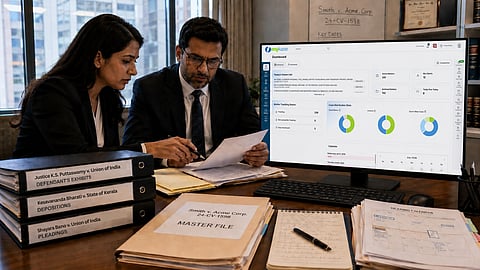
A centralised litigation workspace brings together everything related to a case - pleadings, evidence, court orders, hearing history, correspondence, counsel reports, legal research, and supporting documents, within a single digital matter folder. As the matter evolves, every update is captured in one place, ensuring that legal teams, management, and AI work from the same, complete record.
With a structured and continuously updated repository, AI can generate more accurate summaries, build comprehensive timelines, answer questions across case documents, and provide meaningful litigation insights.
Building an AI-ready litigation practice is about more than adopting new technology. It requires redesigning how information is captured, connected, and managed throughout the lifecycle of a matter. It fundamentally changes how legal team’s work.

The impact extends beyond operational efficiency. When information is organised around the matter rather than scattered across systems, AI becomes part of the workflow instead of an isolated tool. Legal teams spend less time finding information and more time interpreting it, enabling faster decisions, better collaboration, and stronger strategy.
Once information is centralised, connected, and continuously updated, AI becomes far more than a productivity tool. With access to the complete matter record, it can analyse information in context, generate reliable insights, and support both legal teams and business leaders throughout the litigation lifecycle.
Routine tasks are automated, information becomes instantly accessible, and lawyers can devote more time to strategy, advocacy, and client advice.
Instant Case Understanding
AI can generate concise case briefs covering the facts, issues, parties, relief sought, procedural history, and recent developments. Stakeholders can understand the status of a matter in minutes rather than spending hours reviewing case files.
Automatically Build Litigation Timelines
AI can automatically generate timelines by extracting key dates, hearings, filings, orders, and procedural milestones from the matter record, helping lawyers prepare more effectively for hearings, ditching the manual prep of hours.
Ask Questions across the Matter
Instead of manually searching through multiple documents, lawyers can ask natural language questions such as: What relief has been sought? Which issues remain pending? What observations did the Court make during the last hearing? Which documents support this argument?
Information that once took hours to locate becomes available in seconds.
Translations
AI can translate pleadings, notices, contracts, and court orders while preserving legal terminology and context, enabling faster collaboration across jurisdictions and languages.
Real-Time Visibility for Leadership
Leadership requires more than periodic status reports. AI-enabled matter management provides real-time visibility into high-risk matters, important hearings, recent orders, pending actions, litigation trends, and overall legal exposure, enabling faster and more informed decisions. Collectively, these capabilities transform litigation data from a record-keeping function into a source of actionable business intelligence.
AI does not replace lawyers, it changes how they work.
Traditionally, litigation teams have spent considerable time locating documents, reviewing lengthy records, preparing chronologies, tracking deadlines, organising evidence, and managing case information. While essential, these activities often leave less time for strategic legal work.
When AI is embedded within a structured litigation workspace, much of this administrative effort is automated or significantly reduced. Lawyers can spend less time finding information and more time analysing it, developing litigation strategy, assessing risk, preparing arguments, advising clients, and appearing before the courts.
The lawyer's role evolves from managing information to exercising judgment. AI accelerates legal work, but legal reasoning, strategic thinking, and professional accountability remain inherently human.
AI can summarise documents, identify relevant information, generate drafts, and answer questions in seconds. It cannot, however, assume responsibility for legal advice, litigation strategy, or professional judgment.
Every AI-generated output should be reviewed by a legal professional. Citations must be verified, legal authorities validated, factual accuracy confirmed, and recommendations assessed in the context of the matter.
The most effective legal teams will combine the speed and analytical capabilities of AI with the judgment, experience, and accountability of lawyers. AI should enhance legal expertise—not replace it.
Litigation has evolved from paper files to digital records, and now to AI-assisted legal operations. But adopting AI alone is not enough. The real transformation lies in creating an AI-ready practice.
Organisations that centralise litigation data, standardise workflows, and maintain a single source of truth for every matter will unlock the full value of AI through faster insights, better collaboration, and more informed decision-making. In contrast, applying AI to fragmented information only leads to incomplete analysis and unreliable outcomes.
MyKase from Manupatra provides the foundation for an AI-ready litigation practice by bringing together matter management, litigation tracking, documents, communications, and legal intelligence into a single workspace. With every case managed through a single source of truth, organisations can confidently leverage AI to deliver faster insights, stronger collaboration, and better litigation decisions.
MyKase is part of the broader Manupatra Suite of Products, which also includes legal research, AI assistants, compliance management, contract lifecycle management, and legal analytics.
See in action: Request Meeting