
Subscribe
Subscribe
- Latest Legal News
- News
- Law Firms
- Columns
- Interviews
- Law School
- Legal Jobs
- हिंदी
- ಕನ್ನಡ
On May 26, 2026, the Supreme Court of India halted what was shaping up to be a quiet, long-overdue overhaul of Indian legal pedagogy. By staying a landmark direction of the Delhi High Court, which had ruled that law students cannot be barred from examinations or held back academically solely due to attendance shortages, the apex court firmly re-established a rigid, administrative status quo.
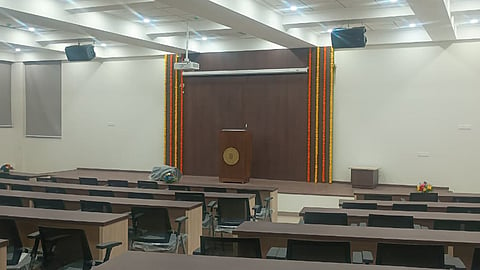
During the hearing, the Bench expressed deep anxiety over increasingly empty law school classrooms. Justice Sandeep Mehta warned that relaxing these rules would reduce National Law University (NLU) hostels into mere “boarding and lodging facilities, nothing else.” To the standard-bearers of legal education, the issue is entirely binary: a lack of physical presence is a moral and professional failure on the part of the student.
But this perspective mistakes a glaring symptom for the underlying disease. The panic over empty benches ignores a much harsher reality. Students are not abandoning classrooms because they lack discipline; they are abandoning them because the traditional Indian law classroom has become pedagogically obsolete. By focusing entirely on forcing presentism through biometric tracking and the threat of exam debarment, the regulatory old guard is treating a structural crisis as a behavioural one. They are choosing to police empty seats rather than interrogate an antiquated, non-inclusive and passive educational model that has long outlived its utility.
When the Supreme Court noted with concern that “all NLUs are suffering”, it inadvertently highlighted the tip of a much larger, darker pyramid. National Law Universities represent the absolute elite tier of Indian legal education. They are resource-rich fortresses equipped with massive libraries, subscriptions to expensive legal databases and star-studded faculty. Yet, if even these premier institutions cannot convince their highly ambitious students to occupy classroom seats voluntarily, the institutional alarm bells should be deafening.
This realisation forces us to confront a far grimmer question: if the classroom model is failing at the top, what is happening to the forgotten majority outside the NLU bubble?
The vast majority of India’s future lawyers do not study on pristine, Wi-Fi-enabled campuses. They study in overcrowded state universities, underfunded regional colleges and evening shifts where the ground reality of legal education is bleak. In these institutions, the academic environment is frequently non-existent. Lecture halls are often poorly lit, non-air-conditioned and suffocatingly crowded, making sustained physical presence an endurance test rather than an intellectual pursuit.
Furthermore, a severe shortage of permanent, qualified professors means classes are routinely assigned to underpaid ad-hoc teachers or guest lecturers who simply read aloud from outdated commercial guidebooks or dictate notes verbatim. Libraries are often locked, understocked, or entirely devoid of modern digital research tools, leaving students to fend for themselves using whatever material they can scrape together online.
To enforce a ruthless, automated biometric attendance regime in an environment that offers absolutely zero academic or professional return on investment is a form of administrative extortion. When a college provides no placement cells, no practical court-trial exposure, no functional legal aid clinics and no qualitative lectures, it reduces the degree to a mere waiting game. Forcing a student from a humble background to commute hours every day and pay steep fees just to sit in an empty room and watch a clock tick does not build professional discipline. It breeds deep resentment and systemic exclusion. If elite NLUs are suffering from empty classrooms, traditional law colleges are suffering from structural abandonment; and using attendance shortages as a weapon to detain students is a lazy cover for their own institutional bankruptcy.
The contemporary law student belongs to a fundamentally digital-first generation. They navigate a hyper-efficient, on-demand information ecosystem outside university gates, only to step into a lecture hall that operates like a time capsule from a bygone era.
The structural crisis of attendance is, at its heart, an efficiency mismatch. Consider the daily calculus of a modern student: why should they spend 2 hours in a stagnant classroom listening to a professor slowly dictate old notes when the exact same conceptual framework can be mastered in 15 minutes online? Traditional legal pedagogy treats information as a scarce commodity. It assumes the professor is the sole gatekeeper of the text. Today, information is infinitely abundant; it is time that has become the student's rarest, most heavily taxed resource.
By continuing to mandate a grueling 9-to-5 physical lecture routine, law schools are confusing passive compliance with active learning. Sitting quietly in a crowded room while a textbook is read aloud does not create an advocate; it simply drains the energy needed for genuine intellectual engagement. Students are not rejecting education; they are rejecting an archaic distribution channel.
Whether pursuing a 3-year or a 5-year integrated LL.B., students surrender the most formative, energetic years of their early adulthood. The ultimate tragedy of the current attendance regime is how poorly it utilises this finite window of time.
The modern legal market does not reward classroom compliance; it rewards functional professional competence. When administrations prioritise mechanical presentism over real-world skill acquisition, they create a widening chasm between what a student needs to survive in the profession and what the university demands they do to pass.
To understand how out of touch this model has become, one only has to look at a recent remark by Chief Justice of India BR Gavai. Reflecting on his own college days at a valedictory ceremony, the CJI candidly recalled attending classes perhaps "half a dozen times," relying instead on determination and raw commitment to the profession to build his career. While his words are not an endorsement of mass absenteeism, they serve as a scathing indictment of the belief that a lawyer’s worth is manufactured inside a lecture hall.
By continuing to enforce a rigid attendance lock-in, institutions are actively stalling student progression. A student who misses a lecture because they are assisting a senior counsel at a High Court or drafting a brief for an independent research platform is penalised, while a student who sits silently scrolling on their phone in the back row is rewarded with a hall ticket.
A singular, inflexible attendance mandate operates on a highly flawed assumption: that every student possesses the same physical baseline and structural privilege. By implementing rigid attendance clocks, Indian law schools have created a massive blind spot around student diversity, most notably concerning persons with disabilities (PwD) and those navigating chronic health conditions.
Under the Rights of Persons with Disabilities (RPwD) Act, 2016, institutions are legally mandated to offer "reasonable accommodation" to ensure equal access. Yet, the daily reality inside law campuses is a stark contradiction. Many law campuses lack basic barrier-free infrastructure, smooth sensory environments, or flexible formatting. Expecting a PwD candidate to relentlessly endure a grueling, physical 9-to-5 schedule day in and day out - solely to feed a biometric machine without an inclusive ecosystem - is systemic cruelty. Instead of designing creative, accessible pathways for learning, administrations default to their favorite punitive tool: exam debarment.
When law schools refuse to extend this logic to their own attendance frameworks, they treat education as an endurance test rather than an intellectual pursuit.
This rigid administrative mindset directly fuels a compounding mental health crisis. The tragic suicide of Sushant Rohilla at Amity University - the very foundation of the Delhi High Court's intervention - was a horrific warning of what happens when institutional empathy is entirely replaced by algorithmic presentism. Forcing an ambitious student to repeat an entire academic year because of an attendance shortage does not build discipline. It induces profound isolation, anxiety and despair.
Similarly, the Madhya Pradesh High Court recently had to step in to protect a student barred over pregnancy-related absences, declaring that "marriage or pregnancy cannot obstruct education." Why must students consistently drag their universities to High Courts just to plead for basic human empathy? By using attendance shortages as a weapon to detain students, our law schools are failing in their foundational duty: to create a safe, vibrant and interesting space where all students feel they belong.
The Supreme Court’s anxieties miss a crucial, self-inflicted truth: the physical campus only loses its meaning when the institution fails to provide anything of value inside its walls. Forcing students to sit through hours of uninspired lectures will not restore the sanctity of the classroom. Empty chairs are a diagnostic report card for the faculty, not a moral failure of the student body.
If the legal profession thrives on innovation and fierce advocacy, pedagogy must evolve beyond the passive dictation of decades-old notes. True reform requires an environment where hours spent on independent research, active legal aid clinics and competitive mooting are naturally valued as the core of legal education.
The Sushant Rohilla tragedy and the relentless wave of student litigation are clear warnings to the regulators that the old ways are simply no longer sustainable. Punitive debarment is a lazy shortcut for a system unwilling to look in the mirror. Until our law schools abandon administrative coercion and build a practical, flexible and inclusive learning environment, empty lecture halls will remain a monument to institutional failure, no matter how many stays the courts grant. Instead of blindly punishing students, the legal fraternity must investigate the cause.
Rayees is an independent legal researcher and writer. He can be reached at rayeeshere1@gmail.com