Nurturing curiosity in democracy, one quiz at a time: Ready for the Law Challenge

According to former High Court Justice S Muralidhar, to whom the book is dedicated, quizzing nurtures curiosity and curiosity is vital for any democracy to thrive.
Justice S Muralidhar and Raghav Chakravarthy
Published on
6 min read
Listen to this article

The days of Derek O'Brien's Bournvita Quiz Contest and Siddhartha Basu's Mastermind may be locked away in some quiet corner of time, but could bringing back quizzing and nurturing curiosity in young and old minds alike be just what the times call for?
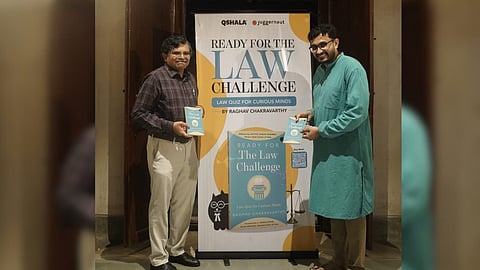
When Raghav Chakravarthy left his law internship under then Delhi High Court Justice S Muralidhar (now a practising Senior Advocate) to attend a quiz tournament in Sweden, he did not know that it would inspire him to author Ready for the Law Challenge: Law Quiz for Curious Minds.

The Law Challenge Book Cover

But an interest in quizzing developed at the dinner table with his family and cultivated in law school in Pune has led to exactly that.

After conducting quizzes for students in local schools while pursuing their law in Pune, Chakravarthy and Sachin Ravi founded QShala in 2014, a social quizzing platform that has now conducted countless quizzes.

When Chakravarthy left the fateful internship during law school, Justice Muralidhar had suggested that he create a question bank focused on law.

A few years later, when he started QShala, he decided it would be a good idea to inform Muralidhar, then Chief Justice of the Orissa High Court, of the development. The jurist commissioned a quiz for law students from universities across Odisha and later one for judicial officers. The enthusiastic participation in these events led QShala to moot an idea of conducting a law quiz at the all India level to comemmorate the 75th year of the Constitution of India and the Supreme Court of India.

The result was "AmiQuiz Curiae" - a nationwide quiz for lawyers which concluded in New Delhi in March 2023. In his foreword to the book, Muralidhar states that the response from the participating lawyers was "truly phenomenal".

Ready for the Law Challenge aims to bring law quizzes into homes and communities.

But in a world that is way too hectic, especially for those in the field of law who often juggle work and family on a knife's edge, why carve out time for quizzing?

The Law Challenge book dedication

Muralidhar, whom the book is dedicated to, answered this question while speaking at the the launch of the book. He said that quizzing nurtures curiosity and curiosity is vital for democracy to thrive.

"I think the best example we should give here, just to see the power of the people, is the MKSS movement in Rajasthan. People were asking a simple question of their own panchayats. Money is allocated for projects in this area. What's happened to that money? Show us the accounts. That's how the entire RTI movement started and it has led to one of the most powerful tools: the RTI Act. It came through small regions of protests where they were asking questions of the local administration. I think it's so important to ask questions of whoever is in power to enforce the accountability in law," Muralidhar said.

Speaking from his own experience as both judge and lawyer, Muralidhar added that honing the art of asking questions will only add to the arsenal of any lawyer or litigant.

"The only way you can really enforce accountability of those in power is to have a strong judiciary - a judiciary that lends its hand to people wanting answers from the government. And the more and more judges realise that they are meant to do this very fundamental duty as a constitutional court, we'll have a better country," he explained.

The Law Challenge Book Launch

Speaking to Bar & Bench's Giti Pratap, Chakravarthy echoed this sentiment, saying,

"I know at some times the environment makes us shut down from asking uncomfortable questions, but I feel that being a part of a quiz builds and nurtures that interest and ability to ask questions. And I think a culture of asking questions is extremely useful for a vibrant democracy."

Raghav Chakravarthy
Raghav Chakravarthy

Ready for the Law Challenge is a far cry from the mammoth quiz books of yore which were replete with hundreds of questions in tiny fonts, with one large glossary of answers at the end. At a 190 pages split into 12 chapters, the book is easy to get through and convenient for those who may want to use each chapter as a short quiz each day.

Chakravarthy explores a wide range of topics in these chapters, all of which either come from within the world of law or exist at its various intersections.

The first chapter, titled We, the People, is a reminder that the Constitution is a living contract with the people of India. It then moves on to Law Beyond Statutes, which focuses on Indian and international institutional frameworks, Past Precedents, which dives into India's historical milestones, and The Final Word, which revisits landmark judgments and lesser known court cases that shaped the country.

The fifth and sixth chapters focus on law as reflected in literature and the silver screen. The questions in these two chapters may even force one to take several long pauses to read the book or watch the movie mentioned. These references are not restricted to just English or Hindi books and movies. From The Case That Shook India by Prashanth Bhushan to Malayalam movies starring Mohanlal, these two chapters are perhaps where the reader might stay stuck for a while, but for the best reasons.

For Chakravarthy, the intersection of law and art is the space that can best nurture multidisciplinary thinking.

"A well-crafted quiz having an intersection of law and movies, history, culture, literature, art, sciences, that is a great milieu, right? There are always stories to in each of these intersections. It is a great way to build that multidisciplinary thinking and not just be siloed in your own tunnel."

The next two chapters focus on eminent legal trailblazers, with one chapter focused entirely on women in law. Legalese Unlocked touches on the backstories of how even everyday legal terms as simple as the Bar, copyright, waqf, munsif and fraternity came to be. Chapters 10 and 12 take you Beyond the Bar and Chapter 11 breaks with the pattern and follows a "list it" round style, where you have to think in connections and patterns.

An interesting feature that sticks out when going through the book is that the questions are not phrased in a cut-and-dry manner. They themselves contain a wealth of infromation. For example, one question reads:

"Begum Shaista Suhrawady Ikramullah was the first Muslim woman to earn a PhD from the University of London. She served as a delegate to the United Nations, advocating for more gender-inclusive language ain the Universal Declaration of Human Rights. Jahanara Shahnawaz was elected to the Punjab legislative assembly and appointed as the parliamentary secretary for education, medical relief and public health. She was the first women in Asia to reside over a legislative session. What other unique distinction do these women share?"

The answer is that they were the only two women members of the Constituent Assembly of Pakistan. But regardless of whether you knew this answer, the question itself teaches you a handful of other facts about these pathbreaking women.

If that weren't enough, Chakravarthy ends every chapter with a trivia section with five points each. These sections, with the assistance of a search engine, can take you down interesting and informative rabbit holes. And perhaps even cure some brainrot.

Say you've gone through the book - which you can buy from the QShala website - and you want to stay engaged with the quizzing community, Chakravarthy suggests joining local quiz communities, online quiz leagues and going for pub quizzes.

While QShala actively conducts quizzes for thousands of school children. If you were not a quizzer in school or college, the more informal setting of a pub quiz may be the best choice.

Chakravarthy also says that for lawyers who may be tired of reading long briefs, a quiz might be the most relaxing yet engaging way to keep abreast of global developments.

"There has to be some way you need to keep yourself abreast of things that are happening in the world. One way is reading newspapers. But in a well-crafted question, there's an opportunity to discover interesting things and also rekindle things that you know. As a lawyer, keeping yourself abreast with things is important. So when you have this gamified format, I feel it's a very good lifelong learning habit to nurture your own sense of curiosity to know about the subject," he says.

Bar and Bench - Indian Legal news
www.barandbench.com