
Subscribe
Subscribe
- Latest Legal News
- News
- Dealstreet
- Viewpoint
- Columns
- Interviews
- Law School
- Legal Jobs
- हिंदी
- ಕನ್ನಡ
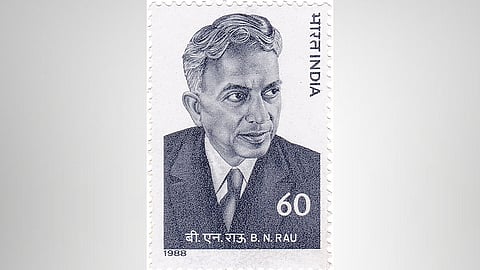
On November 25, 1949, the eve of the Constituent Assembly formally adopting the Constitution, Chairman of the Drafting Committee Dr BR Ambedkar delivered a long speech. In this speech, he reserved special praise for Benegal Narasing Rau, the Constitutional Advisor.
“The credit that is given to me,” said Dr. Ambedkar, “does not really belong to me. It belongs partly to Sir BN Rau, the Constitutional Advisor to the Constituent Assembly, who prepared a rough draft of the Constitution for the consideration of the Drafting Committee.”
TT Krishnamachari echoed these sentiments. He hailed Rau for his progressive vision and his alacrity in providing solutions for problems which seemed intractable.
The Assembly debates were marked by high-minded discussions and, often, disagreement. But everyone agreed that the Assembly’s task was made infinitely easier because of the assistance provided by BN Rau.
Rau was appointed as Constitutional Advisor on the invitation of Viceroy AP Wavell and on the self–imposed condition that he would work only in an honorary capacity. Before he took on this role, Rau had a stellar career. A fellow student of Jawaharlal Nehru at Trinity College, Cambridge, Rau joined the Indian Civil Services in 1909 and quickly rose through the ranks. He served at various points of time as a judge of the Calcutta High Court, as Prime Minister of Kashmir and India’s emissary in the United Nations.
Arvind Elangovan’s outstanding biography of Rau titled Norms and Politics fully captures his character and intellect in the INA Trials, where he was instrumental in working out the legal strategy for the defence. It is believed that at one time, Rau was in the reckoning for being appointed as the Secretary General of the United Nations. His final posting was as a judge in the Permanent Court of International Justice, the precursor to the International Court of Justice. He was the first Indian to be appointed to the post.
As Constitutional Advisor, the most delicate task assigned to Rau was to prepare the first working draft of the Constitution. The Assembly had met for the first time on December 9, 1946. From then till August 1947, the Assembly had taken decisions on a large number of constitutional provisions. However, these were scattered among various votes and resolutions. In addition, there were numerous recommendations made by several committees, such as the Advisory Committee, on different aspects of the Constitution.
It was in August 1947 that the Assembly resolved to ask Rau to prepare this first draft of the Constitution, which reflected the decisions the Assembly had taken so far. In what can only be described as a Herculean task, Rau finished this job in about two months. By October 1947, Rau’s Draft Constitution was ready.
Much of Rau’s draft Constitution has an enduring influence even today. For instance, he came up with a working draft of the Preamble to the Constitution, which was later refined by the Drafting Committee, especially by Dr. Ambedkar. More pertinently, Rau drew up a detailed catalogue of fundamental rights; a nuanced list of directive principles of state policy and the division of power between the three branches of the State. All these features were taken as basic principles by the Drafting Committee. His attention for detail is there for all to see: from providing the minutest details of the powers and jurisdiction of the Supreme Court of India to the legislatures conducting their business. Rau was able to provide a strong framework for the Drafting Committee as well as the Constituent Assembly.
After Rau submitted his Draft Constitution, he travelled the world. In the USA, he met President Truman and Justice Frankfurter of the US Supreme Court. Frankfurter is learned to have remarked that he would recommend Rau to be a judge of the US Supreme Court itself, purely, “on the strength of his knowledge of the history and working of the American Constitution.” President Truman’s only piece of advice to Rau was that India’s Constitution must not provide for mid–term elections.
However, Rau’s Draft Constitution was not without its fair share of criticism. Some quarters felt that he had borrowed too extensively from the Government of India Act of 1935, thus signaling a continuity in British tradition, rather than a clean break from it. Yet, Rau’s Constitution was widely celebrated as properly expressing the sense of the Constituent Assembly.
During the drafting process, Rau had voiced a critical idea. In 1947, he propounded that if in free India, the government were to embark on a land reform project to democratise the holding of land in the hands of the citizens, then it would be essential to create a regime where such an ambitious project did not run into too many hurdles. What he proposed was that unlike the USA, due process protection ought not to be conferred on property rights. He worried that if property rights were given too high a level of protection, then land reform would be nigh impossible. In many ways, Rau presaged that if this were not done, then the ideal of achieving constitutional welfare would be insufficiently realised. As it turned out, his apprehensions came true.
When the Constitution came into force on January 26, 1950, it did not sufficiently articulate this idea propounded by Rau. At one point of time in the Assembly, there had been a commitment to ensuring robust protection for life and liberty and a lesser degree of protection for property rights. But by a rather unorthodox turn of events, the original Constitution ended up granting near due process level of protection to property rights even though there was broad consensus that this ought not to be done. Life and liberty guaranteed by Article 21 were devoid of due process protection.
As a result, in the initial years, land reform laws faced difficulties in the constitutional courts. To make the entire project of land reform easier, the First Amendment to the Constitution in 1951 introduced new articles in the chapter on fundamental rights, which endeavoured to ensure that land reform measures that aimed to dismantle the zamindari system of land tenure in India should be secured against legal challenges. These constitutional changes were given the seal of approval by the Supreme Court in the Sankari Prasad Singh Deo v. Union of India (1951).
More than two-and-a-half decades later, the fundamental right to property itself was deleted by the 44th Amendment to the Constitution and placed as Article 300A, thus reducing its place of importance in the Constitution. This transformation in the constitutional understanding of the right to property, in a substantial measure, came to sanctify Rau’s original vision on the proper place of property rights in the Constitution.
Rau passed away at the age of 66 in November 1953. Such was his stature that in the wake of his passing, the Lok Sabha held a remembrance session; a rare honour as Rau had never been a member of parliament.
It is important to remember the people who made this momentous achievement a reality. And, as was universally acknowledged in the Constituent Assembly itself, Rau’s name would be at the top of any such list.
Rohan J Alva is an arguing counsel in the Supreme Court and the Delhi High Court and author of two books on the Indian Constitution, "Liberty After Freedom" and "A Constitution to Keep".