
Subscribe
Subscribe
- Latest Legal News
- News
- Law Firms
- Columns
- Interviews
- Law School
- Legal Jobs
- हिंदी
- ಕನ್ನಡ
On June 25, 2026, barely a day after Passport Seva Divas, and almost ironically so, the Ministry of External Affairs (MEA) dropped a bureaucratic anvil on the Indian consciousness.
An Indian passport, the Ministry clarified, is strictly a "travel document" meant to facilitate international transit; it cannot be treated as conclusive proof of citizenship.
For the ordinary Indian, this is the ultimate cognitive dissonance. If a document stamped with the sovereign seal of the Republic - one that commands the diplomatic protection of the Indian state on foreign soil - cannot definitively prove you are a citizen at home, then what does?
This paradox arrives at a time when the question "What makes you an Indian?" has ceased to be a subject of academic debate. We have entered a new epoch in Indian jurisprudence and civil life. Between the sweeping, data-driven purges of the Election Commission of India’s (ECI) Special Intensive Revision (SIR) of electoral rolls and a fractured legal framework surrounding identity, millions of Indians are discovering a grim reality of the Indian state. For it has engineered a highly efficient matrix to track your existence but has no single, unified standard to validate your belonging.
If you are stripped of your voter ID, the police will deny your background checks. If you offer your Aadhaar, the Supreme Court reminds you it is merely a biometric receipt. If you produce your passport, the executive branch downgrades it to a travel pass. We are witnessing the Kafkaesque transformation of Indian citizenship - from an inalienable constitutional right into a precarious administrative subscription.
When every document proves something, but nothing enough
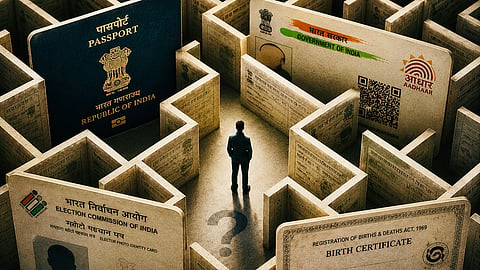
To understand the architecture of this crisis, we must look at the legal bedrock of our primary identity markers. In an era where data is supposedly king, our physical and digital papers amount to an evidentiary desert. The debate is not not just political, it is also fundamentally structural.
Let us deconstruct the identity matrix that millions of Indians rely upon daily, only to find it hollow when tested in the courts.
1. The Aadhaar Card
Enacted under the Aadhaar (Targeted Delivery of Financial and Other Subsidies, Benefits and Services) Act, 2016, the Aadhaar card is arguably the most ubiquitous document in India. Yet, Section 9 of the Act explicitly states that an Aadhaar number does not confer any right of, or serve as proof of, citizenship or domicile.
This is not a dormant clause. Just weeks before the MEA’s passport declaration on June 16, 2026, a Supreme Court bench comprising Chief Justice of India Surya Kant and Justice V Mohana heard a public interest litigation petition demanding strict limits on Aadhaar.
The petition pointed out that despite UIDAI notifications explicitly stating Aadhaar cannot prove age, address or citizenship, it is routinely demanded for voter registration (Form-6). The Supreme Court has repeatedly affirmed that Aadhaar is proof of identity and residence at best- it confirms that a human being exists at a specific geographic coordinate, but it says absolutely nothing about their legal right to call that nation their own.
2. The Passport
The MEA’s June 2026 declaration sparked a firestorm precisely because it stripped the passport of its domestic aura. A passport is governed by the Passports Act, 1967.
Crucially, Section 20 of the Passports Act empowers the Union government to issue passports or travel documents to individuals who are not citizens of India, provided it is necessary in the public interest.
Because this loophole exists, the executive argues that holding a passport cannot be equated with an absolute, unchallengeable adjudication of citizenship. It creates a "strong presumption," but in the eyes of the MEA, it is not conclusive proof. You can use it to enter the United States, but you cannot use it to prevent your name from being erased from an electoral roll in Murshidabad.
The MEA has attempted to buttress its stance by citing a 2013 Bombay High Court judgment, claiming the court ruled that passports are incapable of evidencing citizenship.
However, a closer reading of that ruling reveals a glaring executive misrepresentation: the High Court did not reject the evidentiary value of a valid passport; rather, it rejected the specific passport produced before it because its legal validity had already been revoked and terminated. The Court was not analyzing a valid passport under the statutory scheme at all.
3. The Voter ID (EPIC)
Issued under the Representation of the People Act, 1950, the Voter ID allows you to participate in the democratic franchise.
In the 1995 case of Lal Babu Hussein, the Supreme Court ruled that a Voter ID creates a strong presumption of citizenship. However, the modern ECI framework treats the voter list as a fluid, administrative database subject to constant revision (under Article 324). Inclusion on the list gives you the right to vote, but exclusion from the list - as we have seen in recent months - is treated as an administrative cleansing, not a denationalization.
4. The Birth Certificate
Perhaps the most misunderstood document is the birth certificate, governed by the Registration of Births and Deaths Act, 1969. While it is conclusive proof of age and the geographic location of your birth, its value as proof of citizenship is entirely dependent on the year you were born, owing to the shifting goalposts of Indian law.
The Citizenship Act’s generational trap
The root of our documentation crisis lies in the amendments to the Citizenship Act, 1955, which transitioned India from a generous regime of jus soli (right of the soil) to a stringent, exclusionary regime of jus sanguinis (right of blood).
The law splits the Indian population into three distinct historical tiers:
Tier 1 (Born between January 26, 1950, and July 1, 1987): Citizenship is guaranteed by the sheer fact of birth on Indian soil, irrespective of parental nationality. Your birth certificate is conclusive proof.
Tier 2 (Born between July 1, 1987, and Dec 3, 2004): Birth on Indian soil is insufficient. The individual must prove that at least one parent was an Indian citizen at the time of their birth.
Tier 3 (Born on or after Dec 3, 2004): The individual must prove that both parents are Indian citizens, or that one parent is a citizen and the other is not an illegal migrant.
Herein lies the trap: Because a standard Indian birth certificate records only the date and place of a child's birth - not the legal, constitutional status of the parents - it is legally impossible for anyone born after 1987 to prove citizenship using their own birth certificate alone.
They must produce a chain of ancestral documentation. This effectively shifts the burden of proof entirely onto the citizen. If your parents' documents are lost to floods, administrative apathy, or simply the passage of time, your own citizenship is instantly rendered precarious.
Inside the SIR
The theoretical vulnerabilities of this framework were violently exposed during the ECI’s 2025-2026 Special Intensive Revision (SIR). Originally pitched to the public as a routine electoral purification exercise - designed to weed out deceased, shifted, or duplicate voters - the SIR mutated into a demographic and legal earthquake.
Data from the ground paints a harrowing picture of administrative overreach. According to finalised data sets, Phase II of the SIR resulted in the net deletion of over 5.18 crore names from the electoral rolls across just 12 major states and Union Territories. This represented a staggering 10.2% reduction in the total electorate of those regions.
Let us look at the hard numbers of disenfranchisement from the Phase II Draft to the Final Roll:
Uttar Pradesh: Approximately 2.05 crore voters deleted (-13.21%)
West Bengal: 83.86 lakh voters deleted (-10.9%)
Tamil Nadu: 74 lakh voters deleted (-11.5%)
Gujarat: 68 lakh voters deleted (-14.5%)
How did a routine exercise result in the erasure of tens of millions of voters? The answer lies in the algorithms deployed by the poll body. In critical border states like West Bengal, the ECI relied heavily on a categorization known as the "logical discrepancy" metric.
This administrative dragnet flagged voters not for lack of citizenship, but for minor data anomalies. If a grandfather’s name was spelled differently on an old 1971 handwritten ledger compared to a 2015 digitized database, the family was flagged. If the arithmetic age gap between a mother and child seemed mathematically improbable in the records (a common occurrence in rural India where ages were historically guessed by block officers), they were flagged.
In the district of Murshidabad alone, over 4.5 lakh notices were issued under this singular "logical discrepancy" category. A total of 1.36 crore voters were caught in this net in Bengal. Bureaucratic typos were suddenly weaponized to strip people of their democratic voice.
The Law tried to catch up
The sheer scale of these deletions triggered massive legal blowback, forcing the highest courts in the land to intervene and attempt to synthesize a cohesive legal doctrine out of administrative chaos.
In the landmark case of Association for Democratic Reforms (ADR) v. Election Commission of India, the Supreme Court confronted the sharp drops in voter ratios. While the Bench ultimately upheld the Election Commission’s constitutional powers under Article 324 to ensure electoral integrity, it drew a vital, undeniable red line - deletion from a voter list is an administrative exercise regarding franchise eligibility; it is not, and can never be, a formal adjudication of nationality.
This crisis deepened significantly in Mostari Banu v. Election Commission of India (Feb 2026). Mostari Banu, a homemaker from Bhagwangola in Murshidabad, brought the human cost of the "logical discrepancy" algorithm to the Supreme Court. Recognising that local Booth Level Officers (BLOs) and Electoral Registration Officers (EROs) were overwhelmed, under-trained, and utterly incapable of conducting fair quasi-judicial hearings for millions of flagged citizens, the Supreme Court took an extraordinary step.
The Court ordered High Court Chief Justices to establish specialised SIR Appellate Tribunals. It is crucial to distinguish these bodies from the notorious Foreigners Tribunals operating under the Foreigners Act. The SIR Appellate Tribunals are staffed by sitting or former judicial officers. Their sole, laser-focused mandate is to adjudicate electoral roll exclusions with strict, week-long timelines to prevent the permanent disenfranchisement of legitimate citizens.
During the Mostari Banu hearings, the ideological and institutional rift within the Indian state became glaringly apparent. A Supreme Court bench comprising the Chief Justice of India Surya Kant and Justice Joymalya Bagchi grappled openly with the systemic fallout.
Justice Bagchi explicitly noted that if a citizen holds a valid Indian passport, their name should not ordinarily be struck from the voter rolls on a whim, pointing out that even a tribunal should not casually dismiss such a high-level sovereign document.
And yet, mere months later, the MEA's June 25 declaration effectively rebuffed this judicial logic. We now have a scenario where a Supreme Court judge views the passport as a powerful shield against disenfranchisement, while the Ministry that issues it dismisses it as a mere travel luxury.
The human collateral: The case of the stranded Agniveer
Legal theories, statistical data and constitutional debates often obscure the life-altering terror faced by the individual citizen. If you want to understand the devastating real-world friction caused by this systemic disconnect, look no further than the Calcutta High Court case of Akash Sarkar.
Akash Sarkar is a young man from a modest, middle-class family in West Bengal's Cooch Behar. In 2025, driven by a desire to serve the nation and secure his family's future, he participated in the gruelling recruitment rally for the Indian Army. He cleared every single hurdle - the written examination, the physical rally race, and the stringent medical tests - and was successfully selected for appointment as an Agniveer (General Duty).
To finalise his appointment, the Army required a Police Clearance Certificate (PCC) valid within the preceding six months, certifying he had no criminal antecedents. Akash possessed a spotless record and had easily obtained a clean PCC on November 15, 2025.
Then, the algorithms came for him.
In early 2026, the ECI’s SIR machinery swept through Cooch Behar. Under the nebulous "logical discrepancy" category, the names of both Akash and his father, Faruk Sarkar, were unceremoniously deleted from the electoral roll. Crucially, this deletion was not based on any finding touching upon their citizenship or their moral character. It was a data mismatch.
When Akash’s initial PCC lapsed and he applied for a fresh one on June 3, 2026, to take up his military joining, the local police withheld it. Their rationale was devastating in its simplicity - his name no longer appeared on the voters' list.
Consider the sheer absurdity of this systemic pipeline:
Merit Cleared (Army) ➔ SIR Deletion (Data Typo) ➔ PCC Withheld (Police) ➔ Career Impasse.
A young man who had proven his merit, a youth fully qualified and willing to bleed for the Republic, was nearly denied his uniform. An administrative data-cleanse was treated by the local police as a proxy citizenship test, completely overriding the Supreme Court’s mandate in ADR v. ECI that a voter list deletion is not a determination of nationality.
Akash had no choice but to move the Calcutta High Court's circuit bench at Jalpaiguri. On June 17, Justice Bivas Pattanayak presided over the matter. Akash’s counsel rightly argued the settled legal positions established in ADR and Mostari Banu.
Significantly, during the hearing, the Assistant Additional Advocate General appearing for the State made a stunning submission - until the SIR Appellate Tribunal decided the family's appeal, the police authority was paralyzed and could not issue the PCC. The High Court, bound by process, could only request the Cooch Behar SIR Appellate Tribunal to expedite the matter.
It was only when the Tribunal, functioning under its strict Supreme Court-mandated timelines, restored their names on June 25, that the police finally granted Akash his clearance. He has since joined the Indian Army, but the structural violence he endured remains unaddressed.
The Kafkaesque reality of modern citizenship
The matter ended well for Akash Sarkar, but it leaves behind a deeply troubling, unresolved legal precedent that affects 1.4 billion Indians.
If the Supreme Court of India has explicitly ruled that an SIR deletion does not strip you of your citizenship, why are local police forces, passport offices and State welfare boards treating an SIR omission as an absolute, active disqualification from civic life?
We are living in a precarious paradox. The executive branch claims that your Aadhaar, your PAN, your voter ID, and even your passport do not conclusively prove you are an Indian. Yet, if you are struck off any one of these non-definitive lists due to a clerical error, the State machinery instantly treats you as an outsider. You are denied police clearances, you are blocked from government jobs, and you are forced into a labyrinth of tribunals to prove that you belong to the very soil you were born on.
In established democracies, the burden of proving that a citizen is an illegal alien rests entirely on the State. In India, the State has inverted this paradigm. The burden of proof now rests entirely on the citizen, who must navigate a maze of digitised databases that even the government admits are legally inconclusive.
If the sovereign documents issued by the State cannot shield a citizen from institutional erasure, then citizenship in India is no longer a guaranteed constitutional right. It has been reduced to an administrative subscription - one that can be canceled by a single, unexplainable algorithmic glitch.
Until the parliament of India or the Supreme Court defines a single, accessible, and un-forgeable standard for what constitutes "conclusive proof," the Indian citizen will remain forever trapped in the waiting room of their own country.