
Subscribe
Subscribe
- Latest Legal News
- News
- Law Firms
- Columns
- Interviews
- Law School
- Legal Jobs
- हिंदी
- ಕನ್ನಡ
Perpetual leases have long offered institutions, housing societies and cultural establishments in Delhi a rare form of security: land held without a terminal date, subject only to the covenants of the deed itself. The Land and Development Office under the Ministry of Housing and Urban Affairs administers over 60,000 such leasehold properties across the capital, encompassing housing societies, hospitals, hotels and institutions.
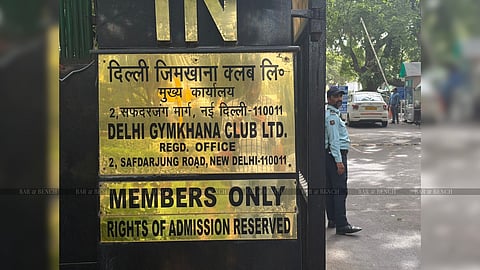
That security has come under increasing strain in recent years, as a broader pattern of eviction notices and re-entry orders has been directed at historic institutions, residential colonies, sporting establishments and cultural centres holding land on similar perpetual or long-term leasehold tenures. A recent notice concerning the Delhi Gymkhana Club is only the most visible instance.
If a perpetual lease of nearly a century’s standing, held with appropriate land use and under active judicial oversight, offers no protection against re-entry, the security of leasehold title across this entire category of property is called into question. This raises a question of considerable legal consequence: under what circumstances and by what process, may the government validly terminate a perpetual lease and resume possession of the demised premises?
This article examines the legal framework governing perpetual leases of such properties in Delhi. In particular, it covers the high threshold that must be satisfied before the State may invoke a “public purpose” clause in a lease deed to exercise its right of re-entry, the circumstances in which such a right may be lawfully triggered, and the procedural safeguards and reasoned justification the law demands before it can be validly invoked.
The use of the phrase “or in perpetuity” in Section 105 of the Transfer of Property Act (TPA) is not incidental. It reflects a deliberate choice to recognise two modes of creating a lease: one bounded by a terminal date and one that is not. A lease in perpetuity is, therefore, as complete and valid a statutory lease as any fixed-term lease. It is constituted by the same essential elements - a transfer of the right to enjoy immoveable property, a lessor, a lessee, a consideration - and is distinguished from a fixed-term lease by one structural feature alone: the absence of a termination date fixed by the passage of time.
To understand the boundaries of a perpetual lease granted by the government, one must turn to the statutory framework of the Government Grants Act, 1895 (GG Act). Under Section 3 of the GG Act, if a perpetual lease is granted by the sovereign, the tenancy is governed exclusively by its explicit covenants and terms. The only lawful mechanism to terminate such a lease is through the enforcement of the provisions, within the instrument itself. Although the government as the lessor continuously retains the absolute ownership and superior reversionary estate in the land, it cannot simply invoke general eviction acts or rent regulations to bypass, substitute, or alter the contractually mandated terms of the lease.
If the lessee violates the terms of the lease deed, the State can re-enter the leasehold property citing the same, if the deed allows for re-entry on such violations. In such cases, however, the State is to follow the due process of law and file a suit, asserting the right of re-entry on such a violation and establish the same.
A different legal challenge arises, however, when a notice of re-entry is predicated not on a contractual breach of the lease deed, but on the exceptional grounds of public purpose and national security.
For instance, in the notice of re entry served to the Gymkhana Club, the government had cited clause 4 of the lease deed, which allows for re-entry if “the demised premises or any part thereof are required for a public purpose”. The public purpose cited was “for the strengthening and securing of Defence infrastructure and other vital public security purposes”. While similar clauses exist in other deeds of a similar nature, the mere invocation of public purpose or national security does not render the executive’s action non-justiciable. Rather, the State remains obligated to provide a reasoned basis establishing what the public purpose entails and how the specific national security implications arise.
In Mohinder Singh Gill v. Chief Election Commissioner, the Supreme Court held the following:
“Public orders, publicly made, in exercise of a statutory authority cannot be construed in the light of explanations subsequently given by the officer making the order of what he meant, or of what was in his mind, or what he intended to do. Public orders made by public authorities are meant to have public effect and are intended to affect the actings and conduct of those to whom they are addressed and must be construed objectively with reference to the language used in the order itself.”
It follows that if the terms of the lease agreement allow for re-entry on the grounds of public purpose, such a clause cannot be used merely as a boilerplate. The notice must provide, with a certain degree of specificity, the nature of the public purpose. Such a notice does not survive on the basis of a subsequent explanation provided by the officer. It has to be a self-contained document.
In Manohar Lal Sharma v. Union of India, the Supreme Court conclusively held that while the judiciary must remain circumspect and respect the executive’s domain, the power of judicial review is neither extinguished nor entirely defeated by claims of national security. Rather than granting the executive absolute deference, the Court established that the invocation of national security places an active burden on the State: it must satisfy the Court that such security concerns genuinely arise out of the concrete facts of the case and that any curtailment of the principles of natural justice is fully justified.
While the State isn’t required to give a detailed explanation regarding the national security concerns being cited for re-entry into the leasehold property, it must establish that the re-entry is due to certain genuine national security reasons.
Disputes over Delhi’s leasehold properties underscore a fundamental constitutional truth: the State is bound by the very laws and agreements it creates. Under Section 3 of the GG Act, 1895, the rights of the parties are governed strictly by the explicit covenants of the lease deed and any attempt by the State to resume possession must strictly adhere to the due process of law. The threshold for invoking a public purpose clause is a demanding one: citation of public purpose for such resumption must be accompanied by explanations regarding the specific nature of that purpose in the notice of re-entry itself. National security cannot be used as a blanket excuse to claim immunity from judicial review. The State must establish that genuine national security concerns are being addressed through re-entry.
These protections are necessary: their absence would allow the State to execute re-entry through vague or unreasoned administrative notices, destabilising the security of leasehold titles across the capital’s institutions and heritage centres. Disputes such as that concerning the Delhi Gymkhana Club are a reminder that this threshold is no mere technicality; it is the safeguard that determines whether a lease held for nearly a century can be undone by a single unreasoned notice.
Yash Madhav Johri leads Johri & Co, prior to which he had the benefit of training in the Chambers of Dr. Abhishek Manu Singhvi and in the disputes and securities litigation team of Cyril Amarchand Mangaldas.
Akashdeep SR is a 5th year law student at NALSAR, Hyderabad.
