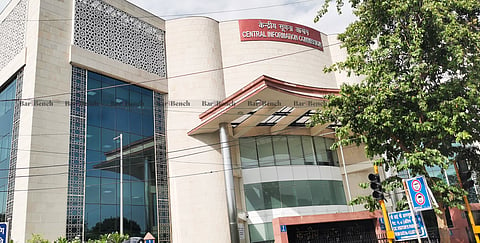

The High Court of Jammu & Kashmir and Ladakh recently observed that while the Right to Information Act, 2005 does not prescribe any timeline for deciding second appeals and complaints, the Central Information Commission (CIC) cannot keep such matters pending for years and must improve its functioning to address the growing backlog [Junaid Javid V/s Union of India].
The observation came from a Division Bench comprising the Acting Chief Justice Sanjeev Kumar and Justice Mohd Yousuf Wani while disposing of a public interest litigation (PIL) petition.
“The Right to Information Act, 2005 does not lay down any timeline for deciding the second appeals and complaints under the Act and, therefore, we cannot, by issuing a mandamus, fix a timeline of 45 days for disposal of the second appeals and complaints by the CIC, as prayed for by the petitioner. However, it cannot be said that the CIC can sit over the appeals for an unduly long period and keep them undecided for years together. The CIC needs to improve its working and put a mechanism in place so as to overcome the pendency of appeals and to tackle the inflow of fresh appeals and complaints”, the High Court observed in its July 1 order.
The PIL petition was filed by a resident of Uri- Baramulla, Junaid Javid, who sought a direction to the CIC to decide all pending second appeals, particularly those filed by residents of Jammu & Kashmir, within 45 days and to evolve a time-bound mechanism for their disposal.
In reply, the CIC submitted that it was unable to adhere to any fixed timeline due to infrastructural constraints and the heavy volume of second appeals and complaints pending before it.
The High Court accepted that the RTI Act does not lay down any statutory timeline for deciding second appeals and complaints and hence, the Court cannot lay down a 45-day deadline as sought by the petitioner.
However, the Bench made it clear that the absence of a statutory timeline does not entitle the CIC to keep appeals pending indefinitely. It observed that the CIC cannot sit over appeals for an unduly long period and leave them undecided for years together.
Hence, it asked the CIC to improve its working by putting in place an effective mechanism to reduce the pendency of appeals and deal with the continuous inflow of fresh second appeals and complaints, subject to its infrastructural constraints.
The Bench also observed that the CIC may consider the suggestions submitted by the petitioner if they are found to be genuine and realistic.
With these observations and directions, the High Court disposed of the PIL.
Advocate Naveed Bukhtiyar appeared for the petitioner.
Deputy Solicitor General TM Shamsi with advocate Rehana Qayoom appeared for the respondents.
[Read Order]