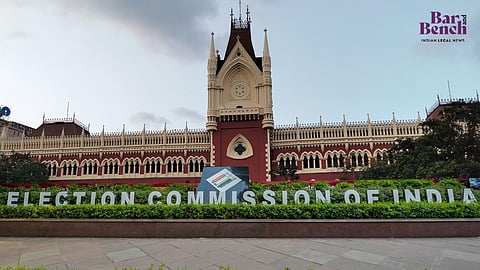
ECI cannot bypass its own rules: Calcutta High Court sets aside appointment of faculty for West Bengal election duty

The EC had previously issued a communication that Group A equivalent officers, including teaching staff, should not be deployed for polling duties unless it is unavoidable.
Election Commission of India with Calcutta High Court
Published on
3 min read

The Calcutta High Court on Friday set aside the Election Commission of India (ECI) order to appoint assistant and associate professors of government colleges as presiding officers for the upcoming West Bengal Assembly elections. [Rupa Banerjee Nee Samjpati v. The Election Commission of India & Ors]

Justice Krishna Rao held that the ECI failed to justify such deployment despite repeated directions. The Court found that the authorities did not place any material to show that appointing college professors to polling booths was unavoidable, as required under existing guidelines.

“This Court finds that the authorities failed to produce any document to show that due to the some unavoidable circumstances, the authorities have taken a decision for appointment of the petitioners as a presiding officer in the polling booth,” noted the Court.

The Court further emphasised that the Commission’s power to appoint officials is not unfettered and must comply with its own circulars requiring recorded reasons in exceptional cases.

“This Court finds that the authorities, without taking any decision, has appointed the petitioners who are working as assistant professor or associate professor in different college of the state of West Bengal as presiding officers in violation of the circular dated February 2010. Accordingly, the appointment of the petitioners as presiding officers in the polling booth are set aside and quashed."

Justice Krishna Rao
Justice Krishna Rao

The Court was hearing a petition challenging the appointment of assistant professors from government colleges as presiding officers for polling booths in the upcoming West Bengal Assembly elections.

When High Court had first considered the matter on April 13, the petitioner relied on an Election Commission communication stating that Group A equivalent officers, including teaching staff, should not be deployed for polling station duties unless unavoidable circumstances are recorded in writing.

The Court had directed the Election Commission to produce records showing such circumstances.

When the case was taken up again on April 16, the Commission failed to place any documents on record to justify the appointments and sought additional time.

The Court had granted a further opportunity, adjourning the matter to Friday while reiterating its direction to disclose the basis for appointing the petitioners as presiding officers.

On Friday, the Court examined whether the Election Commission had complied with its own guideline requiring recorded reasons for appointing Group A equivalent officers like assistant professors to polling duties.

The Court repeatedly asked which circular governs the field and pressed the Commission to show documents justifying “unavoidable circumstances.”

Senior Advocate Soumya Majumdar, appearing for the Commission, argued that a June 7, 2023 circular had superseded earlier instructions. He argued that given the scale of elections across nearly 90,000 booths, strict adherence to rank and pay parity is not always feasible.

It also contended that the petition was filed late and effectively sought a change in assigned duties.

On the other hand, Senior Advocate Bikash Ranjan Bhattacharya, counsel for the petitioners, maintained that the issue was primarily procedural. He argued that the Election Commission was bound to record specific reasons before deploying Group A equivalent officers like assistant professors to polling booths.

Additionally, he also pointed to instances where lower-ranked staff such as typists and stenographers were appointed as sector officers, while professors were assigned as presiding officers.

He noted that the Commission had failed to properly consider rank, status and pay as required under its own guidelines.

At that stage, the Court questioned the impact of judicial intervention on the electoral process, asking,

“What will happen to the election, Mr. Bhattacharya, if any order is passed?”

Responding to concerns about disruption, Bhattacharya argued,

“No difficulty, my lord, there are huge officers in the reserve pool. The Election Commission, my lord, never recruits the officers, my lord, only with one individual. They have a huge reserve pool. The election is not going to be affected, these are all imaginary apprehensions raised by the persons responsible for conducting it.”

However, the Court carved out a limited exception for those who had already undergone training and were willing to serve.

“This order will not affect the members of the society (professors) who have already undergone training in terms of the order issued by the Election Commission,” directed the Court.

The Court further clarified that the Election Commission remains free to assign duties to the petitioners in roles commensurate with their rank, pay and status, in line with applicable guidelines.

Advocates Shamim Ahmed, Srijib Chakraborty, Subhasis Chakraborty, Aditya Mondal and Sushmita Kumari Singh also represented the petitioners.

Advocates Shamim Ahmed, Ambiya Khatun, Md Nasirul Haque, Reshma Khatun, Subnam Mostari and Huma Shakil appeared for the appellant.

Advocate Anamika Pandey also appeared on behalf of the Election Commission.

Bar and Bench - Indian Legal news
www.barandbench.com