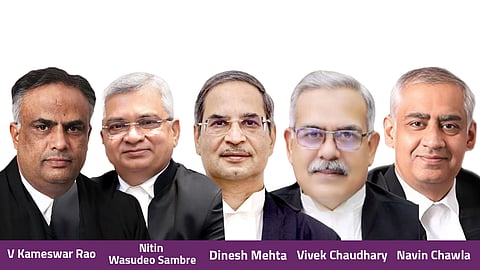
The Delhi High Court's recent recommendation to raise the pecuniary jurisdiction of district courts in the national capital to ₹10 crores had caused mayhem with the High Court bar opposing the recommendation tooth and nail..After three days of work suspension by the Delhi High Court Bar Association (DHCBA), the Union Law Minister and Delhi High Court Chief Justice Devendra Kumar Upadhyaya on July 16 assured them that the issue would be looked into.The bar then called off their strike.However, the issue is far from over with a fresh decision yet to be taken. Bar and Bench has now accessed the judges' committee report of June 3 which led to the recommendation to raise the pecuniary jurisdiction in the first place and triggered the strike by the bar.The six-member committee's recommendation to increase the pecuniary jurisdiction was not unanimous.While five of the six judges - Justices V Kameswar Rao, Nitin Wasudeo Sambre, Dinesh Mehta, Vivek Chaudhary, and Navin Chawla - batted for raising the pecuniary jurisdiction of district courts, Justice Prathiba M Singh recorded a separate opinion differing with the majority.The majority cited rising litigation values due to inflation, expansion in judicial capacity, case disposal rates, and the need to bring justice closer to litigants to recommend increasing the pecuniary jurisdiction of district courts to ₹10 crores. While the majority recommended raising the pecuniary jurisdiction of the district courts to ₹10 crore, Justice Singh favoured increasing it to ₹5 crore.She also proposed several other reforms..Below are findings and recommendations made by the majority:.DHCBA, APAA and IPAA objections overruled.In its report, the five-judge majority rejected the objections raised by DHCBA, the Asian Patent Attorneys Association and the Intellectual Property Attorneys’ Association (IPAA) against its formation.It noted that the committee was constituted after the full court authorised the Chief Justice on September 2, 2025 to examine a representation received from the coordination committee of the district court bar associations.The committee concluded that the High Court has supervisory jurisdiction over district courts and is therefore, a key stakeholder in any revision of pecuniary limits..11 years since last increase in pecuniary jurisdiction and inflation.The committee observed that enhancement of pecuniary jurisdiction has historically been undertaken after considering case pendency, disposal rates and judicial strength, and that similar exercises were carried out in 2000, 2012 and 2015.It reasoned that the last enhancement was carried out 11 years ago and since then, inflation has increased many times. "Owing to inflation and rise in the cost of immovable properties, the valuation of suits has increased. Quantity as well as quality of litigation has also undergone a change, resulting in an increase, both in numbers and in value of cases," the judges said. .Expanding strength at district courts.According to the report, the strength of the Delhi Higher Judicial Service (DHJS) rose from 276 officers in 2015 to 468 in 2026 and is expected to increase further. It also highlighted that as of December 31, 2025, district courts were handling substantially larger volumes of civil and commercial cases while the High Court's original side has only seven judges dealing with ordinary civil suits, commercial disputes, intellectual property matters, arbitration petitions and testamentary cases..Higher disposal rate at district courts.The majority opinion also underlined the higher disposal rate and low pendency in district courts. “Similarly, as on 31.12.2025, the pendency of cases in the cadre of Delhi Judicial Service (DJS) (including CJ/SrCJ/ACJ/JSCC/ARC) exclusively dealing with civil cases was approximately 59,158 with average pendency of 883 with a disposal rate of 37%. In the High Court, the pendency of civil cases (as on 31.12.2025) was approximately 8,595 with a disposal rate of 29.88%. The pendency of commercial cases was approximately 9,982 with a disposal rate of 27.41%. Therefore, average pendency before a learned Single Judge on the original side of the High Court was approximately 3,096,” the report said. .Recommendations.The committee recommended increasing the pecuniary jurisdiction of Delhi's district courts from ₹2 crore to ₹10 crore and raising the jurisdiction of civil judges to ₹25 lakh, citing inflation over the past 11 years, the rising cost of living and the need to provide "justice at the doorstep." It declined to express any view on whether commercial matters pending before the High Court should be transferred to district courts, stating that the issue must be dealt with as per law. "It may be clarified, the recommendations i n this report, enhancing the pecuniary jurisdiction o f the District Courts, shall have no bearing/effect, on petitions which are required to be maintained in the High Court as per law," the report said. The judges also recommended constituting designated district courts to exclusively hear intellectual property disputes and adopting or framing rules based on the Delhi High Court IPD Rules, 2022, to ensure consistency in adjudication.