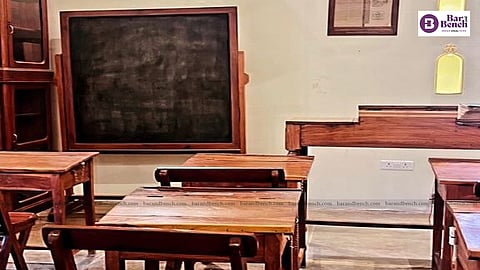
Classroom (for representation only)

Failure of public education system led to mushrooming of private schools: Jammu & Kashmir High Court

The Court added that while the government must ensure that private schools do not engage in profiteering, it must also work to strengthen such schools instead of unnecessarily interfering in their functioning.
Published on

The High Court of Jammu and Kashmir and Ladakh recently observed that the failure of the public education system is largely responsible for the mushrooming of private schools in the country [New Convent High School, Gogji Bagh Srinagar v. Union of India].
A Division Bench comprising Justice Sanjeev Kumar and Justice Sanjay Parihar made the observation in a case raising concerns about the extent to which the government may regulate the fees charged by private schools.

"The mushroom growth of private schools in Jammu and Kashmir, like in many States, is largely as a result of the failure of the public school education system. ... The compulsion of citizens to go to private schools is not created by private schools but is the doing of the Government, which has failed to deliver through its public education system," the Court said.

Justice Sanjeev Kumar and Justice Sanjay Parihar
The compulsion of citizens to go to private schools is not created by private schools but is the doing of the Government, which has failed to deliver through its public education system
Jammu and Kashmir High Court

The Court went on to observe that while the government may have made sincere efforts to revamp public schools, such measures have not been very effective.

We also cannot remain oblivious of the fact that the public education system in the Union Territory has virtually collapsed and, in any case, is not coming up to the expectations of the citizens. Even the poorest of the poor longs to send his children to private schools with the hope that they would get better education which may help them come out of poverty. There may be some sincere efforts made by the Government to revamp the public education system, but such efforts are not showing any visible results on the ground," it said.

The Court held that it is time to acknowledge the reality that private education, which was originally intended to supplement government schooling, is now on the verge of supplanting it.

It added that while the government must ensure that private schools do not engage in undue profiteering, it is high time that the government works to strengthen such schools instead of unnecessarily interfering in their functioning.

"It is thus high time that the Government should change its mindset and promote and strengthen private schools, by forbearing from interfering or causing unnecessary interference in their functioning," it said.

The Court also clarified that it is not suggesting that the growth of private schools should be prioritised over public schools.

We are not suggesting, even for a moment, that privatisation of education should be done at the cost of public education. Both public and private education systems are necessary to meet the diverse educational needs of a country like India … There is ... a dire need to invest in the public education system and to ensure that the quality of education and infrastructure provided in Government schools matches with the schools in the private sector," it said.

The High Court passed the ruling on a writ petition by seven unaided private schools, challenging amendments introduced by the Central government to the J&K School Education Act, 2002, through orders issued in 2020 and 2022, which led to the insertion of Sections 20A to 20J, and the constitution of the Fee Fixation and Regulation Committee (FFRC).

The petitioners also assailed the Jammu and Kashmir Private Schools (Fixation, Determination and Regulation of Fee) Rules, 2022, as well as specific orders of the FFRC regulating tuition and transport fees. They contended that the regulatory framework violated the law laid down by the Supreme Court in TMA Pai Foundation and subsequent judgments.

A major grievance raised by the petitioners was the arbitrary manner in which the FFRC functioned. They alleged that in some cases, schools were asked to submit proposed fee structures for approval, while in other cases, the committee unilaterally fixed fees without calling for any proposal.

It was further contended that the FFRC determined fees without conducting mandatory physical verification of relevant factors such as location, infrastructure, staff strength, administrative expenditure and facilities.

The petitioners also challenged Section 20A(2) of the Act, which permitted the appointment of a retired Financial Commissioner or senior government officer as Chairperson of the FFRC.

They argued that this was directly contrary to the Supreme Court's directions in the case of Islamic Academy of Education and Modern School, which mandate that such fee-regulating committees must be headed by a retired High Court judge.

In its January 28 ruling, the High Court reiterated that running private schools is an occupation protected under Article 19(1)(g) of the Constitution, and cannot be treated as a purely charitable activity, since such schools involve substantial investment of money, time and labour.

It, therefore, opined that private schools are permitted to try and generate reasonable profits, provided there is no commercialization or undue profiteering in school education.

The Bench concluded that regulations to prevent commercialization and profiteering are valid, and upheld the validity of Sections 20A to 20J of the Act of 2002 and the Fee Rules of 2022. The Court ruled that the statutory framework provides sufficient guidance to the FFRC to determine whether a school is indulging in undue profiteering.

However, the Court cautioned that the FFRC should not subject every private school to exhaustive scrutiny and must adopt a rational approach by focusing on large institutions in urban areas or cases where specific complaints are received.

"The FFRC needs to devise some rational mode to pick up only a few cases, particularly pertaining to big educational institutions established in urban areas, for in-depth scrutiny to determine whether such schools are indulging in commercialisation and profiteering of education. The other schools could be those where the FFRC receives specific complaints ... It is only where the conscience of the FFRC is shocked by the nature and magnitude of the fee proposed that it should interfere; otherwise, it should ordinarily accept the fee structure," the judgment said.

The High Court further held that the provision permitting a retired Financial Commissioner or senior government officer to act as Chairperson of the FFRC was contrary to the mandate of the Supreme Court.

Striking down this part of Section 20A(2), the Court directed that the FFRC must be headed only by a retired High Court judge nominated by the Chief Justice of the High Court of Jammu and Kashmir and Ladakh.

The Court also addressed contentions about the manner in which the FFRC was proposing to regulate the transport fees charged by private schools. The Court noted that providing transport facilities is not a mandatory requirement for private schools and that transport charges should ordinarily not form part of school fees.

However, acknowledging that the statute includes transport fees within the definition of “fee”, the Court directed the FFRC to constitute a committee involving the Transport and Consumer Affairs Departments to frame broad guidelines for the fixation and periodic revision of transport charges.

Notably, the High Court has also urged the government of Jammu and Kashmir to revisit the Fee Fixation Regulations, 2022, and lay down clearer parameters to ensure a uniform yardstick for fee determination.

Senior Advocate NA Beigh, with Advocate Murshid Rashid, appeared for the petitioners.

Deputy Solicitor General of India (DSGI) TM Shamsi, with Advocate Shagufta Maqbool, appeared for the Central government.

Senior Additional Advocate General Mohsin Qadri, with Advocates Maha Majeed and Mohd Younis Hafiz, appeared for the Jammu and Kashmir administration.

[Read Judgment]

Attachment
PDF
New Convent High School, Gogji Bagh Srinagar v. Union of India
Preview
Bar and Bench - Indian Legal news
www.barandbench.com