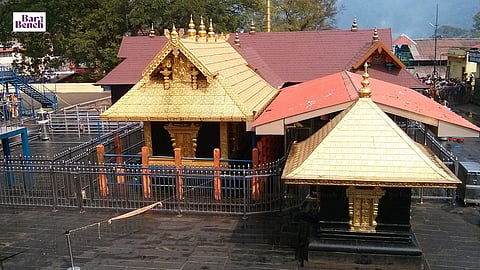
Freedom of religion under Article 25(1) of the Constitution cannot be violated in the name of social reform, the Supreme Court remarked on Tuesday while hearing the Sabarimala reference case concerning religious rights. .The remark was made by Justice BV Nagarathna in response to an argument by Kerala government counsel that essential aspects of religion cannot be done away with in the name of social reforms. "Essential part of Hindu religion is right to worship an idol. If you exclude them from it, you exclude them from practicing religion," Senior Advocate Jaideep Gupta, appearing for Kerala government, said."In the name of social reform, you cannot breach or violate the freedom granted under Article 25(1)," Justice Nagarathna concurred."You cannot hollow out religion entirely, but if it needs change and if done somebody cannot use 25(1) against it," Gupta added.The matter is being heard by a Bench of Chief Justice of India (CJI) Surya Kant along with Justices BV Nagarathna, MM Sundresh, Ahsanuddin Amanullah, Aravind Kumar, Augustine George Masih, Prasanna B Varale, R Mahadevan and Joymalya Bagchi The case concerns seven larger legal questions on the scope of religious freedoms in India..The matter is connected to the Supreme Court's 2018 verdict allowing women of all ages to enter the Sabarimala temple in Kerala. This judgement overturned a custom restricting the entry of women of menstruating age to the hilltop shrine.In November 2019, the Supreme Court pronounced its judgment on the review petitions against the 2018 verdict but did not decide the matter one way or the other.Rather, the Court framed seven larger questions touching about religious freedoms in India for consideration by a larger bench of the Court.These included deciding on the interplay between Articles 25 (freedom of conscience and religion) and 26 (freedom to manage religious affairs) on the one hand and the right to equality under Article 14 of the Constitution.The nine-judge bench is now examining these questions. .Hearing today.Senior Advocate Jaideep Gupta, appearing for State of Kerala, sought to explain how courts should deal with 'religious practice' and 'secular activity' associated with religion."The conflict here is between what constitutes a religious practice and what constitutes a secular activity associated with religion. That distinction itself is not expressly articulated in constitutional language as “religious practice versus secular activity,” but it emerges from the interpretation of Article 25. At one point, Your Lordships had asked whether there exists any test to distinguish the two. The only judgment which directly addresses such a test is Ratilal. That judgment says that ultimately common sense will have to be applied. Now, that may not provide a complete answer, but it is the only guidance available on how one determines whether something is secular or religious," he argued. He said that the Court should evolve a basic test though it need not be an exhaustive test."At that stage, much depends on where the balance is drawn. A person deeply rooted in scriptural traditions may draw the balance more toward the religious side. On the other hand, someone approaching the issue purely from a constitutional perspective may draw the balance more toward secularism. Therefore, ultimately, this becomes a matter for judicial determination. I am not suggesting that Your Lordships should formulate an exhaustive test. It may well be left to courts to determine on a case to case basis in appropriate matters," Gupta submitted..Gupta said that the Constitution's Article 25(2)(b) makes it clear that steps taken for social reforms will not amount to trespass on religious rights."Now, as far as social welfare and reform are concerned, I only wish to make one submission. Why are these concepts located within the constitutional provisions dealing with religion at all? If the issue were merely social, then there would be no reason for it to appear within the Articles on religious freedom. The reason, I respectfully submit, is that many social rules and practices historically came to be sanctified as religious customs. Therefore, if the State wishes to undertake social reform, it may inevitably have to engage with religion itself. That is why the Constitution expressly grants that power to the State. And this is important - this is not judicial review in the strict sense. This is not about the Court itself deciding matters of reform. It is about the State making that determination through legislation. The Constitution itself creates a separate compartment for such legislative intervention, thereby making it clear that when the State acts for social welfare and reform under Article 25(2)(b), it is not necessarily trespassing upon protected religious rights," he said..However, he made it clear that an essential aspect of religion cannot be excluded or done away with in the name of social reforms..He also said that religious denomination and 'sampradaya' are the same for Constitutional purpose."According to you, denomination and sampradaya are effectively the same thing for constitutional purposes?" the Bench asked. "For the purposes of the Constitution, yes. In another context or document, it may mean something else altogether. Now, if that is the position, then what exists is a group of individuals who are given certain rights. Take Shirur Mutt. There was never any serious dispute there as to whether it was a religious denomination. Why? Because they were disciples of Madhavacharya, and within that, a subgroup of Shivalli Brahmins. The Court looked at the definition and said this obviously falls within the concept of a denomination. It was not something requiring extensive adjudication. But later cases did raise difficult questions, and the Court continued with this broad classification. The sum and substance of the later judgments is that on one side were institutions like mutts, organised around a religious leader, disciples and a body of doctrine, often traceable to texts and teachings. On the other side were general Hindu temples where no particular body of precepts or identifiable sectarian doctrine existed. Take the Ramakrishna Mission. It is a religious denomination. It was founded by Swami Vivekananda and fellow disciples of Ramakrishna Paramahamsa. Ramakrishna himself was not part of the Mission. He was a priest at a Kali temple. His teachings later became the foundation around which followers organised themselves into a denomination," Gupta argued..In the name of social reform, you cannot breach or violate the freedom granted under Article 25(1).Justice BV Nagarathna.The Bench said that the word 'denomination' used in the Constitution should not be interpreted too rigidly."Certainly, My Lord. We have no difficulty with flexibility. But what we respectfully oppose is equating denomination entirely with religion itself," Gupta replied."No, you are right. Use it flexibly, but not as synonymous with the whole religion," Justice Aravind Kumar concurred. "Exactly, My Lord. My respectful submission is that these denominations were historically seen as sectarian streams or organised paths distinct to some extent from the mainstream. That is perhaps why constitutional protection was thought necessary. This is ultimately a concept the Court is still trying to discover and define. It is not easy. Even linguistically, the Constitution in Hindi distinguishes between Dharma for religion and Dharmik Sampradaya for denomination. They are not the same thing. Before I conclude, three brief points. First, mere bona fide belief cannot by itself create a religious denomination. Second, one must first identify the denomination and only then identify a section thereof. Not the other way around. Third, there can be no non religious denomination under Article 26," Gupta said in conclusion.Senior Advocate Vijay Hansaria contended that a law enacted for social reform under Article 25(2) of the Constitution will override the religious rights under Articles 25(1) and 26. Hence, such challenge to such a law cannot succeed before a court."My submission is that the State can make a law which may even trench upon what is otherwise protected under Article 25(1). And if Article 26 is merely a manifestation of Article 25(1), then such a law can also operate notwithstanding Article 26. A law under Article 25(2) will therefore override protections flowing from Article 25(1) and Article 26. That is my respectful submission. Such legislation may be enacted either for social welfare and reform or for throwing open Hindu religious institutions of a public character to all sections and classes. If such a law is challenged on the ground that it violates Article 26, that challenge cannot succeed because Article 26 is controlled by Article 25(2)," Hansaria contended..Senior Advocate Sanjay Hegde, appearing on behalf of rationalist Dr. Amitabh Dabholkar and Jagad of the Maharashtra Andhashraddha Nirmulan Samiti, highlighted how rationalist Dr. Narendra Dabholkar, was assassinated in 2013."That was followed by the murders of Comrade Govind Pansare, Professor Kalburgi and Gauri Lankesh. It is our respectful submission that there are several accretions to religion, all claiming religious sanction, which have been exploited and which ought not receive the protective cover of religion," he said.He then proceeded to highlight how rationalist principle is also relevant to the Constitutional history."This rationalist principle is also relevant to the constitutional history and to the history behind these provisions themselves. Because the Constitution was forged in a particular historical moment. We are a deeply religious and ritualistic country. But our Constitution was written not merely against the backdrop of a struggle against imperialism. It was also forged amidst a social struggle within Indian society itself,"He then proceeded to highlight Vaikom Satyagraha that happened in Kerala in 1925 which ultimately led to the opening up of temples to all castes."Today, we are almost at the 101st anniversary of where this story truly begins in Kerala, not with Sabarimala, but with the Vaikom Satyagraha of 1925. At Vaikom, not only were certain people prohibited from entering the temple, even the roads surrounding the temple were inaccessible to the depressed classes and to several other castes. The satyagraha against this was supported by Mahatma Gandhi. Among those who participated in it was Periyar. And Periyar later went on to say that there is no God," Hegde said..He then explained the rights that a denomination has under the Constitution."Denominational rights are ultimately collective rights. A denomination does not necessarily have to be a juristic entity. No greater right is conferred upon it beyond what is collectively possessed by the individuals who constitute it. That is why Article 25 itself says that the right is subject to the other provisions of Part III. Individuals then come together, congregate and form a denomination. What additional rights do they obtain? The right to establish and maintain institutions for religious purposes, to own and acquire property, to administer such property in accordance with law, and to manage their own affairs in matters of religion. Now, against whom are these denominational rights asserted? Not merely against the outside world. They may also be asserted against the orthodoxy within one’s own religion," Hegde argued.He cited an example to buttress his argument."If I may illustrate, without meaning any disrespect, suppose the orthodox position within a religion is that there is only one God and one Prophet. But a denomination emerges saying yes, there is God and there is the Prophet, but there is also a subsequent prophet. Then that denomination may claim the right to manage its own affairs in matters of religion against the orthodoxy of the parent faith itself. That, perhaps, is one possible way of understanding denominational rights," he submitted..He maintained that while denomination has rights, it cannot override the rights available to others who do not belong to the denomination."That is why this Court attempted a harmonisation. The Court said that where the denominational right does not completely extinguish the right of entry of others, then limited exclusivity may be permitted. Suppose the Gowda Saraswat Brahmins of Mulki were to say that despite the temple now being a public temple, only members of their own sect may worship within the temple courtyard and everyone else must remain outside, then would that not clearly violate the Constitution? My respectful submission is that in such a case, the principle of temple entry must prevail fully," Hegde contended.He then cited various legends/ lores of people from lower caste being denied entry to temples and how the Lord/ deity itself appeared "God does not discriminate, man does," Hegde stated."The common factor in all the examples you have cited is that they were all great devotees. The Lord appeared to them because of their devotion," Justice Nagarathna stated."Indeed, My Lords. That is the quality of a believer. But the Lord does not turn away any believer, or even someone with only partial belief, so long as the person comes respectfully. It is not the province of man to push away anyone who comes with respect, or even without belief. Belief itself may come later," Hegde replied..Senior Advocate Menaka Guruswamy, appearing for Swami Agnivesh, recounted her early days as a lawyer when she started off as a junior to then Attorney General Ashok Desai."When I first entered these courtrooms, I used to come around 9:30 am or 9:45 am in the morning. The Attorney General’s office was upstairs. We would have conferences. And before court began, I would walk from courtroom to courtroom, excited simply to be inside the Supreme Court. I looked at the walls, and I saw not one woman. That is why the issue Your Lordships are dealing with today is so important in constitutional law, because exclusion takes many forms and operates in many ways, including at the highest institutions of justice. So it is my hope," she said."You know, it is a strange thing. Depending on whether you succeed, perhaps after some years people may come here and say - where are the men?" the Bench said."My Lords, perhaps one day we will have a nine judge Bench entirely of women. My Lady knows that Justice Ruth Bader Ginsburg in the United States was once asked - 'how many women judges are enough'? And she answered - 'when all nine are women'," Guruswamy said. "One Supreme Court Bench once said that we do not want to see women only in portraits. We want to see them alive before us," the Court remarked. "And that is precisely the point, My Lords. It is my hope that when Justice Nagarathna becomes Chief Justice, we will finally have that first portrait on these walls. And may I also add that it would only be fitting if Ms. Indira Jaising’s portrait were also placed here, because she has defended the Constitution throughout her career," Guruswamy added..She then proceeded to advance four arguments."The first proposition is this: the Constitution envisages the reform of Hinduism, and Hinduism itself has confidently accommodated such reforms. That, in fact, reflects the confidence of the religion itself, that it has engaged with and accommodated reform over time. The second proposition concerns the language of Article 26. Your Lordships will notice that the Constitution uses the word “manage” and not “control.” This distinction has not been advanced before. The use of the word “manage” in Article 26, instead of “control,” reflects the constitutional intent to harmonise denominational rights with the individual freedoms protected under Article 25. I will demonstrate this through constitutional references showing where the Constitution uses the language of “control” and where it uses “manage” or “management,” and how these expressions signify very different zones of power. "You are trying to juxtapose control with management . They are completely different. Control is with regard to institution create A cooperative society has a managing committee. Here you establish an org and you manage it. Here control is with regard to body created and then managing it," Justice Amanullah said."When you control an institution, when you control a body corporate, when you control a corporate society, there are many things that you do in addition to what you do when you merely manage. Those additional elements include coming together through articles of association, putting in place rules, putting in place an institutional framework. Here, the degree of autonomy is of a lesser nature. That is the only point I am trying to make. The point is simply this: management under Article 26 reflects a lesser degree of autonomy than control. Judicial Precedents have to be harmonised. Therefore, Articles 25 and 26 must also be harmonised in situations of possible constitutional conflict," Guruswamy replied.Fourthly, the test of proportionality. The test of proportionality ought to be employed in resolving conflicts between individual rights and group rights, as well as competing claims inter se. Morality under Articles 25 and 26 is ultimately an extension of the core constitutional values. Whatever terminology we may use, constitutional morality, constitutional ethos, or otherwise, what is really being referred to are the foundational values of the Constitution itself," she said..She argued that the words “sections of Hindus” in Article 25(2)(b) of the Constitution include women of all age groups within Hinduism and the same is not limited to addressing caste discrimination alone."Even before Articles 25 and 26, Your Lordships may see Articles 15(2), 15(3) and 15(4). Article 15 prohibits discrimination on grounds of religion, race, caste, sex or place of birth. Article 15(2)(b) specifically refers to wells, tanks, bathing ghats, roads and places of public resort maintained wholly or partly out of State funds or dedicated to public use. These provisions exist because caste exclusion historically operated in precisely these spaces. Then please see Articles 15(3) and 15(4), which permit special provisions for women, children, socially and educationally backward classes, Scheduled Castes and Scheduled Tribes. The Constitution therefore deliberately wades deeply into accumulated structures of discrimination that existed in Indian society for centuries," Guruswamy said.A restrictive interpretation of the phrase “section of Hindus” would effectively wipe out the rights of Hindu women to practice their religious beliefs and customs, she emphasised."This becomes particularly problematic when the right of a denomination to manage its religious affairs does not include a right to deny temple entry to any section or class of Hindus," she said..She further said that the Constitution makers never intended to be a new nation without faith. "It was intended to be a faith which was open and inclusive to all," it was submitted..Senior Advocate Shadan Farasat, appearing for two professors, said that Constitutional morality cannot be excluded while interpreting the Constitution."The question is whether the word “morality” in Articles 25 and 26 is meant to include constitutional morality. The framing is conscious. It does not ask whether morality means constitutional morality exclusively. My submission is that it includes both....The Preamble begins with the words “We, the people of India,” and then speaks of justice, liberty, equality and fraternity, and finally says “give to ourselves.” Therefore, if these constitutional values are values which the people of India have given to themselves, they cannot simultaneously be excluded from public morality. They are necessarily also part of public morality," Farasat said.He then proceeded to rely on a survey report as per which more than 50 percent Indians were against inter-caste marriage and more than 60 percent were against inter-religious marriages."I have referred to a 2025 survey which states that more than 50 percent of Indians are against inter caste marriages and more than 60 percent are against inter religious marriages. If that is taken to represent public morality in 2025, Your Lordships would still not enforce it," Farasat said."Such surveys are themselves problematic. Everybody knows how these are tailored and constructed," the CJI responded."May I say this, Your Lordships may ignore the survey entirely for the moment. Let us assume what Your Lordships are saying. But Your Lordships would still agree with me on this much - that at a given point in time, the prejudices prevailing within society may in fact be held by the majority. That is possible. It has happened historically," Farasat said. The CJI said that such surveys are often tailored to suit a particular agenda."But one must be careful in relying upon such material. These are often produced with a particular agenda in the guise of academic work. One should not place excessive reliance on them," the CJI responded..Surveys are often produced with a particular agenda in the guise of academic work. One should not place excessive reliance on them.CJI Surya Kant."Every individual has a right to marry whom he or she chooses. Why should prejudice matter?" Justice Nagarathna asked."Precisely, My Lords. I am saying that society itself may often be driven by prejudice," Farasat replied."No, but even these surveys depend entirely on whom you ask. If you survey parents and grandparents, you may get one result. If you survey younger people of marriageable age, you may get a completely different result," CJI Kant said. "And that is exactly my point, My Lords. It depends on the selective class chosen for the survey. That is why Your Lordships are rightly cautious about relying upon such surveys. But the broader point remains that public attitudes themselves evolve and change over time," Farasat replied..Advocate Shraddha Deshmukh contended that the Constitution framers had debated extensively on the interplay between religion and personal laws and refused to give absolute immunity to personal laws."The interplay between religion and personal law was explicitly debated in the Constituent Assembly and the framers consciously refused to give personal laws absolute immunity. They recognised the power of the State to regulate personal laws. Then under Article 26 there is the right of a denomination to administer property subject to law. And under Article 325, no person can be excluded from the electoral roll only on grounds of religion. These are all examples of secular aspects connected with religion where the Constitution nevertheless preserves regulatory power with the State," Deshmukh said.On the essential religious practices test, she contended that the test itself has undergone changes over the years and evolved with time."In Shirur Mutt, the Court said religion enjoys autonomy. In Haji Ali, the test became one of optional versus obligatory practice. In Dargah Committee, the inquiry shifted to whether something was essential and integral as opposed to mere superstition. In Acharya Jagdishwarananda, antiquity became relevant. Then in Shayara Bano, the inquiry became whether removing the practice would alter the essential character of the religion itself. So over the last seventy three years, the ERP doctrine has undergone a remarkable evolution and there has never been one standard formula. Therefore, the ERP test is not a straitjacket formula. But there is another difficulty. If today we are to enter into an exercise of determining what is essential and what is not essential, then one must remember that even practices such as sati may once have been defended as essential practices. Yet they were abolished because they violated other guarantees contained in Part III of the Constitution," it was argued."Sati, it was a social practice," Justice Nagarathna said."My Lords, I bow down to that. And under Article 25(2)(b), we are also revisiting such practices. Therefore, my respectful submission is that whenever the Court examines essential religious practices, the inquiry must necessarily be informed by constitutional morality, which in essence means the fundamental values embedded in the Constitution itself," Deshmukh responded. "Very well articulated and argued," CJI Kant said.The hearing will continue on Wednesday..[Read Live Coverage]