

Industrialist Gautam Adani has told a United States (US) court that he is not aware of any quid pro quo for the US Department of Justice's (DoJ) decision to drop criminal charges against him and seven others in the alleged $250 million bribery case [USA Vs Gautam Adani].
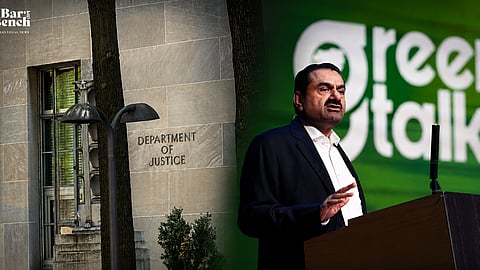
In an affidavit filed on July 15 before the United States District Court for the Eastern District of New York, Adani stated that he has no knowledge of anything promised, offered, sought, received, agreed to or accepted by anyone in connection with the DOJ's proposal to withdraw the indictment against him.
He is also unaware of any agreement exchanging anything for the dismissal of the indictment, the affidavit said.
The affidavit also categorically denied Adani's pledge to invest $10 billion in USA as the ground for dropping the criminal charges against him.
The affidavit was filed in response to Judge Nicholas G Garaufis' July 8 order, directing Adani to disclose whether anything was promised or exchanged for the United States government’s decision to seek the dismissal of the bribery case.
The Court had asked Adani to answer the following two questions:
- Are you aware of anything promised, offered, sought, received, agreed to, or accepted, by anyone, in connection with the dismissal of the Indictment?
- Are you aware of any agreement exchanging anything for the dismissal of the Indictment?
A large part of the affidavit deals with Adani's November 2024 social media post pledging a $10 billion investment in US energy, security and infrastructure projects. The Court's July 8 order had flagged press reports suggesting this pledge may have been linked to the dismissal.
Adani clarified that when he made the post on X, the indictment and the SEC complaint had not yet been unsealed, and he was unaware of their existence at the time.
The affidavit further stated that earlier this year, Adani's counsel Sullivan & Cromwell LLP held meetings with the DOJ and the Securities and Exchange Commission (SEC) as part of settlement discussions, during which his counsel suggested that the $10 billion investment pledge could potentially form part of a resolution, if that was something the DOJ or SEC wanted.
However, the DOJ later informed his counsel that it would not consider the potential investment in deciding whether to seek dismissal of the indictment, Adani said in the affidavit.
He added that, to his knowledge, the Adani Group's interest in investing in the United States had no role in the DOJ's decision.
The affidavit and July 8 order came after Principal Associate Deputy Attorney General R Trent McCotter responded to the Court’s direction to explain why the United States Department of Justice (DOJ) wanted all charges against Adani dismissed with prejudice.
McCotter said he was the “final and sole decision maker” behind the request, rejected reports suggesting that the decision was linked to a promise by the Adani to invest in the United States.
However, the Court said the response raised, for the first time, the possibility of an arrangement involving one or more defendants that had neither been recorded nor previously disclosed to it.
“In other words, Mr. McCotter’s response to the court’s June 26, 2026 Memorandum & Order raises, for the first time, the specter of a possible agreement (involving one or multiple Defendants) in connection with the dismissal of the Indictment that has neither been memorialized nor previously brought to the attention of this court,” the order stated.
By way of background, the indictment by the US government had alleged that Gautam Adani, Sagar Adani, Vneet Jaain, Ranjit Gupta and others devised a plan to bribe Indian state government officials to get the project going. It was alleged that bribes worth ₹2,029 crore (around $265 million) were promised to officials of state electricity distribution companies. Of this, ₹1,750 crore was allegedly allocated to officials in Andhra Pradesh to secure purchase of 7 gigawatts of solar power.
The United States DOJ later sought to drop the indictment and moved the Court seeking dismissal of the indictment against all eight accused.
However, judge Nicholas G Garaufis on June 25 refused to immediately allow the request by DOJ to drop the charges and instead asked it to give reasons for its decision to seek dismissal of the indictment.
The DOJ then filed a response on July 4 in which it described the prosecution against Adani as a “name and shame” indictment unsealed during the final days of the Biden administration without any realistic prospect of a trial.
It argued that the case was overwhelmingly foreign in character, since it concerned Indian nationals allegedly offering bribes to other Indian nationals for Indian electricity contract.
In his July 8 order, Judge Garaufis said that while considering a motion under Rule 48(a) of the Federal Rules of Criminal Procedure, a court must satisfy itself that the reasons advanced by the government are substantial and represent the real grounds for seeking dismissal.
Since the Court did not find that any undisclosed agreement existed, it now sought Adani’s affidavit to satisfy itself on this aspect before deciding the government’s application to dismiss the indictment.
Gautam Adani, Sagar Adani and Vneet Jaain were represented in the proceedings by Sullivan & Cromwell LLP co-chair Robert J Giuffra Jr and partner James McDonald. Incidentally, Robert Giuffra happens to be US President Donald Trump’s personal lawyer.
The other lawyers who represented Adani are Timothy Sini (Nixon Peabody) and Andrey Spektor (Norton Rose Fulbright).
Ranjit Gupta was represented by Paul Schoeman of HSF Kramer (New York).
Cyril Cabanes was represented by Stephen Best from Brown Rudnick (Washington, DC).
Saurabh Agarwal was represented by Winston Paes of Debevoise & Plimpton (New York).
Deepak Malhotra was represented by Aditya Singh (Singapore) and Michael Kendall (Boston) of White & Case.
Rupesh Agarwal was represented by Iris Bennett and Patrick Linehan of Steptoe (Washington, DC).