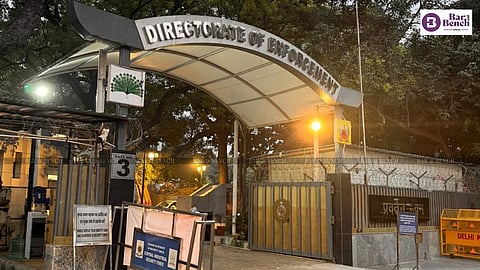

The Delhi High Court has come down heavily on the Enforcement Directorate (ED) for the manner in which it tried to sustain a money laundering case after the First Information Report (FIR) forming the basis of its Enforcement Case Information Report (ECIR) was closed by a court [Kanchana Rai v Directorate of Enforcement + connected matters].
ED was investigating money laundering allegations against certain family members of late Rajya Sabha MP Dr. Mahendra Prasad, the founder of Aristo Pharmaceuticals, whose net worth is estimated to be over ₹4,000 crores. His family is now engaged in a bitter dispute over the control of his assets.
In a judgment delivered on August 18, Justice Anish Dayal noted that the ED had added a 2019 FIR to the ECIR through an addendum in August 2025, despite being aware of its existence since at least 2023.
The addendum was issued only after a Delhi magistrate court accepted the Economic Offences Wing’s (EOW) cancellation report in June 2025 and closed the 2021 FIR on which the ED’s case was originally based.
Justice Dayal underscored that the ED’s conduct in the case “raises serious concerns” and that the agency was, in effect, “seeking to breathe life into a proceeding which had lost its foundational basis”.
“The conduct of the ED in this regard is found wanting and raises serious concerns. The chronology assumes particular significance when viewed in conjunction with the other circumstances noticed above. Despite being aware of the first FIR at least since 2023, the ED did not seek to rely upon it as a predicate offence until after the very FIR forming the original substratum of the ECIR had been brought to an end. This circumstance further fortifies the conclusion of this Court that the impugned addendum is vitiated by illegality, procedural impropriety, irrationality and a colourable exercise of power,” the Bench said.
It stressed that the issuance of an addendum to such an ECIR was “without jurisdiction, illegal, and procedurally irregular”.
The Court observed that ED’s conduct lends credence to the argument that the agency was trying to preserve the existing ECIR and retain the coercive powers available under the PMLA, including those relating to search, seizure, freezing and attachment.
“It is another matter that consequential coercive actions undertaken by the ED have, at different stages, been interdicted by orders of this Court,” the Bench added.
It also questioned the ED’s contention that the 2019 and the 2021 FIRs formed part of the same transaction as they relate to the alleged illegal misappropriation of Mahendra Prasad’s assets by Uma Devi -- a long-time companion and alleged partner of Prasad – and others.
The Bench found that the allegations forming the substratum of the first FIR and the second FIR were “materially different”.
“The persons proceeded against are not the same. There is no direct nexus between these two sets of offences registered under separate FIRs, except that the complainant is common,” the Court said.
Ultimately, the Bench quashed the proceeding emanating from the ECIR, observing that they could not continue after the magistrate court had closed the 2021 predicate FIR.
The dispute traces back to a bitter family feud following Prasad's death in November 2021. His estate became contested among his widow Satula Devi (since deceased), his sons, Uma Devi (Prasad's long-time companion) and other relatives.
A 2021 FIR had alleged that signatures of Satula Devi were forged on share transfer forms and bank documents. It was on this FIR alone that the ED registered its ECIR.
However, EOW later found no offence was made out, with a forensic report confirming the disputed signatures were genuine. A magistrate court accepted this cancellation report in June 2025, formally closing the case. A protest petition filed by representatives of Satula Devi against the cancellation report was also dismissed by the Court on the same date.
However, roughly two months later, the ED issued an addendum bringing in a separate, older FIR from 2019 concerning alleged wrongful confinement of Satula Devi by Uma Devi and certain staff and removal of jewellery as a fresh scheduled offence to keep the ECIR alive. This was followed by searches and asset-related summons against the members of Prasad’s family.
Some of Prasad’s family members approached the High Court against the continuation of the ECIR and the subsequent inclusion of the 2019 FIR.
The Court quashed the proceedings related to the ECIR.
Justice Dayal also returned a finding that High Courts can entertain civil writ petitions challenging ECIRs and the proceedings emanating from the ECIR, including search and seizure steps taken under Section 17(1) of the Prevention of Money Laundering Act (PMLA).
“This Court has jurisdiction in a civil writ petition to consider a challenge to an ECIR instituted by the Enforcement Directorate and to the proceedings emanating therefrom, including steps taken under Section 17(1) of the PMLA,” the Court said.
It reasoned that PMLA is a hybrid statute with two distinct streams, civil and criminal. The statute empowers the ED to take civil measures - attachment and freezing of properties - and to pursue criminal consequences, including prosecuting entities for the offence of money laundering.
Justice Dayal relied on the Supreme Court’s judgment in Vijay Madanlal Choudhary to observe that ECIR only an “internal administrative document” and that the probe under PMLA is not akin to an investigation conducted by the police under the Code of Criminal Procedure (CrPC).
Therefore, he concluded that civil writ petitions challenging “proceedings initiated or sought to be initiated by the ED” under PMLA’s civil ambit can be challenged before the High Courts.
Senior Advocates N Hariharan, Siddharth Agarwal and Dayan Krishnan along with advocates B Shravanth Shanker, Prerna Robin, IV Nikhil, Shiv Nath, D Abhinav Rao and B Yeshwanth Raj appeared for the petitioners.
Senior Advocate Vikas Singh along with advocates Varun Singh, Deepeika Kalia, Alankriti Dwivedi, Somesa Gupta, Sudeep Chandra and Khushi represented the complainant/intervenor Satula Devi.
Senior Advocate Mahesh Jethmalani along with advocates Ravi Sharma, Anjani Kumar Rai, Sarthak Chhilwar, Satish Kumar Shukla and Praphull Kumar represented intervenor Rajeev Sharma.
Advocates Kshitij Mudgal and Ansh Mittal appeared for another intervenor.
ED was represented through Special Counsel Anurag Jain as well as advocates Sagar Singh and Vaishali Gujjar.
[Read Judgment]