
Subscribe
Subscribe
- Latest Legal News
- News
- Law Firms
- Columns
- Interviews
- Law School
- Legal Jobs
- हिंदी
- ಕನ್ನಡ
India is not yet ready to allow lawyers to participate in success-based fee arrangements, said Mahesh Agarwal, Managing Partner at Agarwal Law Associates, during a panel discussion at the London International Disputes Week (LIDW) 2026.
Cautioning against blurring the line between legal representation and financial stakes in litigation, he said,
“Lawyers should not be getting any success fees. They can charge whatever they want to, but they should not be part of the litigation. Litigation funding is quite a separate thing and should be recognised. But a lawyer or a law firm getting involved or taking a stake in the litigation, I think we are not that mature as of now. At least the Indian system is not that matured."
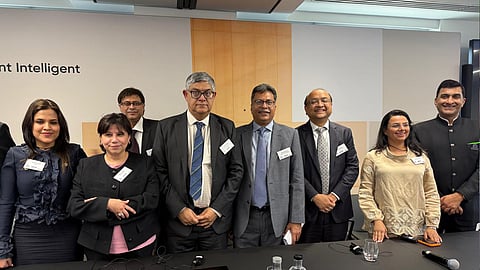
Agarwal was speaking at a panel discussion on Dispute Resolution 2.0: Arbitration, Mediation & Technology in a Digital Economy, held as part of the General Counsels’ Association of India’s Two Nations, One Legal Future: India–UK Partnership 2026 event at Bryan Cave Leighton Paisner (BCLP) Governor's House, London on June 5.
The session was moderated by Shivani Sanghi, Partner at Bryan Cave Leighton Paisner and Sherina Petit, Partner and Head of International Arbitration and the India Practice at Stewarts Law.
The panel featured speakers including Sapan Gupta, Group General Counsel at ArcelorMittal Group; Arbitration Bar of India (ABI) President and Senior Advocate Gourab Banerji; Karishma Vora, Barrister and Arbitrator at 39 Essex Chambers.
On the question of success fees, Agarwal drew a clear distinction between third-party funding and lawyer participation in outcomes. He maintained that while litigation funding should be formally recognised, allowing lawyers to take a stake in disputes risks compromising the integrity of the profession.
This view was, however, contrasted by Banerji, who noted that success-linked arrangements already exist indirectly through third-party funders. He argued that the focus should shift to regulating an existing reality rather than resisting it. Banerji said,
“The fact is… it's already there. However much we might think that it's not there, it is already there in some fashion...We should regulate it, instead of saying law is a noble profession.”
The panel also discussed whether adopting stricter cost regimes, similar to the English “loser pays” principle, could help reduce India’s mounting case backlog. Agarwal pointed out that historically, low litigation costs have encouraged prolonged disputes.
“Most of the time, even after a contentious matter which has gone on for days together, last order is ‘no order as to costs’. Basically nobody has to pay anybody,” he said.
He also added that the absence of financial consequences allows parties to pursue “frivolous” litigation without risk.
“So what happens then is that obviously you take a chance; even if you don't have a claim, you want to delay enforcement; you want to delay recovery. You file some frivolous case, go and appeal and appeal after that and then review and then curative, because no cost to you, and there's no stake in the game."
While legislative changes have introduced the concept of awarding actual costs, he noted that enforcement remains inconsistent and the system is still “very nascent”.
Vora echoed this sentiment, observing that while cost-shifting exists in theory, it is rarely applied in practice.
“Imposing cost is an excellent way to reduce litigation or reduce the number of cases in court. India does have the system in theory, but it's just not enforced in practice,” she said.
She noted that concerns around high legal fees should not prevent courts from awarding costs, as long as those fees are reasonable.
“So long as the counsel or the legal team's fees are reasonable, there's no reason why an Indian court cannot say that the losing party must pay the winning party's costs,” she said.
She suggested that proportionality principles used in England could be adapted for Indian courts. She added that cost discipline has proven effective elsewhere, noting,
“Costs is also a manner in which the pendency of cases in England considerably reduced. It actually worked.”
However, Banerji pointed to a deeper structural issue rooted in judicial mindset.
“I think you have to understand the mentality of our judges,” he said, explaining that historically low costs were tied to ensuring access to justice.
The panel also examined enforcement of foreign awards and judgments - an area of persistent concern in cross-border disputes involving Indian parties.
On cross-border disputes, Agarwal strongly advised parties to prefer arbitration over litigation when Indian assets are involved, citing challenges in enforcing foreign judgments.
“The answer is arbitrate. Get a foreign award rather than a foreign judgment if it involves an Indian party or assets in India. The track record is poor and there is a huge reluctance in the judiciary to enforce foreign judgments. It will definitely be tested on merits at length and the whole process will take forever,” he said.
He also highlighted the practical reality that enforcement delays often lead parties to settle at a discount, saying,
“Many cases are actually getting settled and resolved rather than waiting for enforcement... If somebody comes to me with an award, I would say settle at 40%, 50%, even if you have succeeded. Rather than waiting for enforcement in India.”
Gupta described enforcement as a broader global concern.
“Enforcement is probably the biggest issue for the future of arbitration globally. All jurisdictions have their peculiar problems, but enforcement is a real issue for the arbitration...In enforcement, India is worse than UK, but I wouldn't really say UK is great at enforcement,” he said, noting that asset tracing and delays complicate recovery across jurisdictions.
Looking ahead, Agarwal suggested that mediation could play a larger role in resolving commercial disputes in India, especially given delays associated with arbitration and court challenges.
"In India, mediation would be very, very successful, for one simple reason that in India arbitration has lost respect," he noted.