
Subscribe
Subscribe
- Latest Legal News
- News
- Law Firms
- Columns
- Interviews
- Law School
- Legal Jobs
- हिंदी
- ಕನ್ನಡ
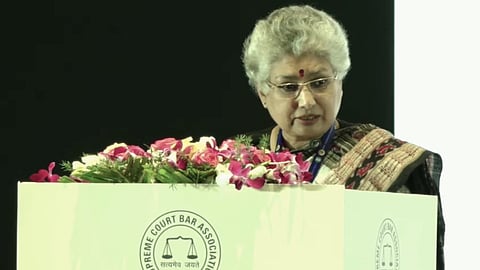
Supreme Court judge Justice BV Nagarathna on Saturday remarked that judges frequently use court vacations to write judgments rather than take the time off to relax, highlighting the demanding nature of judicial work.
She was speaking at a panel discussion held as part of the Supreme Court Bar Association’s first national conference on the theme “Reimagining Judicial Governance: Strengthening Institutions for Democratic Justice.”
Explaining the workload faced by judges, Justice Nagarathna said the work of adjudication extends well beyond court hours.
She noted that while judges may take time to write orders while disposing of cases, their role is dual in nature as they spend the day hearing matters in court and the rest of their time writing judgments.
“Morning till evening, they are sitting in the court, adjudicating, conducting trial, hearing cases. But it is only after court hours, if the judgments are not dictated in open court, that they have time to dictate the judgments in the evening hours. Late into the night, weekends, summer vacation, Dasara vacation, Holi vacation, Christmas vacation, are all used by judges to write judgments and not to take only LTCs (leave travel concessions) and go here and there. So, therefore, this is the dual role of judges - both inside the court and after court hours,” said Justice Nagarathna.
She further commented on how government litigation impacts case backlogs.
“The government is also the biggest litigator, whether it is at the Central level or at the State level. The State is expected actually to litigate with restraint and be a model litigator, but that does not happen. It goes on litigating until the end. The government is not only a mere participant in litigation, it is also the largest single generator of litigation,” noted Justice Nagarathna.
She explained that bureaucratic incentives often push officials to pursue appeals even where disputes could be settled earlier.
“A government officer who settles a dispute will face audit objections… By contrast, an officer who files an appeal or a revision rarely faces this criticism. So what does he do? He will go by caution. An appeal signals diligence, whereas a decision not to file an appeal will invite vigilance inquiries,” she said.
As a result, cases that should end at lower levels of the judiciary frequently travel through multiple layers of litigation, the judge noted.
“The result is predictable. Appeals become routine rather than rare. Cases that shouldn't end in lower courts continue through successive layers up to Supreme Court. The behavior transfers the cost of bureaucratic caution into the judicial system,” observed Justice Nagarathna.
She described the situation as a paradox where the State contributes to the backlog it publicly criticises.
“The pattern produces a paradox. The government publicly expresses concern about judicial backlog while simultaneously feeding that backlog through relentless litigation. The State becomes both the complainant and the cause,” she said.
Justice Nagarathna also pointed to the lack of continued political attention to judicial infrastructure, noting that investment in courts often remains a low priority for governments.
“Judicial infrastructure rarely receives sustained political attention. Expanding courts does not generate the same immediate visibility as constructing highways or launching welfare programs. The political incentive is weak when it comes to judicial infrastructure investment. Therefore, the percentage allotted is also very less,” she noted.
She added that the result is a growing mismatch between the number of disputes and the capacity of courts to handle them.
“The consequence is stagnation. The volume of dispute grows with population, economic activity, and regulatory expansion. But the institutional capacity of courts grows slowly,” observed Justice Nagarathna.
She also proposed the creation of a Judicial Reforms Commission to address the persistent problem of pendency in Indian courts.
Justice Nagarathna suggested that such a body should include representatives from across the justice system, including the judiciary at different levels, members of the Bar, law officers and representatives from government.
According to her, systemic delays often arise because incentives within the justice system encourage prolonging litigation.
She held different stakeholders, such as litigants, lawyers, government departments and even judges, tend to make decisions that appear rational individually but collectively slow down the system.
“From the point of view of various stakeholders, a litigant gains from status quo, so to prolong proceedings. And a lawyer or an advocate loves adjournments and postponement because he benefits from per appearance and extended timelines. A government department reduces bureaucratic risk by appealing rather than accepting defeat,” she observed.
She added that judges often proceed cautiously while managing cases, mindful that their decisions could be overturned on appeal, which leads them to prioritise procedural safeguards rather than aggressively pushing cases forward.
Justice Nagarathna emphasised that delays in the system cannot be solved merely by expecting better conduct from stakeholders, and require structural intervention.
She emphasised the need to modernise the service of court notices as well, noting that delays in serving notices often prolong litigation. Litigants use every trick to evade court notices and several years are spent on the service of notices, the judge observed.
“We need reforms as to how notices must be served, not just through the usual RPAD system, we say the postal system... It should be by other ways such as WhatsApp methods or through the electronic methods which should be introduced and applied in the courts,” suggested Justice Nagarathna.
[Read Live Coverage]
