

Section 34 of the Arbitration and Conciliation Act of 1996 is very badly worded and requires a clear explanation of what constitutes the 'fundamental policy of Indian law', Delhi High Court Justice C Hari Shankar recently said.
Section 34 allows courts to set aside arbitral awards on limited grounds. These include an award being in conflict with the fundamental policy of Indian law or, in domestic arbitrations, suffering from patent illegality.
Justice Hari Shankar said he had examined several Supreme Court judgments interpreting the expression “fundamental policy of Indian law” but could not find a satisfactory explanation of its meaning.
“I don’t know if Indian law even has anything called a policy, and then to say what is Indian law, what is a policy, and then what do you call a policy fundamental?” he said.
Justice Hari Shankar noted that some judgments have linked the “fundamental policy of Indian law” to compliance with natural justice while others have examined whether the tribunal’s decision was one that a reasonable person could have reached. However, the meaning of “reasonable” could itself vary, he pointed out.
“I think there is need for either judicial or legislative, precise clarification of what this expression ‘fundamental policy of Indian law’ means,” he said.
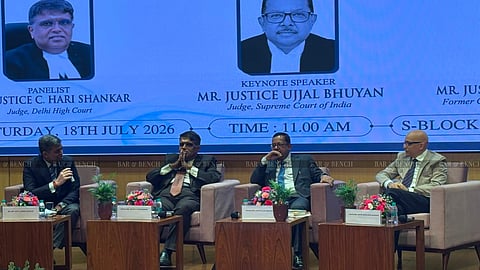
Justice Hari Shankar was speaking at a lecture and panel discussion titled Arbitration in India: Reform, Relevance & the Road Ahead, organised by The Law Forum at the Delhi High Court on July 18.
Supreme Court judge Justice Ujjal Bhuyan delivered the keynote address. Justice Hari Shankar and former Himachal Pradesh High Court Chief Justice Rajiv Shakdher participated in the panel discussion. The session was moderated by Senior Advocate Amit Gupta.
Justice Hari Shankar also flagged a possible overlap between the expression 'fundamental policy of Indian law' and patent illegality. Some decisions have held that the fundamental policy of Indian law should guide courts even while examining patent illegality, thereby blurring the distinction between the two grounds, he explained.
Justice Hari Shankar stressed that Section 5 of the Act, which restricts judicial intervention, must guide courts while deciding challenges to awards.
“Section 5 is a guiding principle that you should not interfere, if possible, with arbitral awards,” he said.
He added that courts cannot re-appreciate evidence or interfere merely because an arbitrator may have applied the law incorrectly.
Meanwhile, Justice Bhuyan spoke about the appointment of arbitrators under Section 11 of the Act. He suggested that courts should maintain panels of arbitrators containing information about their expertise.
Institutional arbitration should be given priority and retired judges should be encouraged to empanel themselves with arbitral institutions, he said. Justice Bhuyan also flagged the concentration of arbitration work among a limited number of retired judges who sometimes conduct several proceedings simultaneously.
Justice Shakdher addressed situations where a party participates in arbitration and later challenges the award on the ground that the arbitrator was appointed unilaterally.
He said that while the law may require such an award to be set aside, the party responsible for proposing the defective appointment mechanism should bear the resulting costs.
“If you’re going to set aside awards, then someone must pay for the time and cost that was incurred, both by the administration of the court as well as by the parties,” he said.
Justice Shakdher also called for greater autonomy for arbitral institutions. He said India could have several regional arbitration centres given its size and diversity, but they must be managed by professionals and allowed to function independently.
The success of arbitration centres in Singapore, Hong Kong and London was partly attributable to their autonomy, he observed. Attempts to exercise day-to-day control over Indian institutions would prevent them from developing similar credibility.
The discussion concluded with the speakers stressing that delays, mounting costs, uncertainty and excessive judicial interference remained the principal challenges facing arbitration in India.