

The Delhi High Court on Thursday sought the response of the Indian Patent Office to an appeal raising the question of whether an artificial intelligence (AI) system can be recognised as an inventor under Indian patent law [Stephen Thaler Vs Assistant Controller Patents]
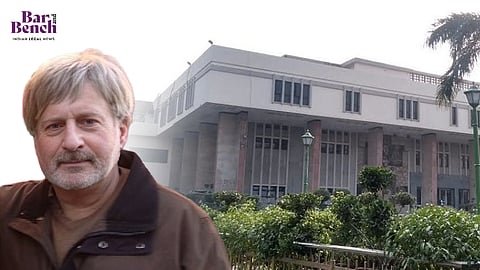
Justice Jyoti Singh issued notice on an appeal filed by American scientist Stephen Thaler against the refusal of a patent application which named his AI system, DABUS, as the inventor.
During the hearing, the Court asked the petitioner about the nature of the invention.
Advocate Ankit Sahni, appearing for Thaler, explained that it concerns a container with a fractal outer layer which allows it to be coupled with and separated from other containers. Its flexible walls expand and contract during this process.
The counsel also told the Court that this was the first patent appeal of its kind in India involving an invention stated to have been generated by AI.
“Interesting,” the Court remarked.
DABUS stands for Device for the Autonomous Bootstrapping of Unified Sentience.
The invention concerns a food or beverage container with a wall having a fractal profile. Pits and bulges on the wall allow multiple containers to be joined together, while the flexibility of the wall permits their subsequent disengagement.
Thaler, who created the system, has maintained that DABUS autonomously generated the invention and must, therefore, be accurately identified as its inventor.
The appeal before the High Court was filed against an April 15 order by which the Assistant Controller refused the patent application titled “Food container and devices and methods for attracting enhanced attention”.
The Patent Office rejected the application on three grounds. It found that the nine surviving claims lacked an inventive step, that DABUS could not be recognised as the “true and first inventor” and that Thaler had not fulfilled the requirements relating to declaration of inventorship and proof of right.
However, Thaler has argued that the Patents Act, 1970 does not expressly require an inventor to be a natural person.
According to the appeal, Section 2(1)(y), which deals with the “true and first inventor”, only excludes the first importer of an invention and a person to whom an invention is first communicated from outside India.
He has clarified that he is not asking the Court to confer legal personality or patent rights upon DABUS. His case is that DABUS must be named as inventor to correctly identify the source of the inventive concept, while the resulting patent rights would vest in Thaler as the applicant and owner of the system.
The appeal further argues that naming Thaler or another human as the inventor would amount to making a false declaration. Excluding AI-generated inventions from patent protection would also encourage applicants to conceal the role of AI or retain such inventions as trade secrets, it contends.
Thaler has also challenged the finding that the container lacked an inventive step.
The case will be heard next on September 18.
The appeal was filed through advocates Ajay Sahni, Ankit Sahni, Kritika Sahni, Chirag Ahluwalia, Mohit Maru, Tanisha Sharma and Aparna Sharma of Ajay Sahni & Associates.