

The Supreme Court on Wednesday observed that while India is a constitutional democracy where majority rule prevails, majoritarianism cannot trump constitutionalism and courts must test decisions against constitutional principles.
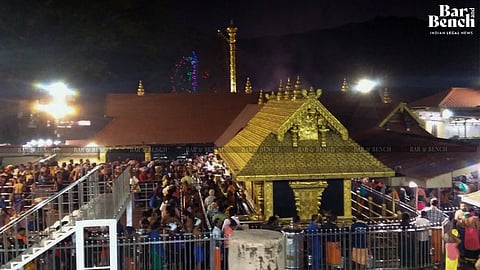
The observation was made by Justice Joymalya Bagchi during the hearing of the Sabarimala reference case, which concerns seven larger legal questions on the scope of religious freedom in India.
The matter is being heard by a Bench of Chief Justice of India (CJI) Surya Kant along with Justices BV Nagarathna, MM Sundresh, Ahsanuddin Amanullah, Aravind Kumar, Augustine George Masih, Prasanna B Varale, R Mahadevan and Joymalya Bagchi.
"It is not majoritarianism which the Court is bothered about. The Court is essentially bothered about majoritarianism trumping constitutionalism and that is the lakshman rekha. We are committed to a democracy which is definitely a test of numbers, but we are also a constitutional democracy. So even if a majority feels that particular thing is to be done, the courts have that role to test that decision from the constitutional principles," Justice Bagchi remarked.
The Court made the remark after Solicitor General Tushar Mehta said that the scope of judicial review in religious matters is very restricted. Courts should ordinarily leave the subject to the legislature, he submitted.
Justice Amanullah said that the submission prima facie was not acceptable.
"That means sheerly because of majoritarianism…we should not?”
Mehta questioned the use of word majoritarianism
“I am sorry. It is democracy. Democracy means majority,” he said.
Joining the discussion, CJI Kant remarked that the debate was unnecessary.
“The question of religious practice has nothing to do with majoritarian principle or minority principle. Minorities can have their own religious practices, the majorities can have their own rights. All are protected under 25. It is not that majority will take over minority or minority will…,” the CJI added.
Justice Bagchi said that under Article 25, everyone has equal rights irrespective of the numbers they have.
"That is precisely the significance of the phrase “equally entitled.” “Equally” is preceded by “all” and followed by “freely”," the judge added.
Mehta said that whether it is a small religion or a large religion, the entitlement remains equal.
At this, CJI Kant said,
"Article 25(1) is religion neutral. 25(2) is not religion neutral because condition is imposed on Hindu religion that you can't indulge in certain practices which are prohibited under [Article] 17."
When Mehta referred to various reforms accepted by the "majority", Justice Bagchi said,
"Since you are bringing up witchcraft, it was this Court's direction to various State governments to make specific legislation. This is where the judicial role comes in - it supplements and encourages the legislatures towards the constitutional goal of reform. It may not supplant it."
The matter is connected to the Supreme Court's 2018 verdict allowing women of all ages to enter the Sabarimala Temple in Kerala. This judgment overturned a custom restricting the entry of women of menstruating age to the hilltop shrine.
In November 2019, the Supreme Court pronounced its judgment on the review petitions against the 2018 verdict, but did not decide the matter one way or the other. Instead, it framed seven larger questions touching about religious freedoms in India for consideration by a larger bench of the Court.
These included deciding on the interplay between Articles 25 (freedom of conscience and religion) and 26 (freedom to manage religious affairs) on the one hand and the right to equality under Article 14 of the Constitution.
The nine-judge bench is now examining these questions.
Today's hearing
Prof G Mohan Gopal, who represented Kerala-based Sree Narayana Manavadharman Trust, asked whether reformist forces within religions have a space under the constitutional right to religion.
If members of a religious community or denomination wish to bring reform within themselves, they are free to do so voluntarily, Gopal said. However, he added:
"My submission is that the architecture of the constitutional right to religion, as interpreted over the last seventy five years, has effectively silenced these internal reformist voices."
Gopal said that the real issue before the Court is of "faith in God versus faith in clergy."
"Please do not allow faith in clergy to defeat faith in God originating in the conscience of the individual...We were not merely subsumed into religion, we were consumed by religion. Therefore, from a constitutional point of view, we also have to consider - where is choice, where is agency?"
At this, Justice Nagarathna remarked,
"That is why Hinduism is called a way of life. It is not necessary for a Hindu to mandatorily go to a temple or perform a ritual. He or she still remains a Hindu"
Gopal responded that if that understanding comes in the reference judgment, it would provide huge relief. CJI Kant said that no judgment is required for it.
"It is integral in religion," the CJI added.
Justice Nagarathna added that many people may not even have a prayer room or a sacred space in their homes, but their psyche remains Hindu.
"Nobody can come in the way of people having their faith," she added.
Gopal said that Article 25 protects that right, but "our jurisprudence does not".
Advocate Sneha Kalita argued that customs originating centuries ago cannot remain immune from constitutional scrutiny in a modern constitutional democracy governed by transformative constitutionalism and constitutional ethos.
"I may just give one comparative example. In Nepal, there exists the Chaupadi system, where a menstruating woman is made to leave the village and remain for five to seven days in a mud hut. I am only giving this as a comparative illustration. Under that practice, women are not permitted to enter homes, temples or other public spaces. This again is rooted in notions surrounding menstruation and purity," she added.
Senior Advocate Indira Jaising later informed the Court that Nepal has abolished the practice of isolating menstruating women outside their homes. Jaising also addressed the Court on an argument made by another counsel about double proportionality.
"I think my learned friend addressed it very well. However, I wish to point out that the doctrine of proportionality has never ever been invoked in the context of a clash between two fundamental rights over the last seventy five years. It has primarily operated as a doctrine of administrative law following the Wednesbury principle, where the issue is whether State action is arbitrary or unreasonable," she said.
She added that a better approach would be the substantial injury test.
"Whether the injury caused is substantial or merely minor. If the injury is minor, then the Court may decide which right ought to receive precedence. But where there is substantial injury, the Court must determine which right is to prevail and which right may have to yield to some extent."
Solicitor General Tushar Mehta, who made rejoinder submissions, argued that while interpreting and expanding fundamental rights over decades, courts have consistently adopted the most expansive interpretation possible.
He added that Articles 25 and 26 are perhaps the only provisions where the Court has adopted narrowed interpretation by introducing the essentiality test.
"The question then is where does this doctrine of essentiality come from? It is not textually present in the Constitution. My submission is that it is not only textually absent, but also constitutionally impermissible," he further said.
Mehta further submitted that Articles 25 and 26 must be read together – Article 26 becomes the collective manifestation of the very same rights protected individually under Article 25, he said.
"If Article 26 is treated as a silo or standalone island provision, the consequences would extend far beyond religion and destabilise the interpretation of other constitutional rights as well," he added.
Mehta also said that he would not take an extreme proposition that judicial review in religious matters was completely ousted.
"But it would be very, very restrictive. And the constitutional meaning of arbitrariness under Article 14 would not be the test while deciding these issues because we are dealing with religion, and religion may not at times have any causal connection," he said.
Mehta added that scrutiny by the Court cannot proceed only on the ordinary constitutional understanding of Article 14 or Article 21 or other rights. The inquiry cannot simply be whether there is discrimination and whether the constitutional test is satisfied, he said.
"It has to proceed from the perspective of a person who follows the religion and possesses a belief system protected by the Constitution," he submitted.
Senior Advocate CS Vaidyanathan said that the Constitution does not prescribe any minimum numerical requirement for a denomination.
"There is no requirement of a formal organisational structure, nor is there any requirement that a denomination must necessarily possess a distinctive name," he said.
Vaidyanathan argued that a mutt is not a religious institution of a public character within the meaning of Article 25(2)(b).
"Therefore, that provision has no application to mutts. In many places such as Sringeri, Kanchi and Ramanashram, a mutt and a temple coexist. But the mutt remains distinct from the temple. If the temple is a public temple, then Article 25(2)(b) may apply to it. But insofar as the mutt is concerned, it remains private, and Article 25(2)(b) cannot be invoked against it," he added.
Senior Advocate Abhishek Manu Singhvi said that the exercise of social reform power cannot be seen as a general mandate for throwing open religious institutions across all religions.
"Equally, the Hindu specific throwing open clause cannot be universalised across religions. A bare reading of Article 25(2)(b) demonstrates a conscious constitutional choice to single out Hindu public religious institutions in the latter limb because of the entrenched historical practice of caste-based exclusion in that context. That carefully structured constitutional design cannot be erased by merging the broad language of “social welfare and reform” with the narrower and targeted language of “throwing open"," he added.
Singhvi also argued that freedom of conscience and the right to freely profess and practise religion are not secondary or subordinate rights.
"They are express, substantive and justiciable fundamental rights. In that sense, freedom of religion may appropriately be viewed as completing a broader constitutional quadrilateral consisting of liberty, equality, dignity and conscience. One may even call it a golden quadrilateral," he added.
Singhvi further said that there are certain exercises which the Court ought not undertake.
"The Court should not decide whether a religious practice is rational or irrational. That is a complete no-go area. The Court should not examine whether a practice appears progressive or regressive according to judicial perception. The Court should not decide whether a practice is essential or non-essential in the abstract. The Court should not test a practice against the subjective preference of a dissenting member or a non-adherent. Nor should the Court ask itself how it would have framed or redesigned the faith if it were constructing the religion afresh."
CJI Kant remarked that if the Court begins to assume the role of a super-spiritual authority or a super-religious leader and starts interpreting the entirety of religious life, difficulties may arise.
"Where parliament or the legislature steps in as the representative institution embodying the will of the people, the Court’s first presumption ordinarily ought to be that such reforms are being demanded by society itself, that the masses are seeking those reforms, and that the legislature is responding to that social demand. That presumption, unfortunately, is not always accorded due weight," he added.
[Read Live Updates]