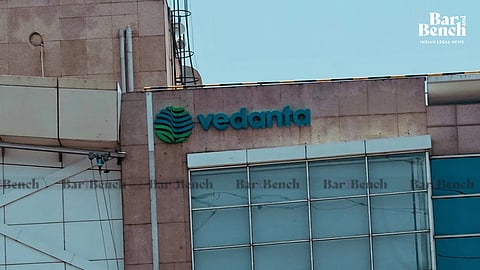

The Delhi High Court recently rejected Central government's objections against enforcement of USD 99 million foreign arbitral awards favouring Vedanta Limited and Singapore-based Ravva Oil in a dispute arising from the Ravva oil field production sharing contract [Vedanta Vs Government of India]
Justice Jasmeet Singh on July 1 allowed an enforcement petition filed by the companies and directed that the bank guarantees furnished by them be released within eight weeks.
The case concerned enforcement of a 2004 partial award and a 2016 final award passed by an arbitral tribunal seated in Malaysian capital Kuala Lumpur.
The Court ruled that the Supreme Court has already dealt with Government of India's objections in a 2020 decision and it cannot overlook the same.
"I find that the substantial objections raised by the respondent have already been decided by the Hon'ble Supreme Court in Union of India v. Vedanta Ltd., (2020) 10 SCC 1, and the findings in the said judgment are binding on me and this Court cannot relook or revisit the same," Justice Singh said.
The enforcement petition was filed by Vedanta and Ravva Oil under Sections 47 and 49 of the Arbitration and Conciliation Act, 1996. The Centre opposed enforcement under Section 48 of the Act.
The dispute arose from a Production Sharing Contract (PSC) executed in 1994 between the Government of India, Videocon Petroleum, ONGC, Ravva Oil and Command Petroleum, later known as Cairn Energy India. Cairn India and Vedanta amalgamated.
The contract was aimed at inviting private investment for development of the Ravva oil field in the Krishna Godavari Basin.
The arbitration concerned interpretation of the PSC, particularly the “ONGC Carry Issue”. The question was whether sums paid by the companies under Article 3.3 of the PSC to ONGC could be included for calculating the Post Tax Rate of Return (PTRR).
The arbitral tribunal passed a partial award in 2004. Two issues were decided in favour of the companies and four in favour of the government. The issue of quantification was left open.
The partial award was initially set aside by the Kuala Lumpur High Court in 2009. However, it was later restored by the Malaysian Court of Appeal and also upheld by the Malaysian Federal Court in 2011.
In 2014, the Centre issued a show-cause notice claiming USD 99 million. Vedanta and Ravva Oil then approached the arbitral tribunal for quantification, leading to a final award in 2016. The final award was also upheld by courts in Malaysia.
Before the Delhi High Court, the Centre argued that the awards were contrary to India’s public policy. It said the arbitral tribunal had rewritten the PSC and reduced the government’s share of profit petroleum by USD 99 million.
The Centre also argued that the enforcement petition was barred by limitation and that the arbitral tribunal had become functus officio before passing the final award.
The Court rejected these objections.
On limitation, the Court relied on the Supreme Court’s ruling in Union of India v Vedanta Ltd, which involved the same parties and the same production sharing contract.
“The present enforcement petition is within limitation period as per Article 137 of the Limitation Act, as the clock of the limitation period began to run from the date of issuance of SCN i.e., 10.07.2014,” the Court held.
The Court said it was bound by the Supreme Court ruling and thus cannot accept Centre’s argument that limitation had begun from earlier correspondence or meetings between the parties.
On merits, the Court said that the scope of interference with foreign awards under Section 48 is narrow.
“The objections do not include the merits of the dispute,” the Court said.
It further noted that Section 48 “explicitly excludes objections on merits of the dispute.”
The Court also relied on Supreme Court precedent to underline that foreign award enforcement proceedings cannot become an appeal on merits.
The Court held that the Centre’s objections on the ONGC Carry Issue essentially sought a re-examination of the tribunal’s interpretation of the production sharing contract. Such an exercise, it said, was beyond the scope of an enforcing court.
It also rejected the Centre’s objections that the tribunal had decided matters beyond the scope of reference.
Senior Advocate Akhil Sibal along with advocates Shruti Sabharwal, Surabhi Lai and Rachit Bansal appeared for Vedanta and Ravva Oil.
Additional Solicitor General Vikramjit Banerjee and advocates Abhishek Singh, Anuja Tiwari, Amitesh Chandra Mishra, Vishakha, Mrityunjai Singh, Aparna Tiwari, Shikhar Thukral and Harshit S Gahlot appeared for the Government of India.
[Read Judgment]