
Subscribe
Subscribe
- Latest Legal News
- News
- Law Firms
- Columns
- Interviews
- Law School
- Legal Jobs
- हिंदी
- ಕನ್ನಡ
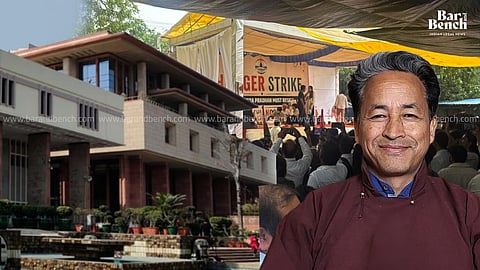
The Delhi High Court on Sunday refused to pass an interim order directing the discharge of activist Sonam Wangchuk from Safdarjung Hospital [Gitanjali J Angmo v. Union of India & Ors].
Wangchuk, who was on a hunger strike against the government, was forcibly taken to the hospital by the Delhi Police from Jantar Mantar, the site of his protest.
Justice Mini Pushkarna said that the government’s decision to take him to the hospital was because of his deteriorating health and it was not an arbitrary decision.
The Court noted that Wangchuk was being monitored by doctors and had consented to the administration of electrolytes. Therefore, his right to bodily autonomy had not been violated, the Court said.
“Considering the overall conspectus, since the government has taken the decision to shift Wangchuk to a hospital due to his health, this Court does not find the same to be an arbitrary action,” the Court observed.
The Court further said that since Wangchuk had not voluntarily admitted himself to a hospital despite his condition, the government was within its rights to intervene.
“Considering the fact that Wangchuk, on his own volition, did not check himself into a hospital, the government was within its right to take such action. As already stated by the Division Bench, every life is precious,” it said.
The Court also took note of the government’s submission that Wangchuk’s family had been granted unrestricted access to him throughout the day. Other patients were permitted visitors only during designated visiting hours, it was told.
The authorities had also provided a separate room to Wangchuk’s family members, the Court noted.
Therefore, it concluded that no interim directions were required at this stage.
The Court sought the response of the Central government to the plea and also directed that Wangchuk's medical reports be shared with his family members.
The matter will be heard again on July 24.

The Court was hearing a plea by Wangchuk's wife Gitanjali Angmo who claimed that “medical intervention” was being used by authorities as a ruse to illegally confine Wangchuk at Safdarjung Hospital and prevent him from returning to his hunger strike at Jantar Mantar.
Wangchuk was on an indefinite hunger strike since June 28 after he joined the protests organised by Cockroach Janta Party (CJP) at Jantar Mantar demanding the education minister's resignation over alleged question paper leaks and irregularities in the education system.
On July 16, another Bench of of the High Court had directed the Central and Delhi governments to ensure that Wangchuk's health and medical condition be monitored on a daily basis by government doctors and that all medical attempts be made to protect his life.
Subsequently, on July 18, Delhi Police personnel forcibly made their way to the protest site, removed Wangchuk from the site and took him to Safdarjung Hospital.
Angmo then moved the High Court on Sunday alleging Wangchuk was forcibly removed without his consent and without prior notice to her. She learnt about his removal through a volunteer at the protest site, the plea said.
Senior Advocates Kapil Sibal, Vivek Tanka and Akhil Sibal, appearing for Angmo, argued that Wangchuk had lost access to his lawyers and doctors after being admitted to Safdarjung. He contended that they want to move him to Medanta hospital and he was not seeking anything more.
"He is not under detention. There is no case against him. Is a citizen of India not allowed to go to a hospital of his choice? How can they say that the government is taking control of his body and they will not allow him?" Kapil Sibal asked.
He also argued that they had no objection to doctors of AIIMS or Safdarjung join the team.
"They have no basis to detain me. I am entitled to a doctor or hospital and doctor of my choice," Sibal underscored.
Sibal said there are police posted around Wangchuk present inside the room.
"Is the family less concerned about his health than the doctors?" he said.
Additional Solicitor General (ASG) Chetan Sharma, appearing for Centre, contended that the July 16 order of the High Court specifically recorded that all medical intervention and treatments to Wangchuk are to be taken by the government. He argued that a team of doctors from Safdarjung and AIIMS are at present treating him.
According to ASG, 18 days of fasting in humid weather could lead to medical complications. He told the court that Wangchuk is admitted in the emergency division.
Sharma argued that some sugar free electrolytes were given to him with his consent.
"They have absolutely no reason to have any doubt. He is being taken care of. But he has to cooperate with the attending doctors," the ASG said.
The ASG also questioned the need for a counsel to be give access to Wangchuk since he is in a hospital and not a court room.
"In the prevailing circumstances, whatever happens to him will have consequences. The government will have to be more circumspect and extra cautious," he added.
Angmo, appearing in person, also argued that the doctors were not cooperating and delayed in giving her the blood sample to test in a private lab.
"This led to us lose confidence in the doctors," she stated.
Angmo said she had made three written representations seeking access to Wangchuk’s complete medical records. She had also sought permission to transfer him to a hospital of their choice.
She told the Court that these requests were not accepted and that Wangchuk was denied access to his lawyers and the doctors who had monitored him during the fast.
She also told the Court that the July 16 order of the High Court only permitted medical monitoring but did not authorise forcible removal, detention, isolation or treatment without consent.
The Court declined to pass any interim order but issued notice to the government seeking its response.
Senior Advocates Kapil Sibal, Vivek Tankha and Akhil Sibal with advocates Bahuli Sharma, Susan Maria Mathew, Yoshit Jain, Suryaansh Kishan Razdan and Ridhi Arora appeared for Gitanjali Angmo.
Solicitor General Tushar Mehta, ASG Chetan Sharma, Central Government Standing Counsel Ashish K Dixit and advocates Umar Hashmi and Ayush Kumar appeared for the government.
[Read Order]