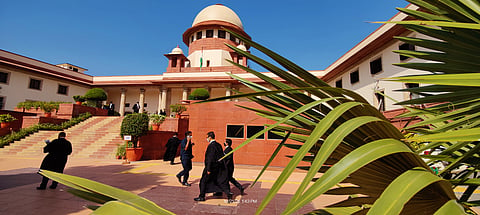
The Supreme Court has ruled that government employees hired on a contractual or ad hoc basis without any public advertisement or interview cannot be made permanent under a State policy [Madan Singh v State of Haryana].A Bench of Justices P S Narasimha and Atul S Chandurkar passed the ruling on April 16 while striking down two notifications issued by Haryana government in 2014 to regularise services of a certain category of employees who had or were about to complete ten years’ of service.The Court said that the Haryana government failed to justify why services of such ad hoc employees, who had not been engaged on the basis of any advertisement or interview, were sought to be regularised.“The claim of being engaged sans an advertisement itself gives rise to doubts as regards the manner of engagement. Absence of any record whatsoever of the manner of engagement does not inspire any confidence in such a process,” the Bench said..However, at the same time, the Court acknowledged the practical reality that many of these employees had been working for years. "A period of almost twelve years has elapsed since the issuance of these two Notifications. It is the specific stand of the State Government that even after excluding the ad hoc employees from Group ‘B’, ‘C’ and ‘D’, who seek benefit of these two Notifications, none of the posts advertised would be aLected. Further, it is informed that such appointees have now gained sufficient experience and are likely to have settled in life with the passage of time," the Court noted.It therefore invoked its power under Article 142 of the Constitution and allowed the employees to continue in service. However, it directed that they would be placed at the lowest pay scale applicable to their posts..In 2018, the High Court in 2018 had struck down a set of Haryana government notifications aimed at regularising Group B, C and D employees. The decision was then challenged before the top court, which ordered a status quo during the pendency of the matter..In the judgment passed on April 16, the top court modified the High Court ruling. While it struck down two of the notifications issued in July 2014, it upheld the validity of two similar notifications issued in June 2014. The policies notified in June 2014 were aimed at extending the benefit of an older 1996 regularisation scheme to employees who had been left out earlier, it noted.The Court found that the criteria prescribed was very much in tune with the criteria that would have otherwise been prescribed for regular recruitment"The criteria prescribed was not in any manner watered down or deviated from the criteria required to be satisfied while seeking regular appointment. What is most relevant, in our view, is that such engagement should have been initially made on a sanctioned post and such engagement on the sanctioned post ought to be continuing even on the date of regularisation of service. This would clearly indicate that when such engagement on ad hoc basis was initially made, sanctioned posts were available and this position continued for a number of years so as to enable regularisation of services of the incumbents holding such posts," it said..After pronouncing the judgment, Justice Narasimha addressing Amicus Senior Advocate Nidhesh Gupta stated that the issue may require consideration by a larger Bench.“We have gone through your suggestions. We had a particular difficulty being a combination of a two-judge bench. It would have created yet another problem of two conflicting two-judge benches. We have kept everything ready. We will ask you to do a repeat performance at a time, perhaps when we get this matter taken up at a three-judge bench, which is necessary, and we are going to do that because we have seen that it cannot continue like this. You know.,” Justice Narasimha said..The Court placed on record its appreciation for the assistance rendered by amicus curiae Senior Advocate Nidhesh Gupta and advocates Japneet Kaur, Jhanvi Dubey, Ashok Mathur, Vriti Gujral, M Bikram Dwivedi and Jimut Mohopatra..[Read Judgment]