Genuine women devotees wait till age 50 to enter Sabarimala temple: Supreme Court

"The true devotees who are women between 10-50 years, they also observe this restraint and stay away (from Sabarimala temple)," said Justice Nagarathna.
Sabarimala Temple
Sabarimala Temple
Published on
8 min read
Listen to this article

The Supreme Court today orally observed that genuine women devotees of Lord Ayyappa may wait till they cross the age of 50 years to visit the Sabarimala temple [Kantaru Rejeevaru v. Indian Young Lawyers Association].
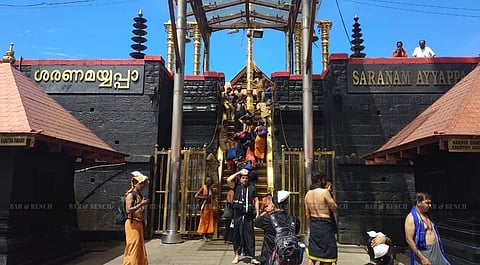
Justice BV Nagarathna, who is part of the nine-judge Bench hearing the matter, made the observation.

"The true devotees who are women between 10-50 years, they also observe this restraint and stay away (from Sabarimala temple). After 50 years, they will go," Justice Nagarathna said.

A Bench of Chief Justice of India (CJI) Surya Kant along with Justices BV NagarathnaMM Sundresh, Ahsanuddin Amanullah, Aravind Kumar, Augustine George MasihPrasanna B Varale, R Mahadevan and Joymalya Bagchi was hearing the case.

The Bench also said that it does not want to play any part in the annihilation of a religion while interpreting the scope of religious freedoms on India.

The Court was hearing a reference case connected to the Supreme Court's 2018 verdict allowing women of all ages to enter the Sabarimala Temple in Kerala, overturning a custom restricting the entry of women of menstruating age to the hilltop shrine.

In November 2019, the Supreme Court pronounced its judgment on the review petitions against the 2018 verdict but did not decide the matter one way or the other. Rather, the Court framed seven larger questions touching on religious freedoms, which is now being heard by the nine-judge Bench.

The reference verdict may also have an impact on other cases involving faith-based customs in other religious communities.

Constitution Bench hearing Sabarimila
The true devotees who are women between 10-50 years, they also observe this restraint and stay away (from Sabarimala temple). After 50 years, they will go.
Justice BV Nagarathna

Annihilation of religion?

During today's hearing, one of the questions that arose from the Bench was whether non-believers or casual visitors can challenge customary restrictions on entry to a religious temple.

Senior Advocate Indira Jaising replied that generally, one needs to be a Hindu to claim such rights of entry.

She was appearing for Kanaka Durga and Bindu Ammini, two women from Kerala who had faced backlash and threats after they entered the Sabarimala temple after the Court's 2018 verdict.

"But I am also saying that it is not important whether I am a believer or not, but I must go with shraddha, with respect, to introspect," Jaising said.

Justice Amanullah then asked whether such rights can be claimed even if it hurts the majority of believers.

"You tell me what legal injury I am causing to someone. If you show me the legal injury, I will not go. I am saying both of us are claiming a legal right," Jaising replied.

Justice Sundresh, however, pointed out that if every individual claim to different, conflicting religious rights were accepted, it could lead to dangerous consequences.

"What my brother (Justice Amanullah) is saying, is that if we agree with your contention, it is going to lead to dangerous consequences. I will tell you why. Suppose there is a common belief, followed by practice, professing and propagation. Each one (believer) goes and says, 'I do not want this, I want it in a particular way.' Another says, 'I do not want this practice.' Where is the end? If you really look at it, this kind of interpretation will be a disaster for the entire concept of religion itself. It will be militating against the right under Article 25(1)," he pointed out.

"It will be annihilation of religion, of which we don't want to be a part," added Justice Nagarathna.

She added that religious rights have to be given a broad meaning.

"We understand Article 25(2), which is the enabling power of the State (to make laws on religious matters on grounds of health, morality, public order). But otherwise, matters of religion are not a matter on which the Court or the legislature can pass a judgment upon. It cannot be the subject matter of debate because it is a matter of conscience. Having regard to the philosophy of that particular idol (Lord Ayyapa deity in Sabarimala), entry is banned for women between 10 and 50 years. It is part of religion."

"First, they have to show there is such a rule. First, they have to show a theological text which says so," Justice Jaising replied.

"It is a custom," Justice Nagarathna observed.

"This question was asked in Shayara Bano case. Justice RF Nariman, who is an ordained priest, had asked this question. He said, can you tell me how court of law can get into this? I said, the moment a court of law gives recognition, it (the custom) becomes subject to Part III (fundamental rights). If you give recognition, it becomes constitutional law," Jaising said.

Jaising added that she is only calling on the Court to interfere with religious customs that are egregiously violative of fundamental rights.

"I am saying, don't get rid of all custom and usage. Get rid of what this court has called 'egregious violations.' That answers my lady's (Justice Nagarathna's) question, 'are we going to invalidate all customs?' No, please don't invalidate all customs. But if you come across customs which are either egregious or if it is based on notions of purity, pollution and defilement, it is covered by Article 17 (prohibition of untouchability)," she said.

True female devotees may wait to enter Sabarimala temple: Court

During the course of the hearing today, Justice Nagarathna noted that there are temple entry restrictions even for people who have had births or deaths in the families. Jaising replied that these are voluntarily adhered to by believers and not forced upon them.

The judge then commented that genuine female devotees of Lord Ayyappa similarly refrain from entering the Sabarimala temple while they are in the 10-50 year age group.

"Yes, there are many women in Kerala who say 'why should I go between the age of 10 and 50 years? I will wait.' But there are also women who say, 'why should I not go between the age of 10 and 50 years? You have to deal with them as well. They are not committing a crime by saying they want to go,' Jaising replied.

"Question is whether they are understanding the philosophy of that God or not," Justice Nagarathna added.

"Yes, we are aware of it. I have read it in the Shastras. It operates in my personal house. I was not allowed to touch my mother during these periods. As you know, they are not even allowed to go to the funeral pyre. But question is, is it right or wrong? That custom is now gone through actual practice. In my family, every single daughter of the family attended the funeral of our father. No one stopped us, no tantri stopped us, no organisation stopped us. It took place in the Arya Samaj premises. We went, no priest said 'why are you here?' We carried out parents on our shoulders," Jaising said in response.

She argued that the basis for excluding women from such matters is that they are viewed as defiling a sacred space.

"Don't perceive it in that form," replied Justice Nagarathna.

"I have taken it (this position) from the Shastras," said Jaising.

Indira Jaising
Indira Jaising

Other highlights from the hearing today

Are rights against untouchability violated in preventing scheduled caste women from entering Sabarimala temple?

Jaising asked which fundamental right would be violated if all women are permitted entry into a public temple.

She submitted that one of her clients is from a scheduled caste (SC) background. As such, she questioned whether barring a Dalit woman from entering Sabarimala temple would also amount to caste-based discrimination.

"You are not prevented because you are a Scheduled Caste woman, but because you belong to the 10 to 50 age group," pointed out Justice Nagarathna.

"My answer is that this exclusion operates during the most productive and creative period of a woman’s life, that is between 10 to 50 years ... You cannot tell me to live half a life, avoid living between 10 and 50, and then live before 10 and after 50," replied Jaising.

Can person who has nothing to do with temple claim entry rights?

The Court also questioned whether Jaising's clients were actually devotees of Lord Ayyappa. The Bench expressed concerns that some non-devotees who have nothing to do with the temple are also seeking rights to entry.

"A person who has nothing to do with the temple - someone who is somewhere in North India - is also claiming entry. This temple is in South India. That also has to be addressed," said Justice Nagarathna.

Jaising replied that her clients were Hindus from Kerala and that one of them had visited the Sabarimala temple as a child.

"Article 25 is a 'freedom.' It's a freedom in the sense I am free to do what I want to do, provided I am not violating morality, health, public order," Jaising argued.

Can courts sit in judgment over religious practices?

Jaising also questioned the view that courts cannot sit in judgment over religion.

"What has been said is that you cannot decide questions of religion because you are not theologians. If you are not theologians, you can call a theologian to advise you, because what constitutes religion is a question of fact," she said.

Justice Nagarathna observed that spiritualism and one's sense of conscience evolved over centuries, and that it was not simply introduced for the first time by the Constitution.

"What has been developed over ages, what has been protected, cannot be taken away by the Constitution," the judge observed.

Jaising replied that the issue boils down to whether such questions should be decided based on semantics or the court's conscience.

"You, as a constitutional court, also have a conscience. This question will have to be decided with reference to the entire Constitution of India," Jaising added.

However, Justice Nagarathna asked whether the past can be discarded altogether.

"We cannot ignore the civilisational and religious history of this land. It is in this background that Articles 25 and 26 has come now. You cannot ignore the past," she said.

Jaising went on to argue that Hinduism itself has been undergoing changes and has been reforming itself. Every religion reforms itself from within if it has to survive, she said.

"The history of Hinduism is the history of reform movements within Hinduism," she contended.

"That is different from saying the courts should reform a religion," Justice Nagarathna pointed out.

"It is very different," Jaising agreed, before adding, "Courts are only recognising it. You take any book on Hindu law or Muslim law, you will see a history of reform in it. Because religion has the capacity to regenerate, to reinvent itself if it is going to be relevant to human beings."

Should essential religious practices be discarded?

Jaising further urged the Court not to discard the essential religious practices test as sought by some of the review petitioners.

In response, Justice Nagarathna observed that the concern raised was whether the essential religious practices test can be the only factor while deciding whether a law on religious reform is unduly intruding upon religious freedoms.

"There has to be a balance. In that context, the submission is, don't say only essential religious practices (are protected)," the judge noted.

Jaising asked what alternative test could be put in place.

"In the name of social reform, a religion cannot be hollowed out, that was the submission," Justice Nagarathna replied.

Jaising replied that she is not opposed to another test, provided that there is a basis for harmonising religious rights and allowing for social reforms within the religion.

"Whatever test you apply, you may apply. But it is incorrect to suggest that the Court is deciding what is essential. The religion itself determines what is essential. That test is then used for harmonisation. If you still wish to do away with the test, that is a different matter."

She went on to assert that religious rights are matters of fact and civil rights, which were elevated to constitutional rights, which can be enforced by courts.

"I am not inviting you (judges) to become theologians. I am saying, please take knowledge (from religious texts) of what is the theology (of a particular religious institution). Everything (religious texts) is available," she added.

If a disputes arise as to which among different texts are more authoritative, theologians can be asked to give evidence about it, she further said.

The hearing will continue on May 5.

[Live Coverage]

Bar and Bench - Indian Legal news
www.barandbench.com